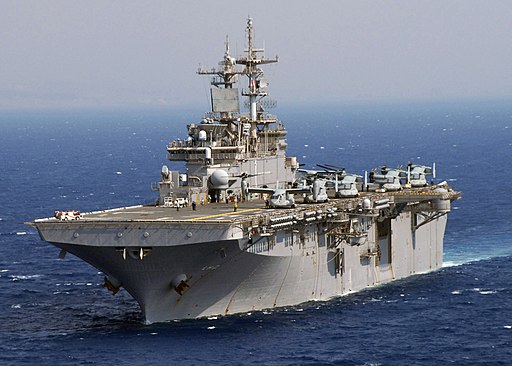
USS Wasp (LHD-1)
USS Wasp (LHD-1) is the lead ship of the Wasp-class amphibious assault vessels in the United States Navy. Commissioned in July 1989, she combines the capabilities of an aircraft carrier, a helicopter assault ship, and a landing platform dock. Designed to project power ashore through both air and surface connectors, Wasp serves as a centerpiece for Marine expeditionary units embarking on amphibious operations.
Historical Background
Namesake and Class Origins
The name Wasp honors a lineage of nine previous U.S. Navy vessels dating back to the American Revolutionary War. As LHD-1, she inaugurated a new class built expressly to support Marine Corps landing craft air cushion (LCAC) vehicles and V/STOL aircraft such as the AV-8B Harrier II, later upgraded to operate F-35B Lightning II jets.
Keel and Commissioning
Ingalls Shipbuilding in Pascagoula, Mississippi, laid her keel on 30 May 1985. She was launched on 4 August 1987 and underwent fitting out and sea trials over the next two years. On 29 July 1989, USS Wasp officially entered service, homeported at Naval Station Norfolk, where she continues to deploy with the fleet.
Hull Design and Survivability
Structural Materials
Wasp’s hull and superstructure are constructed primarily of high-strength steel, with reinforced internal subdivision into 28 watertight compartments. Armor plating around critical engineering and command centers enhances her resistance to damage from mine blasts and small-caliber projectiles.
Damage Control Features
Automated fire-suppression systems, double-skin fuel tanks, and redundant damage control stations enable rapid isolation of flooding or fire. Her extensive ventilation and dewatering network allow crew teams to seal off or purge compartments as threats evolve during combat scenarios.
Propulsion and Maneuverability
Steam Plant and Power Distribution
Propulsion power comes from two D-type boilers feeding steam to a pair of Westinghouse-designed geared turbines generating 70,000 shaft horsepower. Two shafts transmit thrust to controllable-pitch propellers, while an integrated diesel generator farm supplies hotel power and emergency drive.
Speed and Range
At flank speed, Wasp can exceed 22 knots, enabling quick insertion of Marine forces into operational theaters. Cruising at 18 knots, she boasts a maximum unrefueled range of approximately 9,500 nautical miles, permitting extended deployments without logistics tails.
Aviation Facilities
Flight Deck and Hangar
The 844-foot flight deck features six aircraft elevators and two ski-jumps, optimized for simultaneous launch and recovery of helicopters and V/STOL jets. Below deck, a 106,000-square-foot hangar bay stores up to 20 rotary-wing and fixed-wing aircraft, with maintenance shops capable of ordnance handling and component repair.
Air Wing Composition
Typical air wing assignments include AV-8B or F-35B strike fighters, MV-22B Ospreys, CH-53E Super Stallions, UH-1Y Venoms, AH-1Z Vipers, and MH-60S Seahawk helicopters. Embarked Marine aviation detachments provide close air support, assault lift, and logistic resupply throughout amphibious operations.
Well Deck and Amphibious Capabilities
Landing Craft Capacity
Wasp’s 266-by-50-foot well deck accommodates up to three LCACs or two conventional LCU landing craft. Ballasting and deballasting systems flood or drain the dock in under 20 minutes, enabling rapid launch and recovery of surface connectors.
Vehicle and Troop Embarkation
Adjacent to the well deck, a 120,000-square-foot vehicle storage area holds armored vehicles, trucks, and engineering equipment. Ramps and elevators link the vehicle deck to the flight deck and mess decks, streamlining embarkation for up to 1,800 Marines with surge capacity exceeding 2,000.
Armament and Defensive Systems
Missile and Gun Systems
Two RIM-7 Sea Sparrow missile launchers and two RIM-116 Rolling Airframe Missile (RAM) launchers provide medium-range air defense. Four 25 mm Mk 38 chain guns cover surface threats, while four .50 caliber M2 heavy machine guns offer close-in protection.
Close-In Weapons and Countermeasures
Three Phalanx Mk 15 Block 1B CIWS units deliver last-ditch defense against incoming missiles. An AN/SLQ-32(V)6 electronic warfare suite detects and jams hostile radars, and Mk 36 SRBOC chaff/flare launchers deploy countermeasures to confuse incoming guided threats.
Sensors and Electronics
Radar and Communication Suites
Air search is handled by AN/SPS-48E 3-D radar and AN/SPS-49(V)5 2-D radar. Surface navigation relies on AN/SPS-67(V)2, while AN/SPN-43C and AN/SPN-46A provide precision approach and landing control for embarked aircraft. A robust satellite communication array supports C4ISR connectivity.
Electronic Warfare and Decoys
The ship integrates AN/SLQ-25A Nixie towed torpedo decoys and AN/SLQ-49 chaff buoys. An SRS-1 combat direction finders network pinpoints radio-frequency emissions, aiding threat classification and targeting.
Crew and Habitability
Ship’s Company and Marine Complement
USS Wasp sails with approximately 1,054 sailors and can embark a Marine expeditionary unit of 1,687 personnel plus staff and surge. Watch sections rotate through multi-access berthing compartments, each equipped with personal storage and privacy curtains.
Living Quarters and Support Facilities
Amenities include a full-service galley, multiple mess decks, medical and dental clinics, and a 30-bed hospital with operating rooms. Fitness centers, chapels, and recreation rooms support crew morale during long deployments.
Mission Profile and Operational History
Major Deployments
Since 1989, Wasp has participated in global operations ranging from humanitarian assistance after natural disasters to combat missions in the Persian Gulf. Notable deployments include disaster relief following Hurricane Katrina, counter-piracy patrols off Somalia, and exercises with NATO and Pacific partners.
Humanitarian and Joint Exercises
Wasp’s well deck has delivered relief cargo, vehicles, and personnel to austere shorelines during humanitarian crises. Joint training with allied navies validates interoperability of her air wing and landing craft in large-scale amphibious assaults.
Technical Specifications
| Parameter | Value |
|---|---|
| Class & Type | Wasp-class amphibious assault ship |
| Displacement | 40,500 long tons (full load) |
| Length | 844 ft (257 m) |
| Beam | 104 ft (31.7 m) |
| Draft | 27 ft (8.2 m) |
| Propulsion | 2 × boilers; 2 × geared turbines; 2 shafts (70,000 shp) |
| Speed | 22 knots (max) |
| Range | 9,500 nmi at 18 knots |
| Well Deck Dimensions | 266 × 50 × 28 ft |
| Vehicle Deck Area | 120,000 ft² |
| Aircraft Elevators | 6 × deck-edge and centerline |
| Aviation Capacity | Up to 20 aircraft |
| LCAC/LCU Capacity | 3 LCAC or 2 LCU |
| Complement | 1,054 crew; 1,687 Marines (plus surge) |
| Missile Launchers | 2 × RIM-7 Sea Sparrow; 2 × RIM-116 RAM |
| CIWS | 3 × Phalanx Mk 15 Block 1B |
| Chain Guns | 4 × 25 mm Mk 38 |
| Machine Guns | 4 × .50 cal M2 |
| Radar Systems | AN/SPS-48E; AN/SPS-49(V)5; AN/SPS-67(V)2 |
| Electronic Warfare | AN/SLQ-32(V)6; AN/SLQ-25A; Mk 36 SRBOC |
Conclusion
USS Wasp (LHD-1) remains a versatile and potent instrument of U.S. naval power projection. Her unique combination of aviation facilities, well deck, and well-armed self-defense systems allows rapid response to crises worldwide, whether conducting amphibious assaults, humanitarian relief, or multinational exercises. Continuous upgrades ensure she will serve as a linchpin of expeditionary operations for decades to come.
_Osprey_2.jpg)