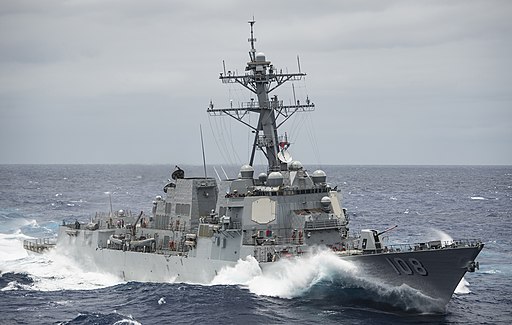
USS Wayne E. Meyer (DDG-108)
USS Wayne E. Meyer (DDG-108) is an Arleigh Burke-class guided-missile destroyer in the United States Navy. As a Flight IIA variant, she integrates advanced Aegis combat systems, robust air-and-missile defense, and multi-mission flexibility. Named for Rear Admiral Wayne E. Meyer, known as the “Father of Aegis,” she carries the 100th Aegis Weapon System delivered to the fleet.
Development and Construction
Naming and Contract Award
The contract for DDG-108 was awarded on 13 September 2002 under the Navy’s DDG-51 Arleigh Burke program. This procurement marked a continued investment in surface combatants capable of ballistic missile defense and multi-threat engagement.
Keel Laying, Launching, and Commissioning
Construction began at Bath Iron Works in Bath, Maine, with her keel laid on 17 May 2007. She slid into the water on 19 October 2008 and completed builder’s trials before formal acquisition in July 2009. USS Wayne E. Meyer was commissioned on 10 October 2009 in Philadelphia and later reported to her homeport at Joint Base Pearl Harbor-Hickam, Hawaii.
Design and Hull Architecture
Flight IIA Enhancements
As a Flight IIA ship, Wayne E. Meyer features a hull extension that supports hangar facilities for two MH-60R Seahawk helicopters. This upgrade enhances her anti-submarine warfare and search-and-rescue capabilities beyond earlier Flight I and II variants.
Stealth and Structural Features
Her hull is welded from high-strength, low-magnetic signature steel and coated with sonar-absorbent material to reduce acoustic returns. Internal compartmentalization into numerous watertight sections improves survivability and damage control in combat environments.
Propulsion and Performance
Gas Turbine Propulsion
Primary propulsion derives from four General Electric LM2500-30 gas turbines producing a combined 100,000 shaft horsepower. These turbines drive two shafts with controllable-pitch propellers, delivering high acceleration and sustained speed.
Auxiliary Power Systems
Two diesel-generator sets and three turbogenerators supply electrical power to combat systems, sensors, climate control, and flight-deck operations. Auxiliary electric motors enable near-silent maneuvering in littoral zones for covert positioning.
Speed, Range, and Endurance
Wayne E. Meyer exceeds 30 knots at full power, allowing rapid response across vast ocean areas. Her operational range extends beyond 4,400 nautical miles at 20 knots, while her endurance is limited primarily by consumables rather than fuel, thanks to efficient turbine operation.
Combat Systems and Electronics
Aegis Weapon System
At the core of her combat capability is the AN/SPY-1D multi-function phased-array radar, integrated with the Aegis Weapon System for simultaneous air and surface search, tracking hundreds of targets in real time. This system provides layered air defense and ballistic missile interception.
Sonar and Electronic Warfare
She carries a hull-mounted sonar in the bow for active and passive underwater detection, complemented by a towed-array passive sonar for long-range submarine tracking. An AN/SLQ-32 electronic warfare suite detects, classifies, and jams hostile radar and communications emissions.
Armament
Vertical Launch System
Wayne E. Meyer is equipped with a 96-cell Mk 41 Vertical Launching System that accommodates:
- Standard SM-2, SM-3, and SM-6 surface-to-air missiles
- Evolved Sea Sparrow Missiles (quad-packed)
- BGM-109 Tomahawk cruise missiles
- RUM-139 VLA anti-submarine rockets
- Potential future hypersonic or ballistic missile interceptors
Guns and Close-in Defense
Her gun battery and close-in weapons include:
- One 5 in/62 Mk 45 Mod 4 lightweight naval gun
- One Mk 15 Phalanx Block 1B CIWS for point defense
- Two Mk 38 25 mm chain guns
- Four .50 caliber (12.7 mm) machine guns
Torpedo Tubes and Aviation Assets
Two triple Mk 32 torpedo launchers deploy Mk 46, Mk 50, and Mk 54 lightweight torpedoes against submarine threats. A hangar and flight deck support two embarked MH-60R Seahawk helicopters for anti-submarine warfare, over-the-horizon targeting, and search-and-rescue missions.
Crew and Habitability
USS Wayne E. Meyer’s crew comprises 312 officers and enlisted personnel. Accommodations include modern berthing compartments, a full-service galley, fitness areas, and secure communication centers to support sustained operations across multiple theaters.
Operational Role and Deployments
Designed for Aegis-based air and missile defense, anti-submarine warfare, strike operations, and maritime security tasks, Wayne E. Meyer has deployed repeatedly to the Western Pacific and Arabian Gulf. Her presence bolsters carrier strike groups, provides ballistic missile defense escorts, and contributes to multi-national exercises.
Technical Specifications
| Parameter | Value |
|---|---|
| Class & Flight | Arleigh Burke-class, Flight IIA |
| Displacement | 7,900 t light; 9,200 t full load |
| Length | 155.3 m |
| Beam | 20.4 m |
| Draft | 9.4 m |
| Propulsion | 4 × GE LM2500-30 gas turbines; 2 shafts; 100,000 shp |
| Electrical Power | 2 × diesel generators; 3 × turbogenerators |
| Speed | > 30 knots |
| Range | > 4,400 nmi at 20 knots |
| Complement | 312 officers and enlisted |
| VLS Cells | 96 Mk 41 |
| Main Gun | 1 × 5 in/62 Mk 45 Mod 4 |
| CIWS | 1 × Mk 15 Phalanx Block 1B |
| Chain Guns | 2 × 25 mm Mk 38 |
| Machine Guns | 4 × .50 caliber |
| Torpedo Tubes | 2 × Mk 32 triple launchers |
| Aircraft | 2 × MH-60R Seahawk |
| Radar | AN/SPY-1D |
| Sonar | Hull-mounted & towed-array |
| Electronic Warfare | AN/SLQ-32 |
This potent combination of firepower, sensors, and propulsion makes USS Wayne E. Meyer a linchpin of modern naval warfare, capable of defending against high-end threats and projecting power across the globe.
.jpg)