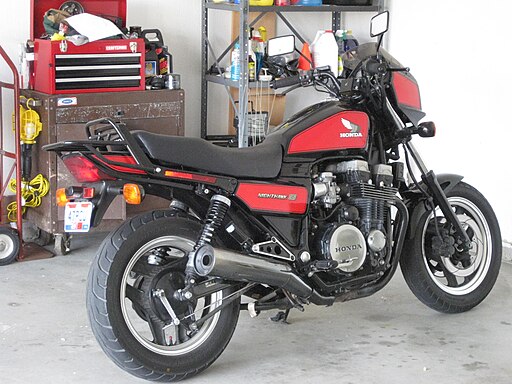
Honda CB700SC
The Honda CB700SC Nighthawk S is a mid-1980s standard/sport-touring motorcycle that blends a compact inline-four engine, shaft final drive, and touring-oriented ergonomics into a machine aimed at comfortable, reliable road use. The model was produced mainly for the mid-1980s market and is often remembered for its smooth four-cylinder refinement, practical running gear, and a mix of sport and touring features.
Heritage and model overview
Market position and production years
Introduced in the mid-1980s as part of Honda’s Nighthawk family, the CB700SC sat between smaller commuter machines and larger sport-touring bikes. It was marketed in the United States and selected export markets during the 1984–1986 model years and served as a blend of approachable ergonomics and capable long-distance behavior.
Design intent
Honda engineered the CB700SC to deliver four-cylinder refinement in a manageable chassis: a relatively low seat height for the class, a semi-faired front for wind protection, and a shaft-drive layout to reduce routine maintenance on long tours. The package targets riders who want smooth power, simple maintenance, and predictable handling rather than outright racetrack performance.
Engine and drivetrain
Engine architecture and displacement
The CB700SC uses an air/oil-cooled inline four-cylinder DOHC engine with four valves per cylinder and hydraulic valve lifters to minimize routine valve adjustment. Displacement is approximately 696 cc, reflecting Honda’s aim to extract refined performance from a relatively compact multi-cylinder package.
Bore, stroke and compression
Factory technical data list bore and stroke and a moderate compression ratio designed to yield a rev-happy character while keeping thermal and mechanical stress in check; published community and spec sheets place bore and stroke in the mid-60s/40s mm range and compression ratios near the low 9:1 range for reliability and usable power.
Induction, ignition and fueling
Fuel delivery is handled by four Keihin carburetors sized to give smooth throttle response across the rev range and to support the engine’s torque curve. Ignition is electronic CDI or transistorized in the regionally specified setups, supplying consistent spark and simplified starting. The presence of hydraulic valve lifters further reduces everyday maintenance requirements by removing regular valve clearance adjustments.
Transmission and final drive
Power is routed through a close-ratio six-speed manual gearbox to a shaft final drive, an arrangement chosen for low-maintenance ownership and long-distance touring convenience. The shaft drive trades a small weight penalty for cleanliness and reduced drivechain service, making the bike well suited to riders who prefer minimal drivetrain upkeep.
Performance characteristics
Power and torque
The CB700SC’s engine delivers brisk performance for its class with claimed peak power figures in the neighborhood of the mid-to-high tens of kilowatts (commonly noted around 58–80 hp in various contemporary sources) and a torque peak designed to give strong midrange pull for highway overtakes and relaxed cruising.
Top speed and real-world behavior
Top speed and acceleration are competitive for a mid-1980s middleweight sport/tourer, with real-world riding emphasizing linear throttle response, smooth revving through the midrange, and comfortable high-speed stability rather than race-bred top-end punch.
Chassis, suspension and handling
Frame and geometry
The CB700SC uses a tubular steel full-cradle frame that balances rigidity with compliance to give stable handling at speed without harsh feedback over long distances. Wheelbase sits in a range that favors straight-line stability while remaining nimble enough for twisty roads and everyday commuting.
Front suspension and anti-dive
Front suspension consists of an air-adjustable telescopic fork with anti-dive TRAC (Torque Reactive Anti-dive Control) features on many units, allowing riders to tune front-end support while limiting excessive dive under heavy braking. Fork travel is generous for the era and tuned to absorb touring loads and imperfect road surfaces.
Rear suspension
The rear uses twin shock absorbers with preload adjustment and damping characteristics set for two-up comfort and luggage-carrying capability. Progressive springing and adjustable damping give the CB700SC predictable balance between comfort and control on loaded runs.
Wheels, tires and braking
Wheel and tyre specifications
The CB700SC commonly shipped with 16-inch wheels front and rear fitted with road-oriented tyres sized to provide a compromise between handling precision and long tread life. The cast wheels and tyre sizing reflect design priorities for pavement grip and stable highway behavior rather than off-road capability.
Brake system
Braking hardware on the CB700SC comprises dual front discs with twin-piston calipers and a rear drum or single-disc arrangement depending on market and year; front disc diameter and caliper sizing were selected to give strong, fade-resistant stopping suited to the bike’s touring role.
Dimensions, weights and capacities
Key dimensions
Overall dimensions place the CB700SC in the standard/sport-touring category with a relatively long wheelbase near 1,500 mm, a compact overall length just over 2,100 mm, and a rider-friendly seat height around 790 mm—values that aid stability and accessibility for a wide range of riders.
Weights and capacities
Dry and wet weight figures vary by specification; dry weight is typically reported in the low 200-kilogram range while wet/curb weight rises with fluids to a mid-200-kilogram figure. Fuel capacity is approximately 16 litres, providing practical range for mixed commuting and moderate touring without excessive tank bulk.
Electrical system and instrumentation
Electrical architecture
The electrical system supports electric start, conventional lighting, and instrumentation with a stator/alternator sized to permit optional accessories. Simplicity and robustness guide the electrical design to ensure reliable starting and lighting over long rides.
Instruments and rider interface
The cockpit is fitted with an analog tachometer, a large central analog speedometer, odometer/trip meters, and warning lamps for neutral, turn signals, and high beam, giving the rider clear, uncluttered information suited to touring duties and routine maintenance checks.
Maintenance and ownership considerations
Routine servicing
The CB700SC is designed for straightforward service tasks: regular oil and filter changes, carburetor synchronization and jetting checks, ignition system checks, drive-shaft inspections, and brake pad/rotor servicing. Hydraulic lifters reduce valve-adjustment chores, while the shaft drive removes the need for chain cleaning and tensioning.
Parts and aftermarket support
As an established Honda model, the CB700SC benefits from reasonable parts availability and an aftermarket focused on comfort upgrades, luggage solutions, and suspension improvements. Common owner upgrades include modern tyre choices, improved seats, and luggage mounts to enhance touring capability.
Detailed technical summary
- Engine type: Air/oil-cooled inline four-cylinder, DOHC, 4 valves per cylinder with hydraulic valve lifters.
- Displacement: Approximately 696 cc.
- Induction: Four Keihin carburetors for responsive fueling.
- Ignition: Electronic CDI/transistorized system for dependable spark.
- Transmission: 6-speed manual gearbox with shaft final drive.
- Frame: Tubular steel full-cradle frame for balanced rigidity and compliance.
- Front suspension: Telescopic air-adjustable fork with TRAC anti-dive features on many models.
- Rear suspension: Dual shock absorbers with preload and damping adjustment.
- Front brakes: Dual discs with twin-piston calipers for strong stopping power.
- Rear brake: Drum or single-disc depending on market/year.
- Wheels/tyres: 16-inch front and rear road-oriented tyres for confident highway handling.
- Wheelbase: Approximately 1,500 mm range for stable high-speed behavior.
- Seat height: Around 790 mm to suit a broad rider population.
- Fuel capacity: About 16 litres for practical touring range.
- Weight: Dry in the low 200 kg region; wet/curb higher depending on equipment and fluids.
Conclusion
The Honda CB700SC Nighthawk S is a thoughtful mid-1980s design that brings multi-cylinder smoothness, shaft-drive convenience, and touring-friendly ergonomics to the rider who wants dependable, low-maintenance road performance. Its combination of an approachable seating position, robust four-cylinder engine architecture, and practical features like hydraulic lifters and shaft final drive make it a compelling option for riders who appreciate classic mechanical simplicity paired with comfortable long-distance capability.
