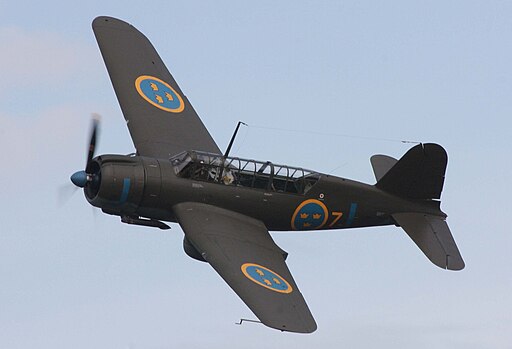
Saab 17
The Saab 17 was a Swedish single-engine monoplane developed as a dive bomber and reconnaissance aircraft during the early 1940s. It was the first all-metal stressed-skin aircraft designed in Sweden, conceived by ASJA before the company merged into Saab AB. The type entered service with the Swedish Air Force in 1942 and remained in various roles until the late 1940s.
This two-seat aircraft could be fitted with wheels, skis, or floats, allowing operations from land bases, snow-covered strips, or coastal waters. Its versatility made it valuable for both combat and patrol duties in neutral Sweden during World War II.
Design and Development
Project Origins
The Saab 17 project began in response to a 1938 Swedish Air Force requirement for a modern reconnaissance plane to replace the aging Fokker C.Ve. Initial work under the ASJA designation L 10 culminated in two prototypes flying in 1940. After ASJA merged into Saab, the design was standardized as the B 17 bomber and S 17 reconnaissance versions.
Airframe and Structure
The Saab 17 employed a mid-wing cantilever monoplane layout with a long greenhouse canopy for excellent visibility. Its semi-monocoque fuselage and wings used duralumin stressed skin panels over an internal framework, offering strength and ease of repair. Control surfaces remained fabric-covered to save weight and simplify maintenance.
Landing Gear and Configurations
Retractable wheels stowed rearward into prominent wing fairings, while swap-out ski sets and float assemblies converted the aircraft for winter or maritime operations. Floatplane versions added small fins to the tailplane for directional stability on water and reinforced wing structures to handle dive-bomber stresses. Wheel-equipped models used their undercarriage doors as dive brakes when fully extended.
Powerplant Variants
Three main engine types powered different Saab 17 versions. The B 17A used a Swedish-built Twin Wasp C (licensed Pratt & Whitney R-1830) delivering 1 065 hp. Later B 17B and S 17B models switched to the Bristol Pegasus XXIV radial at similar output. The definitive B 17C turned to the 760 kW (1 019 hp) Piaggio P.XIbis RC.40D engine, optimizing high-altitude performance and reliability.
Variants and Roles
B 17A Dive Bomber
The initial B 17A combined dive-bomber capability with a pilot and observer crew. It featured internal bomb racks, an external bomb crutch for vertical attacks, and underwing pylons for up to 500 kg of ordnance. Its fixed tailwheel and simple cockpit layout prioritized ruggedness and pilot training.
B 17B / S 17B Reconnaissance
Reconnaissance versions removed the dive-crutch and installed cameras, extended-range tanks, and enhanced radio equipment. They retained the option to carry light bombs but focused on photographic mapping and liaison duties. The S 17Bs served extensively over Sweden’s neutral airspace.
B 17C High-Performance Bomber
Upgraded with the Piaggio engine, the B 17C gained a higher ceiling and improved climb rate. Strengthened wings and revised fuel systems extended its patrol range. Some C-models conducted post-war trials with advanced avionics before final retirement.
Floatplane and Experimental Conversions
A limited number of floatplane Saab 17s replaced obsolete coastal reconnaissance floatplanes, exploiting the type’s adaptable undercarriage. Trials with radar, engine-cowl modifications, and special camera mounts demonstrated Saab’s willingness to evolve the design for niche roles.
Operational History
Swedish Air Force Service
Saab 17s entered Swedish Air Force service in 1942 across bomber and reconnaissance wings. They patrolled Sweden’s extensive coastline, performed winter exercises on skis, and trained new pilots in dive-bombing techniques. Their durability in extreme cold and snow storms highlighted the robust design and simple systems.
Post-War Roles and Export Attempts
After World War II, remaining airframes served as target tugs, communications transports, and avionics testbeds. Floatplane variants were evaluated for potential export to Canada and Finland, but rapid post-war jet development curtailed large-scale foreign sales. Final military retirements occurred by the late 1940s.
Technical Parameters
| Parameter | Specification |
|---|---|
| Crew | 2 |
| Length | 10.00 m (32 ft 10 in) |
| Wingspan | 13.70 m (44 ft 11 in) |
| Height | 4.15 m (13 ft 7 in) |
| Wing Area | 28.5 m² (307 ft²) |
| Empty Weight | 2 680 kg (5 908 lb) |
| Max Takeoff Weight | 3 870 kg (8 532 lb) |
| Powerplant | 1 × Piaggio P.XIbis RC.40D radial, 760 kW (1 019 hp) |
| Cruise Speed | 370 km/h (230 mph; 200 kt) |
| Maximum Speed (vne) | 435 km/h (270 mph; 235 kt) |
| Range | 1 700 km (1 056 mi; 918 NM) |
| Service Ceiling | 9 800 m (32 152 ft) |
| Armament | 2 × 13.2 mm Browning wing-mounted; 2 × 8 mm fuselage; up to 500 kg bombs |
