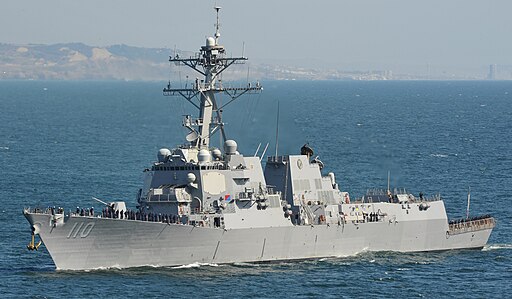
USS William P. Lawrence (DDG-110)
USS William P. Lawrence (DDG-110) is a Flight IIA variant of the Arleigh Burke-class guided-missile destroyer, combining Aegis combat systems, a robust array of offensive and defensive weaponry, and advanced propulsion for multi-mission flexibility. Commissioned in 2011, she serves as a key protector of carrier strike groups and vital sea lanes across global theaters. Her design emphasizes modular construction, allowing for efficient upgrades and extended operational life.
Historical Context
Namesake
The ship honors Vice Admiral William P. Lawrence (1930–2005), a naval aviator, test pilot, Vietnam War POW, Third Fleet commander, and Superintendent of the U.S. Naval Academy. His personal motto, “Never Give In,” reflects the vessel’s resilience and unwavering combat spirit.
Construction and Commissioning
Ordered on 13 September 2002, her keel was laid at Ingalls Shipbuilding in Pascagoula on 16 September 2008. Launched on 15 December 2009 and christened on 17 April 2010, she was officially commissioned at Mobile, Alabama, on 4 June 2011. Her homeport is Naval Station Pearl Harbor, ensuring rapid response across the Pacific basin.
Design and Construction
Hull Form and Materials
The destroyer features a steel hull with a low-magnetic-signature profile and anechoic sonar-absorbent coatings to reduce acoustic detectability. Her flared bow and optimized hull lines improve seakeeping, maneuverability, and fuel efficiency. Block-modular construction techniques permitted parallel assembly of large sections, shortening build time and simplifying mid-life system upgrades.
Propulsion System
Propulsion originates from four General Electric LM2500-30 gas turbines producing a combined 100 000 shp across two shafts. This COGAG configuration enables speeds exceeding 30 knots, while integrated turbo- and diesel-electric generators supply hotel loads and flight operations independent of the main drive system. Top-side electrical redundancy enhances combat survivability under battle damage.
Armament and Defense Systems
Missile and Gun Weaponry
A 96-cell Mk 41 Vertical Launching System (32 cells forward, 64 aft) accommodates a versatile missile loadout:
- RIM-66 Standard SM-2
- RIM-156 SM-2ER
- RIM-174 SM-6
- RIM-161 SM-3 (BMD)
- RIM-162 ESSM (quad-packed)
- BGM-109 Tomahawk
- RUM-139 VL-ASROC
The primary gun is a single 5 in/62 Mk 45 Mod 4 lightweight naval gun capable of land- and sea-strike missions. Secondary guns include a 20 mm Phalanx CIWS and two Mk 38 25 mm machine gun systems for short-range defense, complemented by four .50 cal heavy machine guns for close-in protection.
Anti-Submarine Warfare Capabilities
Two Mk 32 triple torpedo tubes launch Mk 46, Mk 50, or Mk 54 lightweight torpedoes against underwater threats. The Flight IIA upgrade adds full-enclosed hangar facilities for two MH-60R Seahawk helicopters, greatly extending ASW reach and targeting accuracy. The ship’s SQQ-89 USW suite integrates sonar, fire control, and ASROC launch capabilities into a unified ASW network.
Sensor and Electronic Warfare Suite
Radar Systems
At the heart of her air and missile defense is the AN/SPY-1D(V) multifunction Aegis radar, providing continuous 360° surveillance and tracking. Surface-search duties are handled by AN/SPS-67, while AN/SPQ-9B delivers high-resolution fire control targeting over the horizon and littoral environments. These systems coordinate to detect, classify, and engage multiple threats simultaneously.
Sonar and Electronic Warfare
Hull-mounted and towed array sonar sensors feed into the SQQ-89 ASW combat suite, enabling rapid detection of submarines and undersea obstacles. Electronic Warfare support comes from the SLQ-32(V)2 system, providing radar warning, jamming, and decoy deployment to counter incoming missiles and hostile sensors.
Flight Operations
The Flight IIA configuration incorporates a hangar and flight deck supporting two MH-60R helicopters, enhancing anti-submarine, anti-surface, and search-and-rescue missions. On-board handling facilities include a dual-rail weapon elevator and dedicated aviation fuels systems, ensuring sustained flight operations independent of shore support.
Performance and Endurance
Standard displacement is 9 200 t, rising to approximately 9 800 t at full load. Measuring 155.3 m in length with a beam of 20.4 m and a draft of 9.4 m, she achieves an endurance of roughly 4 400 nm at 20 knots. This combination of speed, range, and payload capacity underpins her ability to project power globally and maintain station for extended deployments.
Crew and Habitability
USS William P. Lawrence carries approximately 380 officers and enlisted personnel. Habitability improvements over earlier flights include enhanced berthing arrangements, computerized damage control centers, and expanded medical facilities. Modular living blocks streamline repairs and future refits without major structural alteration.
Operational History
Since her 2011 commission, DDG-110 has executed multiple Western Pacific deployments, integrated into Carrier Strike Groups, and supported ballistic missile defense patrols. She has conducted freedom-of-navigation operations, multinational exercises, and humanitarian assistance missions, demonstrating the adaptability of Arleigh Burke destroyers in 21st-century naval warfare.
Conclusion
USS William P. Lawrence embodies the evolution of destroyer warfare: a blend of Aegis-driven air defense, multi-domain strike capabilities, robust ASW assets, and advanced propulsion. Her Flight IIA enhancements—especially aviation facilities and modular build—ensure she remains a front-line asset capable of meeting emerging maritime security challenges for decades to come.
Key Technical Specifications
| Parameter | Specification |
|---|---|
| Class & Flight | Arleigh Burke-class, Flight IIA |
| Displacement (standard/full) | 9 200 t / ~9 800 t |
| Length / Beam / Draft | 155.3 m / 20.4 m / 9.4 m |
| Propulsion | 4 × GE LM2500-30 GT (100 000 shp) |
| Speed | > 30 knots |
| Range | ~ 4 400 nm @ 20 knots |
| Complement | ~ 380 officers & crew |
| Main Gun | 1 × 5 in/62 Mk 45 Mod 4 |
| VLS Cells | 96 (32 fore / 64 aft) |
| CIWS & Secondary Weapons | 1 × Phalanx; 2 × Mk 38; 4 × .50 cal |
| ASW Torpedo Tubes | 2 × Mk 32 triple for Mk 46/50/54 |
| Aviation | 2 × MH-60R Seahawk |
| Primary Radar | AN/SPY-1D(V) Aegis |
| ASW Suite | SQQ-89 USW |
| EW Suite | SLQ-32(V)2 |
_steams_toward_San_Diego_Harbor_in_May_2015.jpg)