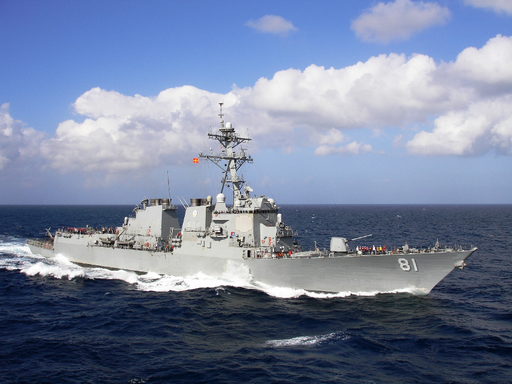
USS Winston S. Churchill (DDG-81)
USS Winston S. Churchill (DDG-81) is an Arleigh Burke–class guided-missile destroyer of the Flight IIA variant, commissioned in 2001. She integrates the Aegis combat system with a versatile mix of weaponry and sensors to perform air defense, surface warfare, anti-submarine warfare, and strike missions across global theaters.
Namesake
The ship honors Sir Winston Leonard Spencer Churchill, former Prime Minister of the United Kingdom and wartime leader. Announced by President Bill Clinton to the British Parliament in November 1995, she became the first U.S. warship named for a non-U.S. citizen since 1976, reflecting the enduring alliance between the United States and the United Kingdom.
Construction and Commissioning
The DDG-81 contract was awarded to Bath Iron Works in January 1995. Her keel was laid on 7 May 1998, she was launched on 17 April 1999, and commissioned during a ceremony at Town Point Park, Norfolk, Virginia, on 10 March 2001.
Hull and Structure
Dimensions and Displacement
At full load, Winston S. Churchill displaces approximately 9,648 metric tons. She measures 155.3 meters in length, has a beam of 18.0 meters, and draws 9.4 meters of water, providing a stable platform for high-endurance operations.
Stealth Features and Modular Construction
Her steel hull incorporates acoustic-absorbent coatings and a low-magnetic-signature design to reduce detectability by sonar and magnetic sensors. Block-modular construction allowed parallel assembly of large sections—machinery, munitions, aviation spaces, and accommodations—streamlining production and future system upgrades.
Propulsion and Performance
Main Propulsion System
Four General Electric LM2500-30 gas turbines generate a combined 100,000 shaft horsepower, driving two controllable-pitch propeller shafts in a COGAG (combined gas turbine) arrangement for rapid acceleration and redundancy.
Auxiliary Power and Maneuvering
Three diesel generators and three turbogenerators supply hotel loads and support quiet, low-speed maneuvers in littoral zones. Dedicated electric motors enable precise station-keeping during replenishment and flight operations without running the main turbines.
Speed, Range, and Endurance
The destroyer exceeds 30 knots at flank speed and achieves a range of roughly 4,400 nautical miles at 20 knots, enabling sustained deployments without frequent refueling stops.
Sensor and Electronic Warfare Suite
Aegis Combat System
At the core of her defensive and offensive capability is the Aegis combat system, a fully integrated suite that fuses radar, fire control, and weapon management into a single network, enabling simultaneous detection and engagement of multiple targets across air, surface, and subsurface domains.
Electronic Warfare
The AN/SLQ-32(V)3 electronic warfare suite provides radar warning, signal interception, and jamming capabilities. Paired with decoy launchers, it defends against anti-ship missile threats by degrading enemy sensors and guiding munitions away from the ship.
Armament
Vertical Launch System
A 96-cell Mk 41 Vertical Launching System (32 cells forward, 64 aft) carries Standard Missile family air defenses, Evolved Sea Sparrow Missiles, SM-3 ballistic-missile interceptors, Tomahawk cruise missiles for land attack, and ASROC anti-submarine rockets for undersea threats.
Gun Systems
The primary gun is a 5 in/62 caliber Mk 45 Mod 4 lightweight naval gun for naval gunfire support and surface engagements. Close-in defense is provided by two 20 mm Phalanx CIWS units and two Mk 38 25 mm machine guns, supplemented by four .50 caliber mounts for last-ditch protection.
Anti-Submarine Warfare Armament
Two Mk 32 triple torpedo tube launchers deploy Mk 46, Mk 50, or Mk 54 lightweight torpedoes. These launchers, integrated with the ship’s sonar suite and helicopter sensors, offer layered prosecution of enemy submarines.
Aviation Facilities
Hangar and Flight Deck
The Flight IIA modification introduced an enclosed hangar capable of housing two MH-60R Seahawk helicopters. The hangar includes dedicated maintenance shops, aviation fuel storage, and handling equipment to sustain extended flight operations at sea.
Helicopter Operations
Embarked MH-60Rs extend Winston S. Churchill’s reach in anti-submarine, anti-surface, and search-and-rescue roles. These helicopters employ dipping sonar, sonobuoys, and air-launched torpedoes, while providing over-the-horizon targeting and real-time data relay to the ship’s combat system.
Crew and Habitability
USS Winston S. Churchill carries a complement of 32 officers and 348 enlisted personnel. Modular berthing compartments, digital damage-control workstations, and enhanced medical facilities improve crew efficiency and morale during extended deployments.
Operational History
Since entering service, DDG-81 has deployed to the Atlantic, Mediterranean, and Middle East, participating in multinational exercises, ballistic missile defense patrols, counter-piracy missions, and humanitarian assistance operations. Her performance underscores the adaptability and sustained combat power of the Arleigh Burke Flight IIA design.
Key Technical Specifications
| Parameter | Specification |
|---|---|
| Class & Flight | Arleigh Burke-class; Flight IIA |
| Displacement (full load) | 9,648 t |
| Length | 155.3 m |
| Beam | 18.0 m |
| Draft | 9.4 m |
| Propulsion | 4 × GE LM2500-30 gas turbines; 2 shafts; 100 000 shp |
| Speed | > 30 kn |
| Range | ~4,400 nm @ 20 kn |
| Complement | 32 officers; 348 enlisted |
| Main Gun | 1 × 5″/62 cal Mk 45 Mod 4 |
| VLS Cells | 96 (32 fore; 64 aft) |
| CIWS & Secondary Guns | 2 × 20 mm Phalanx; 2 × 25 mm Mk 38; 4 × .50 cal |
| ASW Torpedo Tubes | 2 × Mk 32 triple |
| Aviation | 2 × MH-60R Seahawk helicopters |
| Electronic Warfare | AN/SLQ-32(V)3 |
