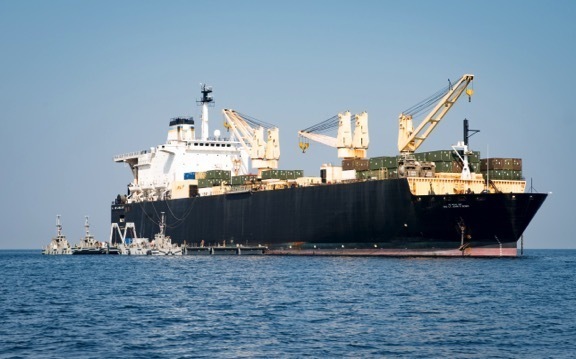
USNS 2nd Lt. John P. Bobo (T-AK-3008)
USNS 2nd Lt. John P. Bobo (T-AK 3008) is the lead ship of her class of dry cargo prepositioning vessels operated by the U.S. Military Sealift Command. As a floating logistics base, she maintains stocks of combat vehicles, bulk fuels, water, ammunition, and sustainment stores near key regions worldwide. Her roll-on/roll-off capability and independent cargo handling systems allow rapid offload in austere ports, supporting Marine Air-Ground Task Forces during crisis response or major combat operations.
Namesake and Mission Profile
Namesake
The ship honors Second Lieutenant John P. Bobo, a U.S. Marine Medal of Honor recipient who displayed extraordinary heroism during the Vietnam War. His selfless leadership under fire embodies the vessel’s commitment to delivering vital supplies under the most challenging conditions.
Prepositioning Role
Assigned to Maritime Prepositioning Ship Squadron One, 2nd Lt. John P. Bobo operates primarily in the Indian Ocean and Western Pacific. She stands ready to offload her prepositioned cargo within 72 hours of arrival, providing the logistics backbone for expeditionary forces ashore.
Construction and Acquisition
Shipyard and Keel Laying
General Dynamics Quincy Shipbuilding Division in Massachusetts laid her keel in September 1983. Modular block construction enabled simultaneous fabrication of hull, machinery, and accommodation sections, accelerating build timelines and simplifying future upgrades.
Launch, Delivery, and MSC Transfer
Launched in January 1985 and delivered later that year under commercial charter, she entered service as MV 2nd Lt. John P. Bobo. In January 2007 the Navy purchased and redesignated her USNS 2nd Lt. John P. Bobo (T-AK 3008), integrating her into the prepositioning fleet.
Hull Design and Structure
Hull Form and Materials
Her welded steel monohull features a flared bow and transom stern to improve seakeeping and reduce slamming in heavy seas. Longitudinal stiffeners and transverse bulkheads provide structural strength for heavy cargo loads, while the outer hull encloses ballast tanks for fine trim control during loading and discharge.
Modular Cargo Layout
The vessel’s internal decks and holds are arranged in modular sections, enabling flexible stowage of vehicles, pallets, and containers. Wide unobstructed lanes and flush deck hatches streamline roll-on/roll-off operations and accelerate throughput during offload.
Propulsion and Performance
Main Propulsion Plant
Two Stork Werkspoor 18TM410 medium-speed diesel engines generate a combined 26,400 bhp, driving a single fixed-pitch propeller shaft. This reliable plant delivers a service speed of 17.7 knots and sustained performance for long transits.
Maneuvering and Endurance
A 1,000 hp bow thruster provides precise low-speed control in confined harbors and alongside causeways. At an economical speed of 18 knots, she can sail approximately 12,840 nautical miles without refueling, limited mainly by crew endurance and scheduled maintenance intervals.
Cargo Capacity and Handling Systems
Vehicle and Container Spaces
162,500 square feet of Ro-Ro deck space accommodate armored vehicles, trucks, and palletized loads. Cell-guide stowage on deck supports up to 522 twenty-foot equivalent units, offering versatility in containerized cargo configurations.
Bulk Liquid Stowage
Dedicated tanks carry 1,605,000 gallons of diesel fuel and 81,700 gallons of potable water. Baffled compartments and reinforced tank structures ensure safe transit of bulk liquids in high sea states.
Cargo Handling Equipment
Three electro-hydraulic deck cranes—a 35-ton unit and two 18-ton units—enable independent loading and discharge without reliance on shore-based gear. Integrated ramp panels and causeway stowage facilitate rapid roll-on/roll-off transfer to lighterage or amphibious connectors.
Aviation Facilities
Flight Deck and Operations
A reinforced helicopter platform supports CH-53E and similar heavy-lift helicopters for vertical replenishment. The deck includes securing points, approach lighting, and refueling hydrants to sustain day-night flight operations during prepositioning missions.
Sensor and Communications Suite
Navigation and Radar Systems
Multi-band navigation radars provide surface search, collision avoidance, and precise berthing guidance. GPS and inertial navigation inputs feed integrated digital bridge consoles, ensuring accurate track-keeping under all conditions.
Communications and Networking
Satellite communications terminals enable secure global voice and data exchange. Tactical Link-11 and Link-16 interfaces support real-time coordination with embarked Marine elements and joint force commanders.
Crew and Habitability
Crew Composition
A civilian mariner crew of approximately 30 handles ship operations, navigation, and maintenance. A small U.S. Navy detachment of around eight personnel manages communications, medical support, and mission planning, while up to 25 civilian technical specialists embark for sustained prepositioning duties.
Living Quarters and Amenities
Two- to four-berth cabins, a self-service mess, recreation lounge, and fitness station support crew welfare on extended deployments. Zonal automation and condition-based monitoring reduce maintenance workload, maximizing habitable space and morale.
Operational Employment
Prepositioning Missions
Since 1985, 2nd Lt. John P. Bobo has staged essential Marine combat equipment and supplies near potential theaters, enabling surge deployments with minimal notice. Her rapid offload capability has proven critical in exercises and contingency operations throughout the Pacific and Indian Ocean regions.
Joint Exercises and Humanitarian Support
The ship regularly participates in large-scale exercises such as Cobra Gold, Freedom Banner, and Balikatan. She has also supported humanitarian relief efforts by delivering fuel, water, and critical supplies to disaster-affected areas with limited port infrastructure.
Technical Specifications
| Parameter | Specification |
|---|---|
| Class & Type | 2nd Lt. John P. Bobo-class dry cargo ship |
| Displacement (light/full) | 19,588 t / 40,846 t |
| Length | 205 m |
| Beam | 32 m |
| Draft | 10.5 m |
| Propulsion | 2 × Stork Werkspoor 18TM410 diesels (26,400 bhp) |
| Shaft & Propeller | Single shaft; fixed-pitch propeller |
| Bow Thruster | 1,000 hp |
| Speed | 17.7 knots |
| Range | 12,840 nm @ 18 knots |
| Vehicle Deck Area | 162,500 ft² |
| Container Capacity | 522 TEU |
| Fuel & Water Capacity | 1,605,000 gal fuel; 81,700 gal water |
| Cargo Cranes | 1 × 35 t; 2 × 18 t |
| Aviation Facilities | Flight deck for heavy-lift helicopters |
| Crew Complement | ~30 civilian mariners; ~8 Navy detachment; up to 25 specialists |
| Prepositioning Squadron | MPSRON 1 |
_off_Furjairah,_United_Arab_Emirates,_on_20_January_2018_(180120-N-KK081-021).JPG)