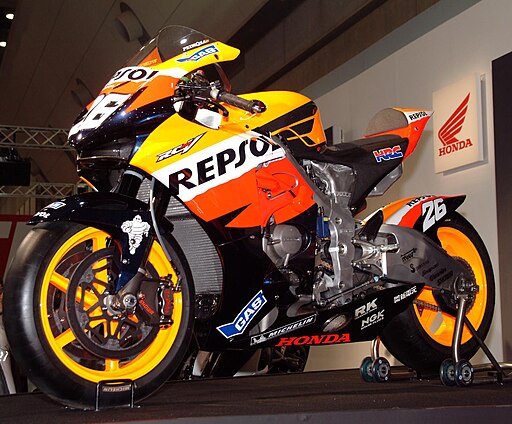
The Honda RC212V is a MotoGP racing motorcycle developed by Honda Racing Corporation (HRC) for the 800 cc era, which began in 2007. It replaced the RC211V and was engineered to meet new regulations that limited engine capacity. The RC212V served as the factory machine for top riders and underwent many revisions through its competitive lifespan, focusing on handling, power delivery, and weight distribution.
Engine Architecture
The RC212V was powered by a liquid-cooled 800 cc four-stroke V4 engine. Honda selected a 75-degree V-angle to provide a balance between compactness and smooth power delivery. Key engine characteristics included:
-
Displacement: 799.5 cc
-
Configuration: V4, 4 valves per cylinder
-
Maximum RPM: approximately 19,000
-
Power Output: 210–230 horsepower depending on development stage
-
Fuel System: Electronic fuel injection with multi-injector setup
-
Bore and Stroke: around 81 mm bore with a short stroke design for high revs
The engine was designed to reduce reciprocating mass and support precise throttle control. Titanium valves and lightweight pistons improved engine response.
Transmission and Drivetrain
The RC212V used a seamless shift six-speed gearbox allowing ultra-fast gear changes without sacrificing traction. It was paired with a multi-plate wet slipper clutch designed to minimize wheel hop during aggressive downshifting. Teams could adjust gearing ratios based on specific circuits.
Electronic Management
Honda integrated advanced electronics to optimize rider control and stability. The system typically included:
-
Traction control with multiple intervention levels
-
Launch control for race starts
-
Engine braking management
-
Throttle-by-wire system
-
Data logging with sensors for suspension, throttle, braking, and engine behavior
-
ECU capable of real-time remapping during pit sessions
Chassis and Frame
The frame was an aluminum twin-spar design, offering rigidity and flexibility in targeted areas. Engineers refined geometry each season to match new tires and rider feedback. The swingarm was also aluminum, typically using a braced design to increase stiffness without weight gain.
Dimensions commonly associated with the RC212V:
-
Wheelbase: approximately 1,435 mm
-
Seat Height: around 830 mm
-
Dry Weight: near the MotoGP minimum, about 148–150 kg at the time
Suspension System
Both front and rear suspension were typically supplied by Öhlins, though Showa components were also tested in some seasons. Common components included:
-
Front: Inverted telescopic fork, 42–48 mm tubes depending on spec
-
Rear: Pro-Link monoshock with variable linkage
-
Adjustability: Full adjustability for preload, compression, and rebound
Teams refined suspension tuning to match the rider’s style and track surface conditions.
Braking Components
The braking package was designed around race demands:
-
Front Brakes: Dual carbon-ceramic discs, approximately 320 mm, with Brembo radial-mount 4-piston calipers
-
Rear Brake: Steel or carbon disc with dual-piston caliper
Brake configurations changed depending on track temperature and regulations regarding carbon braking systems.
Aerodynamics and Bodywork
The fairing was engineered in wind tunnels for reduced drag and improved rider ergonomics. Air intake channels directed air to the airbox to stabilize airflow at high speeds. Body panels were made from lightweight carbon fiber composites. Over time, minor winglets and revised intakes were introduced depending on season and regulation constraints.
Wheels and Tires
The RC212V ran on forged magnesium wheels, typically 16.5 inches during that era, later shifting toward 17 inches as regulations evolved. Tires were supplied by Michelin initially and later Bridgestone, with compounds and construction matched to the chassis setup.
Fuel and Exhaust System
Fuel tank capacity was limited to MotoGP regulations (21 liters early in the 800 cc era). The exhaust system was a custom titanium layout, usually with under-seat or side-exit pipes. Design goals focused on minimizing weight and balancing back-pressure for mid-range torque.
Development Evolution
From 2007 through 2011, the RC212V underwent continuous updates. Early models faced traction and power delivery challenges compared to rivals, but later iterations became highly competitive. Honda introduced revised crankshaft layouts, better electronics, improved aerodynamics, and redesigned chassis geometry. By the later seasons, the machine was a regular podium contender and contributed to world championship wins.
Legacy and Transition
The RC212V represented Honda’s engineering response to the 800 cc rules and laid the groundwork for the subsequent RC213V used in the 1000 cc era. Lessons learned in combustion efficiency, electronics, and chassis balance carried forward, influencing the next generation of MotoGP machines.
Summary
The Honda RC212V combined high-revving V4 performance with precision engineering in electronics, suspension, and aerodynamics. Although regulations changed and engine displacement returned to 1000 cc, the RC212V remains a pivotal model in Honda’s MotoGP history. It demonstrated rapid development cycles and the technical depth required to compete at the top tier of motorcycle racing.
