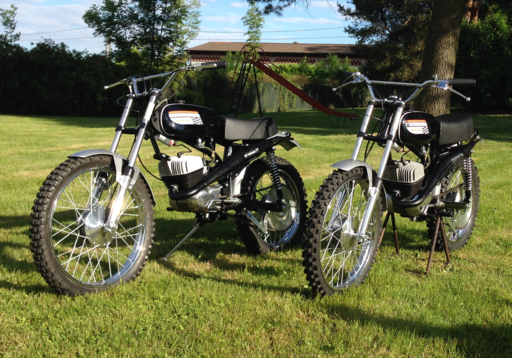
The Harley-Davidson Baja 100, produced during the early 1970s, represents one of the company’s most focused attempts to enter the competitive off-road and enduro motorcycle market. At the time, lightweight two-strokes from Japan and Europe dominated off-road riding, compelling Harley-Davidson—then owners of Aermacchi—to develop a machine engineered specifically for rugged terrain, motocross trails, and endurance competition. The Baja 100 emerged as a simplified but durable single-cylinder two-stroke that delivered dependable performance in environments where reliability meant everything. Riders valued it for its nimble handling, torque-friendly power curve, and resilient chassis components that could withstand punishing dirt conditions. While the Baja 100 was never designed as a high-horsepower racer, it became respected for its practical design philosophy: low weight, minimal maintenance demands, and robust mechanical components suitable for recreational and amateur competition.
Engine Design, Cooling, and Power Delivery
The heart of the Baja 100 was a 98 cc air-cooled two-stroke engine, built upon Aermacchi’s competition-proven single-cylinder platform. The bore and stroke combination provided good mid-range punch and crisp throttle response, making the engine well-suited for off-road terrain where quick bursts of acceleration mattered more than top speed. The piston-ported induction system simplified the overall architecture and reduced mechanical complexity, relying on precise port timing to manage intake flow instead of rotary valves or reed systems. Fuel delivery was handled by a compact carburetor tuned to resist clogging and maintain consistent mixture even under intense vibration.
The engine produced power in the range of 10 to 11 horsepower, a figure that may seem modest by modern standards but was appropriate for the machine’s extremely light weight. Air cooling was optimized using deep fins cut into the cylinder head and barrel, which dissipated heat efficiently when airflow varied across slow and high-speed sections of a trail. The lubrication system relied on a traditional pre-mix fuel arrangement, requiring riders to blend oil with gasoline at a specified ratio to ensure proper internal lubrication. This eliminated the need for a separate oil pump, reducing mechanical failure points and keeping overall maintenance straightforward.
Transmission: Manual Control for Off-Road Adaptability
The Baja 100 used a five-speed manual transmission, providing riders with a range of gear options suitable for climbing, navigating tight trails, or reaching moderate straight-line speeds on open terrain. Gear spacing was intentionally designed to keep the engine within its torque band, reducing the need for constant clutch manipulation. The multi-disc wet clutch offered consistent engagement even when exposed to dirt, water, or prolonged slipping during technical riding.
Final drive was accomplished via a standard chain-and-sprocket system, selected for its durability and ease of gearing adjustments. Off-road riders often altered rear sprocket sizes to customize low-end torque or top speed, and the Baja 100’s driveline allowed this with minimal mechanical effort. The entire driveline was engineered to be simple and user-serviceable, allowing riders in remote areas to perform field repairs if necessary.
Chassis Architecture and Frame Construction
The Baja 100 employed a steel tubular frame engineered for high structural rigidity without excessive weight. The dual-cradle layout surrounded the engine, protecting it from impacts while contributing to the bike’s balanced weight distribution. The frame’s geometry was tuned to emphasize agile handling, featuring a narrow waist and compact wheelbase that made it easy to maneuver through tight or uneven trails.
The subframe section supported a lightweight saddle and rear fender assembly, designed to withstand repetitive harsh impacts. Since off-road riding often exposed motorcycles to sudden drops and unexpected stresses, Harley-Davidson and Aermacchi reinforced critical joints and mounting points to minimize frame flex and prevent cracking. This robust engineering approach, combined with the bike’s low overall mass, gave the Baja 100 a reputation for resilience and mechanical longevity.
Suspension, Steering, and Off-Road Handling
A major part of the Baja 100’s competence stemmed from its suspension system. At the front, the motorcycle used telescopic hydraulic forks providing ample travel for absorbing ruts, rocks, and jumps. These forks balanced compliance with rigidity, ensuring that the front wheel remained planted while offering controlled rebound characteristics during sustained off-road riding.
At the rear, the bike employed a dual-shock swingarm setup, typical of the era but tuned specifically for enduro conditions. Shock absorbers provided generous travel and were angled to optimize progressive compression. This configuration improved comfort while maintaining ground clearance and reducing bottom-out events during aggressive trail riding.
Steering geometry produced a sharp but stable response. The combination of light weight, strong leverage at the handlebars, and well-tuned suspension made the Baja 100 popular among riders who valued precise control on unpredictable terrain. Its low center of gravity further enhanced stability, especially in tight, technical sections.
Wheels, Tires, and Braking Systems
The Baja 100 rode on 21-inch front and 18-inch rear spoked wheels, dimensions chosen to balance obstacle clearance, traction, and handling responsiveness. The spoked wheel design allowed for impact absorption on rough ground while minimizing the risk of rim distortion. Off-road knobby tires provided the grip needed for mud, sand, gravel, and loose soil.
Braking was managed through drum brakes on both wheels, a standard configuration for off-road motorcycles of the time. Although drums lack the crisp bite of modern disc systems, they offered reliable performance when properly adjusted and were less susceptible to clogging from mud or debris during extended trail riding. Their mechanical simplicity reduced service time and increased reliability in remote environments.
Performance Characteristics and Riding Experience
With an approximate curb weight below 190 pounds, the Baja 100 excelled as a lightweight trail machine. The combination of a responsive two-stroke engine, manual gearbox, and nimble frame enabled quick directional changes and rapid acceleration out of corners. Its top speed ranged around 55 mph, depending on gearing, though the bike was engineered more for low- and mid-range torque than for high-speed cruising.
Fuel efficiency was strong due to the lightweight build and small displacement, allowing riders to cover long distances on a single tank even in remote environments. The riding experience emphasized control and manageability; the motorcycle was forgiving for beginners but delivered enough capability to satisfy intermediate-level riders who sought a reliable and well-balanced dirt bike.
Technical Specifications (Summary)
- Engine: 98 cc single-cylinder, two-stroke
- Cooling: Air-cooled with finned cylinder and head
- Power Output: Approximately 10–11 hp
- Induction: Piston-ported carbureted intake
- Lubrication: Pre-mix two-stroke fuel system
- Transmission: 5-speed manual
- Clutch: Wet multi-plate
- Final Drive: Chain
- Frame: Tubular steel dual-cradle frame
- Front Suspension: Telescopic hydraulic fork
- Rear Suspension: Dual shock absorbers with swingarm
- Brakes: Front and rear drum brakes
- Wheels: 21-inch front, 18-inch rear spoked rims
- Top Speed: ~55 mph
- Approx. Weight: Under 190 lbs
Legacy and Historical Significance
The Harley-Davidson Baja 100 reflects a unique period in the company’s history when the brand explored competition-oriented lightweight motorcycles to compete in growing off-road segments. While Harley-Davidson is internationally recognized for heavyweight cruisers, models like the Baja 100 reveal the company’s formerly diverse engineering capabilities. The bike earned respect among trail riders for its simplicity, reliability, and durable design—qualities that allowed it to thrive in harsh environments. Today, the Baja 100 holds a place of appreciation among collectors and vintage off-road enthusiasts who value its distinctive blend of Harley heritage and Aermacchi engineering. It stands as a reminder of an era when Harley-Davidson broadened its horizons and produced machines far different from the V-twin cruisers typically associated with the brand.
