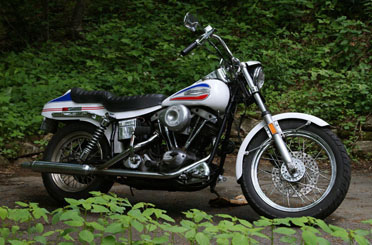
The Harley-Davidson Super Glide occupies a special place in the brand’s history as one of the earliest factory-built custom motorcycles. Introduced as a bridge between stripped-down performance and everyday rideability, the Super Glide was designed to combine the mechanical robustness of Harley-Davidson’s big-twin platform with a leaner, sportier aesthetic. Its design philosophy emphasizes mechanical honesty: exposed components, minimal bodywork, and a stance that reflects both stability and agility. Unlike touring-oriented models, the Super Glide avoids excessive fairings or storage, focusing instead on rider connection, balance, and responsive handling.
The motorcycle’s proportions are defined by a relatively compact wheelbase for a big twin, paired with a low seat height that enhances rider confidence at low speeds. The fuel tank, traditionally a mid-capacity unit around 4 to 4.5 gallons depending on generation, is sculpted to allow knee grip and forward body positioning. Overall mass distribution favors a low center of gravity, which plays a critical role in both straight-line stability and predictable cornering behavior.
Engine Architecture and Performance Characteristics
At the heart of the Super Glide is Harley-Davidson’s air-cooled V-twin engine, historically offered in several displacements depending on model year, including the Shovelhead, Evolution, and later Twin Cam configurations. The classic 45-degree V-twin layout remains constant, delivering a distinctive firing order and torque-heavy power delivery. Bore and stroke dimensions vary across generations, but the emphasis consistently remains on strong low- and mid-range torque rather than high-rev horsepower.
Compression ratios are typically moderate, balancing performance with thermal reliability in air-cooled operation. Carbureted versions utilize a single downdraft carburetor with mechanical throttle control, while later fuel-injected models employ electronic fuel injection systems with closed-loop feedback for improved throttle response and emissions compliance. Peak output figures are less significant than the engine’s torque curve, which provides immediate acceleration from low engine speeds, making the Super Glide well-suited for urban riding and relaxed highway cruising.
Transmission and Drivetrain Configuration
The Super Glide traditionally features a five- or six-speed constant-mesh transmission, depending on the production era. Gear ratios are spaced to take advantage of the engine’s torque characteristics, with a relatively tall top gear designed for reduced engine speed during highway travel. Clutch systems are multi-plate, wet or dry depending on generation, offering a balance between smooth engagement and durability under repeated load.
Final drive is handled via a belt drive system rather than a chain, which significantly reduces maintenance requirements while maintaining quiet operation and long service intervals. The belt drive also contributes to smoother power transfer and reduced driveline lash, enhancing overall ride quality. Primary drive ratios are optimized to provide a responsive launch without sacrificing cruising efficiency.
Chassis Geometry and Frame Construction
The Super Glide is built around a steel tubular frame engineered to provide torsional rigidity while allowing a degree of compliance for rider comfort. Rake and trail figures are conservative compared to chopper-style customs, typically featuring a rake angle in the low 30-degree range and trail values that support neutral steering behavior. This geometry allows the motorcycle to track predictably through corners while maintaining straight-line stability at highway speeds.
Wheelbase measurements vary slightly across model years but generally fall within a range that balances agility and stability. The frame integrates the engine as a stressed member in later generations, increasing overall rigidity and reducing unnecessary mass. Mounting points for the engine often include rubber isolation systems to minimize vibration transmitted to the rider without excessively dulling mechanical feedback.
Suspension Systems and Ride Dynamics
Front suspension on the Super Glide typically consists of conventional telescopic forks with travel tuned for mixed urban and highway use. Fork diameters increase in later models to improve rigidity under braking loads, while internal damping systems are calibrated for a compliant yet controlled ride. Rear suspension is commonly handled by dual shocks mounted at a slight angle, offering preload adjustability to accommodate different rider weights and riding conditions.
Suspension travel is modest compared to adventure or touring motorcycles, but it is sufficient for absorbing road irregularities without compromising the low seat height. The overall suspension setup prioritizes stability and comfort over aggressive sport performance, yet it remains capable of confident cornering when ridden within its design envelope.
Braking System and Control Interfaces
Braking components on the Super Glide evolve across generations, ranging from single-disc setups to more advanced dual-disc configurations in later models. Front brakes typically employ hydraulic disc systems with multi-piston calipers, providing adequate stopping power for the motorcycle’s weight and performance profile. Rear braking is handled by a single disc, offering predictable modulation during low-speed maneuvers and supplemental stopping force.
Brake feel is generally progressive rather than aggressive, aligning with the motorcycle’s cruiser-oriented intent. Control interfaces, including wide handlebars and forward or mid-mounted foot controls depending on configuration, allow for intuitive rider input. Lever ratios and pedal placement are designed to reduce fatigue during extended rides.
Wheels, Tires, and Road Contact
Wheel sizes on the Super Glide commonly feature a larger diameter front wheel paired with a slightly smaller rear, contributing to stable steering and confident straight-line behavior. Cast or spoked wheels are used depending on trim and era, each offering different trade-offs between weight, aesthetics, and maintenance. Tire profiles are selected to provide a broad contact patch while maintaining neutral turn-in characteristics.
Tire compounds emphasize durability and consistent grip rather than maximum sport performance. This choice aligns with the Super Glide’s role as an everyday motorcycle capable of handling varied road surfaces and weather conditions without excessive wear.
Ergonomics and Rider Interface
Ergonomically, the Super Glide is designed to accommodate a wide range of rider sizes. The low seat height allows easy flat-footing at stops, while the reach to the handlebars promotes an upright, relaxed posture. Foot control placement varies between mid and forward setups, each influencing rider positioning and weight distribution.
Instrumentation is typically minimalistic, featuring analog speedometers and basic indicator lights. This simplicity reinforces the mechanical focus of the motorcycle and reduces distractions, allowing the rider to concentrate on the riding experience itself.
Legacy and Technical Significance
The Harley-Davidson Super Glide represents a pivotal moment in motorcycle design, effectively defining the factory custom category. Its technical parameters reflect a deliberate balance between performance, durability, and rider accessibility. Rather than pursuing extreme specifications, the Super Glide refines proven mechanical systems into a cohesive package that emphasizes torque, stability, and rider connection.
