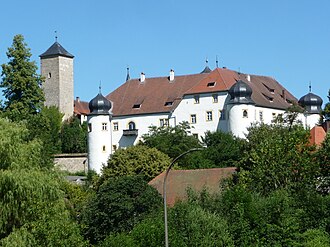
A Castle Standing Through the Centuries
When you first set eyes on Schloss Unteraufseß, you’re greeted by an image that looks as though it has been plucked out of a medieval manuscript: stone walls rising above rolling hills, a sturdy keep that once served as the heart of feudal life, and an aura of enduring history that is impossible to ignore. This castle — more accurately described in its earliest years as a stronghold — has stood watch over the Franconian landscape for nearly a millennium. From its earliest mentions in 12th‑century documents to its present status as an ancestral seat still in the hands of the family that built it, Schloss Unteraufseß embodies the resilience and layered complexity of German history.
Originally constructed as a defensive fortification on a spur overlooking the Aufseß Valley, the earliest parts of the site — including what we today call the bergfried or keep — are believed to date back to the 11th and 12th centuries. From this vantage point, its builders could survey the lush valley below, a landscape that alternated between serenity and volatility depending on the shifting tides of medieval politics and wars. In times of strife, such hilltop strongholds offered sanctuary, and in times of peace, they became symbols of power, lineage, and feudal responsibility.
The Origins of a Noble Line – The House of Aufseß
The name “Aufseß” carries with it a sense of ancient lineage. According to local lore, the noble family that would come to be known as von und zu Aufseß may have roots stretching back to a knight named Ufsaze, who followed King Heinrich II into the Franconian lands in the early 11th century. Whether myth or grounded in historical truth, these early tales speak to the interweaving of familial legend and regional identity — a theme that resonates through the castle’s entire story.
The Aufseß family’s influence was not limited to military power. Over the centuries they produced clergymen, scholars, and cultural patrons. One of the most illustrious members born within the walls of Schloss Unteraufseß was Hans Philipp Werner Freiherr von und zu Aufseß, a 19th‑century antiquarian and the principal founder of the Germanisches Nationalmuseum in Nuremberg. Born into this ancient family, Hans von und zu Aufseß pursued law, history, and cultural preservation with a passion that would leave a mark far beyond the family estate. His portraits hang in the castle’s ancestral hall, a testament to both personal achievement and the enduring legacy of the family name.
The Architectural Evolution – Between Fortress and Palace
Schloss Unteraufseß as seen today is not a single frozen moment in time but a palimpsest of architectural styles and historical layers. Medieval towers mingle with later additions, baroque flourishes speak to periods of peace and cultural patronage, and the very layout of the castle reflects its shifting purpose over centuries. Unlike many structures that were abandoned or fell into ruin, Unteraufseß evolved — rebuilt after wars, enlarged in times of prosperity, and adapted to the needs of its inhabitants.
Throughout its long life, the castle endured the ravages of conflict — from the Hussite invasions of the early 15th century to the ravages of the Thirty Years’ War. Each upheaval left its scars, but also prompted renewal. In 1677, after a particularly destructive period, the castle was comprehensively rebuilt under Christoph Daniel von Aufseß, giving the complex much of its current form. It was at this point that the distinction between Unteraufseß and nearby Oberaufseß became formalized, the latter constructed by a different branch of the family in the wake of intra‑family disputes.
Life Within the Walls – Daily Rhythms of Castle Living
To imagine life inside Schloss Unteraufseß during its medieval heyday is to picture a complex rhythm of social hierarchy, domestic activity, and the constant interplay between the private and public. The keep was not simply a defensive structure; it was a home, a court, and a symbol of authority. Daily life incorporated chores, hospitality, religious observance, and governance of the surrounding lands. Nearby villagers would have looked to the castle not only for protection in times of danger but also as a center of economic and social life.
The castle’s chapel, which stands as one of its most beautiful interior spaces, was the spiritual heart of this life. Its later baroque fittings — including a Rococo‑style stucco ceiling and a columned altar depicting the Crucifixion — speak to the changing tastes and religious sensibilities of the 18th century, long after the initial fortress walls were erected. The chapel’s walls also bear the silent testimonies of family members laid to rest there, engraved in baroque gravestones placed within its sacred interior.
A House of Anecdotes – Legends and Lore
As with many ancient estates, Schloss Unteraufseß is wrapped not only in documents and stone but in stories that have passed through generations. One enduring local legend claims that the family’s heraldic rose originated from an act of chivalry during a tournament in the 11th century. The tale goes that a knight, celebrated for his prowess, rode proudly past the noble spectators and was gifted a rose after bowing in salute — a symbol that was then incorporated into the family crest. Whether this romance of heraldry is factual or folkloric, it has become part of how locals imagine the castle’s early days.
Art, Culture, and Preservation
Beyond its military and residential functions, Schloss Unteraufseß has long served as a repository of art and culture. The Ancestral Hall (Ahnensaal) is perhaps its most poignant cultural space — a room where generations of von Aufseß ancestors are immortalized through portraits, where the legacy of past lives hangs on the walls, and where visitors can feel connected to centuries of family memory. Among these portraits, that of Hans von und zu Aufseß — the museum founder and antiquarian — holds a place of particular honor, reminding present‑day guests that this castle was once both a home and a cradle of cultural ambition.
The castle’s preservation, still under family stewardship, highlights a remarkable continuity rare in Europe, where many noble estates changed hands or were secularized in the tumultuous 19th and 20th centuries. Today, its spaces offer a tangible connection to history, allowing visitors — even if only in guided tours — to step into rooms that have borne witness to centuries of change.
Modern Engagement – Visiting and Learning
Despite its age, Schloss Unteraufseß is not a relic confined to dusty pages of history. It is a living destination where history enthusiasts, cultural travelers, and those fascinated by noble lineage can engage with a place that still breathes. Visits, generally guided and often requiring prior arrangement, provide a rare opportunity to explore interiors that showcase architecture, art, and artifacts spanning eras. Many who have toured the castle speak of its unforgettable ambiance: intimate living quarters, the quiet reverence of the chapel, and the ancestral hall’s silent parade of faces that have shaped the castle’s legacy.
Beyond the castle walls itself, the surrounding Franconian landscape — known as the Fränkische Schweiz — enriches any visit with dramatic natural beauty. Steep limestone formations, deep valleys, and a tapestry of forests and farmland create a backdrop that feels timeless, with hiking paths and scenic roads encouraging slow, contemplative travel.
The Significance Today
To reflect on Schloss Unteraufseß is to contemplate both permanence and impermanence: the permanence of stone structures standing firm for centuries, and the impermanence of individual human lives that came and went within those walls. The castle remains a living chapter of regional and familial history, rooted in the Middle Ages but stretching into modern conversations about preservation, identity, and cultural continuity. (museen.de)
More than just a building, it represents the intersection of power, heritage, and personal narratives — a place where feudal legacies meet cultural aspirations, and where history continues to offer lessons to those willing to explore its stones and stories.
