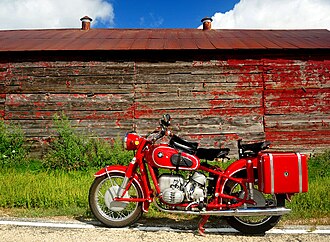
BMW R60/2 – The Pinnacle of Classic Boxer Engineering
The BMW R60/2 stands as one of the most refined and enduring motorcycles produced by BMW during the golden era of post-war motorcycling. Manufactured throughout the 1960s, it represents a perfect synthesis of mechanical reliability, conservative engineering, and functional design philosophy. Unlike machines built purely for speed or style, the R60/2 was engineered as a dependable, long-distance companion capable of handling everything from solo touring to sidecar duty.
This article explores the R60/2 in a comprehensive, blog-style format, analyzing its historical development, engineering systems, mechanical innovations, and long-term legacy in detail.
Historical Background: The Rise of the “/2” Series
The R60/2 belongs to BMW’s famous “/2” series, which marked a period of maturity and refinement rather than experimentation. By the late 1950s and early 1960s, BMW had already established its identity through earlier models such as the R51/3 and R67. The focus had shifted toward improving durability, rider comfort, and mechanical longevity.
Introduced in 1960 as an evolution of the earlier R60 (1956–1960), the R60/2 was part of a broader lineup that included models like the R50/2 and the more performance-oriented R69S. These motorcycles shared a common engineering philosophy but were tailored for different purposes.
The R60/2, in particular, was designed as a versatile machine. It was not intended to be the fastest model in the lineup but rather the most balanced. It was equally capable of solo riding and sidecar use, a critical consideration at the time when motorcycles often served as practical transportation rather than recreational vehicles.
Design Philosophy: Durability Above All
BMW’s engineering philosophy during the development of the R60/2 was rooted in longevity and mechanical integrity. Instead of pursuing high-performance figures, engineers focused on creating a machine that could withstand years of continuous use with minimal maintenance.
This philosophy is evident in the conservative tuning of the engine, the robust frame construction, and the use of proven mechanical systems. Every component was designed with reliability in mind, from the shaft drive to the magneto ignition system.
The R60/2 was built for riders who valued consistency over excitement. It was a machine that could travel long distances, handle varying road conditions, and operate reliably even in less-than-ideal environments.
Engine Architecture: The 594 cc Boxer Twin
At the core of the R60/2 lies its 594 cc air-cooled flat-twin boxer engine. This engine configuration had become synonymous with BMW motorcycles and remained a defining feature of the brand.
The engine used a bore and stroke of approximately 72 mm × 73 mm, resulting in a slightly undersquare design that favored torque and smooth operation over high-revving performance.
With an output of around 30 horsepower at 5,800 rpm, the engine delivered modest but reliable performance. This power level was sufficient for both solo riding and sidecar applications, reinforcing the motorcycle’s versatility.
The horizontally opposed layout provided excellent balance, reducing vibration and contributing to a smooth riding experience. Additionally, the exposed cylinders allowed for effective air cooling, ensuring consistent performance over long distances.
Valvetrain and Internal Engineering
The R60/2 utilized an overhead valve (OHV) design with pushrods and rocker arms. This system was both robust and easy to maintain, aligning with BMW’s emphasis on serviceability.
The camshaft was gear-driven rather than chain-driven, a design choice that reduced wear and eliminated the need for periodic chain replacement. This contributed to the engine’s long-term reliability.
The compression ratio of approximately 7.5:1 reflected the engine’s conservative tuning. While this limited peak performance, it allowed the engine to operate on lower-quality fuels and reduced mechanical stress.
Fuel System and Carburetion
Fuel delivery in the R60/2 was handled by dual Bing carburetors, one for each cylinder. These carburetors were known for their reliability and ease of tuning.
The dual-carburetor setup ensured even distribution of the air-fuel mixture, improving combustion efficiency. Riders could adjust the carburetors relatively easily, making maintenance straightforward.
The fuel system relied on gravity feed, eliminating the need for complex fuel pumps. This simplicity further enhanced reliability and reduced potential failure points.
Lubrication System: Engine Longevity
The R60/2 featured a forced-feed lubrication system powered by a gear-driven oil pump. This system ensured that critical engine components received a consistent supply of oil, even under demanding conditions.
Compared to earlier total-loss systems used in some motorcycles, this recirculating lubrication system significantly improved engine longevity. It also reduced oil consumption and maintenance requirements.
Transmission and Shaft Drive
The transmission system consisted of a four-speed manual gearbox paired with a single-plate dry clutch. This configuration provided smooth and reliable gear changes.
Power was transmitted to the rear wheel via an enclosed shaft drive system, one of BMW’s signature features. Unlike chain drives, the shaft drive required minimal maintenance and was protected from dirt and debris.
The gear ratios were carefully selected to accommodate both solo and sidecar use, with optional configurations available for different applications.
Frame and Structural Design
The R60/2 utilized a twin-loop steel tubular frame, designed for maximum strength and stability. This frame was particularly well-suited for sidecar use, with integrated mounting points.
The rigidity of the frame contributed to predictable handling and durability. It allowed the motorcycle to carry significant loads without compromising structural integrity.
This design reflected BMW’s focus on practicality, as many riders relied on motorcycles as primary transportation.
Suspension System: The Earles Fork Advantage
One of the most distinctive features of the R60/2 was its Earles fork front suspension. Unlike telescopic forks, the Earles fork used a leading-link design with a swingarm and shock absorbers.
This system offered several advantages, particularly for sidecar use. Under braking, the front end would rise slightly rather than dive, improving stability.
Both the front and rear suspension systems used oil-damped shock absorbers, providing a comfortable ride over varying road conditions.
Braking System: Functional but Conservative
The R60/2 was equipped with drum brakes on both the front and rear wheels, each with a diameter of approximately 200 mm.
The front brake used a duplex (double leading shoe) design, which improved braking efficiency compared to simpler drum systems. The rear brake used a simplex design.
While these brakes were effective for the motorcycle’s performance level, they required proper adjustment and maintenance to achieve optimal performance.
Electrical System and Ignition
The electrical system of the R60/2 included a Bosch generator and a magneto ignition system.
The magneto ignition provided reliable spark generation independent of the battery, enhancing reliability. This was particularly important in an era when electrical systems were less dependable.
The simplicity of the electrical system made it easy to maintain and repair, further contributing to the motorcycle’s practicality.
Dimensions, Ergonomics, and Rider Experience
The R60/2 was designed with comfort and usability in mind. Its upright seating position allowed for relaxed riding over long distances.
The motorcycle had a wheelbase of approximately 1,415 mm and a wet weight of around 195 kg. These dimensions provided a stable and predictable ride.
Fuel capacity ranged from 17 liters to an optional 24.6 liters, allowing for extended range between refueling stops.
Performance Characteristics
With a top speed of approximately 145 km/h, the R60/2 offered adequate performance for its intended use. (Wikipedia)
Acceleration was smooth and linear, reflecting the engine’s torque-oriented design. Fuel consumption averaged around 5 liters per 100 km, making the motorcycle relatively efficient.
The R60/2 excelled in long-distance touring and sidecar applications, where stability and reliability were more important than speed.
Production and Market Impact
The R60/2 was produced between 1960 and 1969, with over 17,000 units manufactured. This production volume reflects its popularity and practicality.
It became one of BMW’s most recognizable models and played a significant role in establishing the brand’s reputation for durability and engineering excellence.
Cultural and Enthusiast Legacy
Today, the R60/2 is highly regarded among vintage motorcycle enthusiasts. Its timeless design, mechanical simplicity, and reliability make it a popular choice for restoration and collection.
Many riders appreciate its unique riding experience, which emphasizes smoothness and mechanical connection rather than speed. As one enthusiast described it on Reddit:
“They just float down the road with that motor whirring.”
This sentiment captures the essence of the R60/2—a motorcycle designed not for adrenaline, but for enduring enjoyment.
Technical Parameters Table
| Parameter | Specification |
|---|---|
| Model | BMW R60/2 |
| Production Years | 1960–1969 |
| Engine Type | Air-cooled, 4-stroke, flat-twin (boxer), OHV |
| Displacement | 594 cc |
| Bore x Stroke | 72 mm × 73 mm |
| Compression Ratio | 7.5:1 |
| Power Output | 30 hp @ 5800 rpm |
| Top Speed | ~145 km/h |
| Fuel System | Dual Bing carburetors |
| Lubrication | Forced-feed, gear pump |
| Ignition | Magneto |
| Transmission | 4-speed manual |
| Clutch | Single-plate dry clutch |
| Final Drive | Shaft drive |
| Frame | Twin-loop steel tubular |
| Front Suspension | Earles fork (leading link) |
| Rear Suspension | Swingarm with dual shocks |
| Front Brake | 200 mm drum (duplex) |
| Rear Brake | 200 mm drum (simplex) |
| Wheelbase | ~1415 mm |
| Weight (wet) | ~195 kg |
| Fuel Capacity | 17–24.6 liters |
| Fuel Consumption | ~5 L/100 km |
Final Thoughts: A Machine Built to Last
The BMW R60/2 is not a motorcycle that impresses with extreme performance figures or cutting-edge technology. Instead, it stands as a testament to a different kind of engineering philosophy—one that prioritizes reliability, durability, and long-term usability.
It represents an era when motorcycles were built to serve as dependable transportation, capable of handling real-world demands with minimal fuss. Its enduring popularity among collectors and enthusiasts is a testament to the success of this approach.
