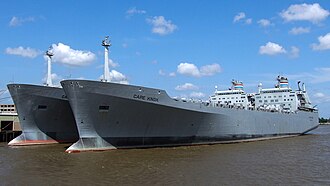
In discussions about military power, the spotlight almost always falls on combat systems. Aircraft carriers dominate headlines, fighter aircraft symbolize technological superiority, and submarines represent stealth and deterrence. Yet behind every successful military deployment lies an enormous logistical infrastructure that receives far less attention. Tanks do not cross oceans on their own. Armored vehicles, engineering equipment, helicopters, ammunition, fuel, and support supplies must all be transported to operational theaters before military forces can perform their missions. This essential responsibility falls largely to strategic sealift vessels, and among these important ships is the MV Cape Knox (T-AKR-5082).
The Cape Knox is one of the key vessels maintained within the United States’ strategic sealift reserve structure. While it lacks the weaponry and visibility associated with front-line warships, its contribution to military readiness is impossible to overstate. The ship exists to ensure that military forces can move their heavy equipment rapidly and efficiently to virtually any location in the world. Whether supporting major combat deployments, multinational exercises, humanitarian relief efforts, or national emergency operations, the Cape Knox serves as a vital link between planning and execution.
Like many ships within the Ready Reserve Force, the Cape Knox began its life in commercial service before being acquired and adapted for government use. Its transformation from a merchant cargo vessel into a strategic military asset reflects broader changes in global shipping, defense planning, and logistical doctrine during the late twentieth century. Over the years, the ship has become part of a carefully maintained reserve fleet capable of responding whenever additional transportation capacity is required.
The story of the Cape Knox is not merely the story of a ship. It is also a story about logistics, preparedness, maritime engineering, and the often-unseen systems that enable military operations on a global scale. Understanding the vessel’s history and role provides valuable insight into one of the most important aspects of modern national defense.
The Importance of Strategic Sealift
Military Power Depends on Logistics
Throughout military history, logistics has often determined the outcome of campaigns more than battlefield tactics alone. Ancient armies depended on supply caravans. Naval empires relied upon merchant fleets. Modern military forces require transportation systems capable of moving enormous quantities of equipment across vast distances.
Today’s armed forces are heavily mechanized. A single armored brigade may require hundreds of vehicles, including tanks, armored personnel carriers, fuel trucks, engineering machinery, maintenance vehicles, communications systems, and support equipment. Transporting such a force by air alone would be extraordinarily expensive and time-consuming.
Sealift provides the solution.
Large cargo ships can move tens of thousands of tons of equipment efficiently across oceans. Strategic sealift vessels make it possible to deploy heavy forces to overseas locations while maintaining the logistical support necessary for sustained operations.
The Cape Knox exists precisely for this purpose. Its mission is not to fight wars directly but to ensure that those who do have the equipment necessary to accomplish their objectives.
The Evolution of American Sealift Capability
The United States has long recognized the importance of maritime transportation. During the Second World War, the country’s ability to produce and transport military equipment across multiple oceans played a decisive role in victory. Lessons learned during subsequent conflicts reinforced the importance of maintaining transportation capacity during peacetime.
By the late twentieth century, defense planners understood that future military operations would require rapid deployments to distant regions. Strategic mobility became a central component of military planning. This led to the development and expansion of the Ready Reserve Force and other sealift programs.
Ships such as the Cape Knox became critical elements within this framework. Their role was to provide surge transportation capability whenever military or national requirements demanded it.
Origins of the Vessel
Construction During an Era of Maritime Growth
The ship that would eventually become Cape Knox was originally constructed during a period of significant growth in global shipping. The 1970s witnessed major advances in maritime transportation technology. Larger vessels, improved cargo handling systems, and increasingly efficient ship designs transformed the commercial shipping industry.
Built in Germany, the future Cape Knox emerged from one of Europe’s highly respected shipbuilding traditions. German shipyards during this era were known for engineering excellence, durability, and innovative approaches to commercial vessel construction.
The ship was designed primarily for cargo transportation, emphasizing reliability, cargo capacity, and operational efficiency. These characteristics made it attractive to commercial operators and later to government planners seeking suitable vessels for strategic sealift roles.
Although originally intended for commercial service, the vessel possessed many features that would later prove valuable in military logistics operations.
Early Commercial Career
Before entering government service, the ship spent years operating within international trade networks. Like countless merchant vessels, it transported cargo between ports, supporting global commerce and economic activity.
Commercial service provided the vessel with extensive operational experience. Long voyages across multiple oceans tested its engineering systems and demonstrated its reliability under demanding conditions. These years established the ship’s reputation as a dependable transportation platform capable of handling complex logistical requirements.
For defense planners evaluating potential sealift assets, such a record was extremely valuable. Proven performance in commercial service often indicates a vessel’s suitability for long-term government use.
The future Cape Knox therefore entered government ownership with a strong foundation of operational credibility.
Transition to Strategic Sealift Service
Acquisition by the United States Government
As sealift requirements expanded, the United States government acquired several commercial vessels suitable for military transportation missions. The future Cape Knox was among those selected.
This acquisition reflected a practical approach to expanding transportation capability. Rather than constructing entirely new ships, the government often found it more efficient to purchase and adapt existing vessels that already possessed the necessary cargo capacity and operational characteristics.
Following acquisition, the ship entered the strategic sealift system and received the name Cape Knox along with the designation T-AKR-5082.
The vessel’s mission changed significantly. Instead of transporting commercial cargo for private customers, it became a national asset dedicated to supporting military readiness and emergency response operations.
Integration Into the Ready Reserve Force
The Cape Knox ultimately became part of the Ready Reserve Force (RRF), a fleet maintained by the Maritime Administration for rapid activation during emergencies.
The Ready Reserve Force represents one of the most important but least visible components of America’s defense infrastructure. Ships within the fleet remain in reduced operating status while undergoing regular maintenance and preservation activities.
This arrangement allows the government to maintain substantial transportation capacity without incurring the expense of continuous operation.
For the Cape Knox, inclusion in the RRF meant becoming part of a strategic reserve capable of supporting military deployments anywhere in the world.
Design and Engineering Features
A Ship Built for Capacity
One of the defining characteristics of the Cape Knox is its cargo-carrying capability. The vessel was designed to transport large volumes of cargo efficiently, making it ideally suited for sealift operations.
Its substantial length and beam provide extensive internal volume. Large cargo decks allow the ship to accommodate military vehicles, containers, support equipment, and various forms of rolling stock. The vessel’s design emphasizes flexibility, enabling it to carry a wide range of cargo types depending on mission requirements.
This versatility is particularly important for military operations, where transportation needs can vary dramatically from one deployment to another.
Roll-On/Roll-Off Operations
Perhaps the most valuable feature of the Cape Knox is its roll-on/roll-off capability.
Traditional cargo handling often relies on cranes to load and unload equipment. While effective, this process can be relatively slow and labor-intensive.
Roll-on/roll-off systems eliminate many of these limitations.
Vehicles can simply be driven aboard using ramps and secured within the ship’s cargo spaces. Upon arrival, they can be driven off just as quickly. This dramatically reduces loading and unloading times while minimizing infrastructure requirements.
For military planners, these advantages are enormous. Rapid cargo operations allow forces to deploy more quickly and efficiently.
The Cape Knox’s extensive vehicle storage areas and internal cargo arrangements make it particularly well suited to this role.
Propulsion and Reliability
A strategic sealift vessel must be dependable above all else. Transportation schedules often operate under tight timelines, and delays can affect broader military operations.
The Cape Knox was built with reliability in mind. Its propulsion systems were designed to support long-distance voyages while carrying substantial cargo loads. The engineering plant emphasizes durability and sustained performance, qualities essential for sealift missions.
Even after decades of service, careful maintenance and modernization efforts have helped preserve the vessel’s operational effectiveness.
The Ready Reserve Force Mission
Maintaining Readiness
Unlike active merchant ships, Ready Reserve Force vessels spend much of their time waiting.
However, this waiting is far from passive.
Maintenance crews conduct inspections, preserve machinery, test systems, and ensure that ships remain capable of rapid activation. Every component of the vessel must be maintained in a condition that allows it to return to service quickly.
For the Cape Knox, readiness is itself the mission.
The ship’s value lies not only in its ability to transport cargo but also in its ability to do so on short notice whenever circumstances require.
Activation Procedures
When activation orders are issued, a carefully coordinated process begins.
Crew members are assembled. Engineering systems are brought online. Safety inspections are completed. Navigation equipment is tested. Cargo operations are planned.
The objective is to transform a reserve vessel into an operational transportation asset within a designated readiness window.
The Cape Knox has participated in numerous readiness exercises designed to verify its ability to meet these requirements. Such exercises ensure that the ship remains prepared for real-world missions.
Supporting Military Operations
Strategic Deployments
The primary purpose of the Cape Knox is supporting military deployments.
Modern military operations often require moving vast quantities of equipment overseas. Heavy vehicles, engineering assets, maintenance facilities, and support systems all depend on transportation.
Sealift vessels provide the capacity necessary to accomplish these movements efficiently.
The Cape Knox contributes to this capability by serving as a floating logistics platform capable of carrying substantial cargo loads across great distances.
Joint and Multinational Exercises
Military readiness depends heavily upon training.
Large-scale exercises frequently involve transporting vehicles and equipment to training areas located far from their home bases. Strategic sealift vessels help make these exercises possible.
By supporting training operations, the Cape Knox indirectly contributes to military preparedness. The vessel helps ensure that forces can practice deployment procedures and maintain readiness for future operations.
Humanitarian Assistance Missions
Although military transportation remains its primary role, the Cape Knox can also support humanitarian relief efforts.
Natural disasters often create urgent transportation requirements. Earthquakes, hurricanes, floods, and other emergencies may overwhelm local infrastructure and disrupt commercial supply chains.
In such situations, strategic sealift vessels can transport emergency supplies, construction equipment, generators, vehicles, and relief materials.
The cargo capacity that makes the Cape Knox valuable for military operations also makes it useful during humanitarian crises.
Life Aboard the Cape Knox
Civilian Mariners
Like many strategic sealift vessels, the Cape Knox is operated primarily by civilian mariners rather than uniformed naval personnel.
These professionals possess extensive maritime expertise. Their responsibilities include navigation, engineering, cargo operations, communications, maintenance, and safety management.
Civilian mariners play a critical role in sustaining America’s sealift capability. Their experience and professionalism ensure that ships remain ready for service whenever needed.
Daily Operations
Even during periods of reserve status, significant work takes place aboard the vessel.
Maintenance activities occur regularly. Machinery must be inspected and preserved. Safety equipment requires testing. Cargo systems need periodic evaluation.
During activation, operational tempo increases dramatically. Crews work long hours preparing the vessel for deployment, conducting cargo operations, and supporting mission requirements.
The result is a highly professional environment focused on reliability and readiness.
Strategic Relevance in the Twenty-First Century
Why Sealift Remains Essential
Despite advances in aviation technology, sealift remains irreplaceable.
Aircraft can transport personnel and certain types of cargo rapidly, but they cannot match the capacity of large cargo ships. Heavy equipment, armored vehicles, and large quantities of supplies continue to depend upon maritime transportation.
This reality ensures the continued relevance of vessels such as the Cape Knox.
As long as military forces require heavy equipment, strategic sealift will remain a cornerstone of military logistics.
Challenges and Opportunities
The sealift community faces several challenges, including aging fleets, infrastructure modernization requirements, and workforce development needs.
At the same time, opportunities exist to improve efficiency through new technologies, enhanced maintenance practices, and updated logistics concepts.
The Cape Knox represents both the legacy and the future of strategic sealift. Its continued service demonstrates the enduring importance of transportation capability within national defense planning.
Legacy of the Cape Knox
Over the years, the Cape Knox has become part of a broader network of ships that quietly support national security. While it may never receive the recognition afforded to aircraft carriers or combat aircraft, its contributions are no less significant.
The vessel embodies a simple but important principle: military power depends upon mobility. Forces cannot operate where they cannot go, and they cannot sustain themselves without transportation.
The Cape Knox helps make that mobility possible.
Its history reflects the evolution of maritime logistics, the value of strategic preparedness, and the enduring importance of sealift within modern defense strategy.
Conclusion
The MV Cape Knox (T-AKR-5082) stands as a powerful reminder that logistics forms the foundation of military capability. While combat platforms may attract public attention, transportation assets enable those platforms to reach operational theaters and sustain their missions.
From its origins in commercial shipping to its role within the Ready Reserve Force, the vessel has demonstrated adaptability, reliability, and strategic value. Its extensive cargo capacity, roll-on/roll-off capabilities, dependable engineering systems, and readiness posture make it an indispensable component of America’s sealift infrastructure.
Whether supporting military deployments, training exercises, humanitarian relief efforts, or national emergency operations, the Cape Knox continues to fulfill a mission of immense importance. It serves quietly, efficiently, and effectively, ensuring that transportation capacity remains available whenever the nation requires it.
In the world of strategic logistics, success is often measured not by visibility but by capability. By that standard, the Cape Knox remains one of the most valuable assets in America’s maritime transportation reserve.
Technical Parameters of MV Cape Knox (T-AKR-5082)
| Parameter | Specification |
|---|---|
| Name | MV Cape Knox |
| Hull Designation | T-AKR-5082 |
| Type | Roll-on/Roll-off Cargo Ship |
| Fleet | Ready Reserve Force (RRF) |
| Owner | U.S. Maritime Administration (MARAD) |
| Operational Role | Strategic Sealift Vessel |
| Original Service | Commercial Cargo Transportation |
| Current Status | Ready Reserve Force Asset |
| Builder | AG Weser Seebeckwerft, Bremerhaven, Germany |
| Year Built | 1970s |
| Length Overall | Approximately 946 ft (288 m) |
| Beam | Approximately 106 ft (32 m) |
| Draft | Approximately 34 ft (10.4 m) |
| Gross Tonnage | Approximately 55,000 GT |
| Deadweight Tonnage | Approximately 26,000–30,000 DWT |
| Cargo Capacity | Tens of thousands of tons |
| Cargo Type | Vehicles, military equipment, containers, rolling stock |
| Cargo Handling System | Roll-on/Roll-off (Ro-Ro) |
| Vehicle Decks | Multiple enclosed cargo decks |
| Propulsion | Diesel engine propulsion system |
| Propeller Configuration | Single screw |
| Maximum Speed | Approximately 18–20 knots |
| Operational Range | Intercontinental |
| Crew Type | Civilian Merchant Mariners |
| Activation Status | Maintained for rapid activation |
| Primary Mission | Military equipment transportation |
| Humanitarian Relief Capability | Yes |
| Aviation Facilities | Limited helicopter support capability |
| Armament | None |
| Strategic Function | Surge sealift and logistics support |
| Managing Agency | U.S. Maritime Administration |
| Readiness Role | National emergency and military deployment support |
