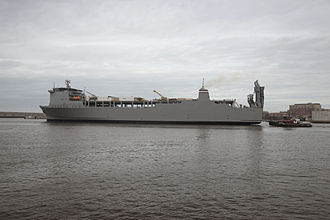
Among the many vessels that make up the United States’ maritime logistics and strategic sealift capability, few have a service history as unique and internationally significant as the MV Cape Ray (T-AKR-9679). At first glance, it appears to be just another roll-on/roll-off cargo ship assigned to the Ready Reserve Force (RRF), quietly moored and maintained in a state of reduced readiness. However, the Cape Ray is far more than a standard transport vessel. It is a ship that has carried out one of the most unusual and politically sensitive maritime missions of the 21st century: the at-sea neutralization of declared Syrian chemical weapons in 2014.
The Cape Ray represents the intersection of commercial maritime engineering, military logistics, and international security cooperation. Built originally as a civilian Ro-Ro vessel in Japan in 1977, the ship later passed through multiple commercial identities before being acquired by the United States Maritime Administration (MARAD) in the early 1990s. After conversion and assignment to the Ready Reserve Force, it became part of America’s surge sealift fleet—designed to provide rapid transportation capacity for military and humanitarian operations worldwide.
But unlike most of its sister ships, the Cape Ray is remembered not only for transporting military cargo, but also for being transformed into a mobile chemical destruction facility operating in international waters. This extraordinary mission placed the vessel at the center of a global non-proliferation effort led by the United Nations and the Organisation for the Prohibition of Chemical Weapons (OPCW).
To understand the Cape Ray fully, one must examine both its conventional role as a sealift ship and its extraordinary moment in history when it became a floating industrial neutralization platform.
Origins and Early Commercial Career
Construction in Japan and Design Philosophy
The MV Cape Ray was built in 1977 by Kawasaki Heavy Industries in Sakaide, Japan, during a period when global shipping was undergoing major technological transformation. According to naval records, the ship was constructed as a roll-on/roll-off (Ro-Ro) cargo vessel, a design optimized for transporting wheeled vehicles and heavy equipment efficiently across long distances.
Ro-Ro ships of this era were engineered around a simple but powerful logistical principle: minimize cargo handling time. Instead of relying on cranes and palletized loading systems, vehicles could be driven directly onto the ship via stern or side ramps, parked on internal decks, and secured for sea transport. This approach significantly reduced port turnaround time and improved operational efficiency for commercial operators.
Originally delivered under the name MV Seaspeed Asia, the vessel entered service within international commercial shipping networks. Its design reflected the global demand for large-scale vehicle transport and industrial cargo movement that characterized the late 20th century.
Multiple Identities in Commercial Service
Like many large Ro-Ro vessels, the ship changed ownership and names several times during its commercial career. It was later known as MV Saudi Makkah and eventually operated under other commercial arrangements before acquisition by the United States. (Wikipedie)
These transitions were typical of the global shipping industry, where vessels frequently move between operators depending on economic conditions, charter agreements, and fleet restructuring. Despite these changes, the ship maintained its core operational identity as a high-capacity vehicle carrier capable of long-range ocean voyages.
What distinguished this vessel was its durability and adaptability. Its robust hull design, efficient internal cargo system, and reliable propulsion machinery allowed it to remain commercially viable for nearly two decades before its transition into government service.
Acquisition by the United States and Transition to Military Role
Entry into MARAD Ownership
The United States Maritime Administration acquired the vessel in the early 1990s as part of a broader initiative to expand strategic sealift capacity following the end of the Cold War. The geopolitical environment of the time emphasized rapid deployment capability, particularly for expeditionary military operations and crisis response scenarios.
On 17 December 1994, the ship formally entered the Ready Reserve Force (RRF) under the designation MV Cape Ray (T-AKR-9679).
This marked a major shift in its operational purpose. The vessel transitioned from commercial freight service to a government-owned strategic asset intended to support U.S. military logistics worldwide.
Conversion and Military Adaptation
Following acquisition, the Cape Ray underwent modifications to adapt it for military sealift operations. These changes included reinforcement of vehicle decks, installation of military-compatible cargo securing systems, and updates to communications and navigation equipment.
The vessel was placed under a reduced operating status (ROS) arrangement, meaning it would be maintained in reserve but capable of activation within a short timeframe. In this condition, the ship is supported by a small caretaker crew while undergoing continuous maintenance to ensure readiness.
The goal of this system is simple: maintain a fleet of ships that can be activated quickly in the event of military emergencies, without the cost of keeping them fully crewed and operational at all times.
Technical Design and Engineering Characteristics
Dimensions and Cargo Capacity
The MV Cape Ray is a large Ro-Ro vessel with dimensions typical of strategic sealift ships designed for heavy military logistics:
- Length: approximately 648 feet (197.5 meters)
- Beam: approximately 105 feet (32 meters)
- Draft: approximately 32–33 feet (10 meters)
- Full load displacement: around 32,000–35,000 tons
These dimensions allow the ship to carry large volumes of wheeled and tracked military equipment while maintaining stability and ocean-going performance.
The vessel provides extensive cargo deck space—over 130,000 square feet in total—allowing it to transport entire unit sets of military vehicles in a single voyage.
Propulsion and Performance
The Cape Ray is powered by two Kawasaki-MAN diesel engines driving a single shaft, a configuration chosen for efficiency and reliability.
Key performance characteristics include:
- Maximum speed: approximately 19–20 knots
- Propulsion: twin diesel engines, single propeller
- Operational range: intercontinental deployment capability
While not designed for speed comparable to naval combat ships, the vessel prioritizes fuel efficiency, endurance, and mechanical reliability—essential characteristics for strategic logistics missions spanning thousands of nautical miles.
Cargo Handling and Ro-Ro Systems
The defining feature of the Cape Ray is its roll-on/roll-off cargo system, which allows vehicles to be driven directly onto the ship via ramps and stored on multiple internal decks.
The ship is capable of transporting:
- Armored vehicles (tanks and APCs)
- Military trucks and trailers
- Engineering and construction equipment
- Containerized support cargo
- Specialized mission systems
This flexibility makes the vessel highly valuable for military deployment scenarios, where entire combat units must be moved rapidly and efficiently.
Role in the Ready Reserve Force
Strategic Sealift Function
The Ready Reserve Force is a critical component of U.S. military logistics, designed to provide surge sealift capacity when required. Ships like the Cape Ray are kept in a reduced readiness state but can be activated within a few days.
Typical readiness conditions include:
- Minimal caretaker crew during standby
- Regular maintenance and inspection cycles
- Preservation of propulsion and cargo systems
- Activation readiness testing
The Cape Ray is typically stationed in Portsmouth, Virginia, where it has been maintained for most of its operational reserve life. (navysite.de)
Activation Capability
When activated, the ship transitions rapidly into full operational status:
- Full civilian crew is mobilized
- Engineering systems are brought online
- Cargo operations are prepared
- Navigation systems are tested
- Mission-specific equipment is installed if required
The vessel is typically capable of full activation within approximately five days, making it a reliable surge asset for military planners.
The Syrian Chemical Weapons Neutralization Mission (2014)
Selection for an Extraordinary Mission
The defining moment in the Cape Ray’s history came in 2014, when it was selected for a mission unlike any other in maritime logistics history: the destruction of Syria’s declared chemical weapons stockpile at sea.
Following international agreement under the OPCW framework, the United States proposed using a mobile neutralization system installed aboard a ship to eliminate chemical agents in international waters.
The Cape Ray was chosen due to its size, stability, and cargo-handling capabilities.
Conversion into a Floating Chemical Processing Facility
In late 2013, the vessel was rapidly modified to carry Field Deployable Hydrolysis Systems (FDHS)—mobile chemical processing units designed to neutralize toxic chemical agents.
These systems were installed onboard within a matter of weeks, transforming the Cape Ray into a floating industrial chemical treatment plant capable of safely processing hazardous materials.
This conversion included:
- Installation of specialized containment modules
- Reinforced chemical handling systems
- Safety and environmental monitoring equipment
- Enhanced ventilation and filtration systems
Execution of the Mission
In mid-2014, chemical agents were transferred from supporting vessels, including the Danish ship MV Ark Futura, to the Cape Ray in the Mediterranean Sea under international supervision.
Once loaded, the ship proceeded into international waters, where the hydrolysis systems began processing the chemicals.
Over approximately six weeks, the Cape Ray neutralized hundreds of metric tons of chemical warfare agents, including precursors for nerve agents and mustard gas components. The process converted these hazardous substances into less dangerous industrial effluents, which were later transferred to shore-based facilities for final disposal.
The mission concluded successfully, marking one of the most significant maritime non-proliferation operations in modern history.
Post-Mission Service and Continued Strategic Role
Following its return from the Mediterranean in late 2014, the Cape Ray resumed its role within the Ready Reserve Force. It continued to serve as a surge sealift asset capable of supporting military and humanitarian operations.
The ship has since been periodically evaluated through readiness exercises designed to test activation timelines, engineering reliability, and cargo handling performance.
These evaluations ensure that the vessel remains capable of fulfilling its logistical mission even decades after its original construction.
Strategic Importance of MV Cape Ray
Why the Ship Matters
The Cape Ray represents more than a transportation platform. It demonstrates the versatility of maritime logistics systems and the ability to repurpose commercial vessels for highly specialized missions.
Its significance can be summarized in three key roles:
- Strategic Sealift Asset – transporting military equipment globally
- Rapid Response Platform – supporting contingency deployments
- Special Mission Vessel – proven capability in chemical neutralization operations
Broader Defense Implications
The success of the Cape Ray’s 2014 mission also demonstrated that maritime platforms can be adapted for complex international security tasks beyond traditional logistics. This has influenced discussions about future hybrid-use vessels capable of supporting environmental, humanitarian, and security missions simultaneously.
Conclusion
The MV Cape Ray (T-AKR-9679) occupies a unique place in maritime and military history. Built as a commercial Ro-Ro vessel in Japan in 1977, it later became part of the United States Ready Reserve Force and evolved into a strategic sealift asset supporting global military logistics.
Its most remarkable achievement came in 2014, when it was transformed into a mobile chemical neutralization facility and successfully contributed to the destruction of Syria’s declared chemical weapons stockpile under international supervision.
Today, the Cape Ray stands as a symbol of adaptability in maritime engineering and strategic logistics. It demonstrates how commercial vessels can be repurposed for critical national and international missions, bridging the gap between transportation infrastructure and global security needs.
In the broader story of naval logistics, the Cape Ray is a reminder that some of the most important ships are not those that fight wars—but those that make it possible to prevent them.
Technical Parameters of MV Cape Ray (T-AKR-9679)
| Parameter | Specification |
|---|---|
| Name | MV Cape Ray |
| Hull Number | T-AKR-9679 |
| Original Name | MV Seaspeed Asia |
| Other Names | MV Saudi Makkah |
| Type | Roll-on/Roll-off Cargo Ship |
| Builder | Kawasaki Heavy Industries, Japan |
| Year Built | 1977 |
| Acquisition by MARAD | 1994 |
| Operator | U.S. Maritime Administration (MARAD) |
| Fleet | Ready Reserve Force (RRF) |
| Length | 648 ft (197.5 m) |
| Beam | 105 ft (32 m) |
| Draft | ~32–33 ft (10 m) |
| Displacement | ~32,000–35,000 tons |
| Propulsion | 2 diesel engines, single shaft |
| Propellers | 1 |
| Maximum Speed | ~19–20 knots |
| Cargo Type | Military vehicles, equipment, containers |
| Cargo System | Roll-on/Roll-off ramps |
| Special Capability | Field Deployable Hydrolysis System (2014 mission) |
| Crew (Reserve) | Small caretaker crew |
| Crew (Activated) | Expanded civilian mariner crew |
| Activation Time | ~5 days |
| Primary Mission | Strategic sealift and military logistics |
| Notable Operation | Syrian chemical weapons neutralization (2014) |
| Status | Ready Reserve Force / retention support status |
_at_Norfolk_VA_in_2014.JPG)