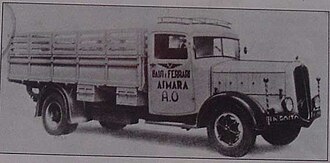
Alfa Romeo 350: The Italian Heavy Truck That Helped Define Alfa Romeo’s Commercial-Vehicle Era
The Alfa Romeo 350 occupies an intriguing place in the history of one of Italy’s most famous automotive manufacturers. Today, Alfa Romeo is overwhelmingly associated with sporting automobiles, elegant grand tourers and motorsport, but the company spent much of the twentieth century producing a surprisingly diverse range of commercial vehicles. Trucks and buses were an important part of Alfa Romeo’s industrial activities, particularly during periods when Italy needed reliable domestic transportation equipment for civilian infrastructure, industry and military logistics. Among these vehicles, the 350 represents an important stage in the company’s development of increasingly capable heavy trucks.
Introduced during the 1930s, the Alfa Romeo 350 was designed for demanding transportation work at a time when European truck manufacturers were rapidly improving diesel technology, chassis construction and payload capacity. It belonged to a generation of Alfa Romeo commercial vehicles that followed earlier projects such as the Alfa Romeo 50, 80 and 85. While those earlier trucks helped the company gain experience in the heavy-vehicle sector, the 350 represented a more mature approach to commercial transportation. It offered a substantially stronger platform and could be adapted to different applications, making it useful for freight operations as well as specialist and military work.
The Alfa Romeo 350 is particularly interesting because it appeared during one of the most complicated periods in European automotive history. The 1930s were characterized by rapid industrialization, growing state involvement in manufacturing and increasing military preparation. Trucks were becoming strategically important because modern armies required enormous quantities of motor transport, while civilian economies were also becoming more dependent on road freight. The 350 therefore belongs to a period when commercial trucks were evolving from simple cargo carriers into highly specialized industrial machines.
The Origins of the Alfa Romeo 350
Alfa Romeo’s Growing Truck Ambitions
Alfa Romeo’s involvement in truck production had begun earlier in the decade. The company’s first major heavy-truck experiments were strongly influenced by German engineering, particularly through cooperation with Büssing and Deutz. The Alfa Romeo 50 provided the company with valuable experience, but its limited production demonstrated that entering the truck market would not be easy.
The subsequent Alfa Romeo 80 and 85 continued the company’s development of commercial vehicles. These trucks gave Alfa Romeo greater experience with multi-axle chassis, diesel engines and heavy-duty drivetrains. The 350 emerged from this continuing effort to create a broader and more competitive commercial-vehicle range.
The company’s objective was not simply to build a truck that could carry a large load. It needed a platform that could be adapted to different bodies and operating conditions. A commercial chassis could potentially serve as a general freight truck, a military carrier, an engineering vehicle or the foundation for specialist equipment. This flexibility was particularly valuable in a period when vehicle production volumes were much smaller than those of modern commercial-vehicle manufacturers.
The Italian Truck Market of the 1930s
The Alfa Romeo 350 entered a highly competitive Italian market. Fiat had established a strong presence in commercial vehicles, while Lancia and other manufacturers were also developing trucks for civilian and military use. Alfa Romeo therefore had to differentiate its products through engineering capability and build quality.
Government policy also played an important role. Italy was increasingly focused on developing domestic industrial capacity, and road transportation was essential to both economic and military objectives. Trucks were needed for construction, agriculture, logistics and industrial production, while the armed forces required vehicles capable of transporting personnel and supplies.
The 350 was therefore developed in a market where a successful truck could have significance far beyond ordinary commercial sales. A manufacturer that secured government or military contracts could potentially achieve production volumes that would be difficult to obtain from the civilian market alone.
Engineering and Construction
A Purpose-Built Heavy-Duty Chassis
The Alfa Romeo 350 was designed as a substantial commercial vehicle, with a heavy-duty chassis intended to support significant loads and withstand demanding operating conditions. The frame was built around the traditional ladder-frame principle used by many heavy trucks of the period.
A ladder frame provides a strong foundation for the engine, transmission, axles and body while allowing the truck manufacturer or body builder to install different cargo configurations. This was particularly important in the 1930s because commercial trucks were often sold as chassis-cab vehicles that could then receive bodies suited to the customer’s requirements.
The frame also had to absorb forces generated by uneven roads and heavy payloads. Unlike a passenger car, a truck’s chassis is repeatedly subjected to high loads during braking, acceleration and cornering. It must also tolerate the twisting forces generated when one wheel or axle encounters a significant bump or depression.
Multi-Axle Capability
The Alfa Romeo 350 was associated with a multi-axle heavy-truck configuration, giving it greater load-distribution capability than smaller two-axle vehicles. Adding an axle allowed engineers to distribute the truck’s mass over more wheels, reducing the load carried by each individual tire and axle.
This was especially valuable as payloads increased. A truck carrying several tonnes of cargo could impose significant stress on its suspension and tires, so spreading the weight over additional axles improved durability and stability.
Multi-axle trucks were also becoming increasingly important for military transportation. Armies needed vehicles capable of carrying heavier equipment without exceeding axle-load limits, and the additional axle provided a practical way to increase capacity.
The Engine of the Alfa Romeo 350
Diesel Technology for Heavy Transportation
Like many serious commercial trucks of its period, the Alfa Romeo 350 was associated with diesel power. Diesel engines were becoming increasingly attractive for heavy vehicles because they offered strong low-speed torque and good fuel economy compared with contemporary gasoline engines.
The engine characteristics of the era were very different from those of modern commercial vehicles. Large displacement was common, while operating speeds were relatively low. Engineers prioritized durability and sustained pulling power rather than maximum horsepower per litre.
For the driver of a heavily loaded truck, this was exactly what mattered. A truck climbing a steep road needed an engine that could maintain forward motion at low speed. It did not need the ability to accelerate rapidly to highway speeds.
The Alfa Romeo 350’s engine therefore formed part of a broader philosophy in which reliability and torque were more important than outright performance. Large mechanical components, conservative operating speeds and robust construction were common features of commercial engines during this period.
Engine and Drivetrain Balance
A heavy truck is only as effective as the relationship between its engine, gearbox and axles. Producing more engine power does not automatically make a truck better if the transmission cannot use that power effectively.
The Alfa Romeo 350 relied on a conventional manual transmission, requiring the driver to select the appropriate gear according to road conditions and vehicle load. The low-speed torque characteristics of the diesel engine meant that choosing the right ratio was critical when climbing hills or moving away with a heavy load.
This mechanical simplicity also had practical advantages. There were no electronic systems to diagnose and no automated gearbox controls to fail. Repairs could be performed using mechanical knowledge and conventional tools, an important consideration for vehicles operating away from major service facilities.
Applications of the Alfa Romeo 350
Freight and Industrial Transportation
One of the primary purposes of a truck such as the Alfa Romeo 350 was general freight transportation. During the 1930s, road transport was expanding rapidly, and trucks were increasingly being used to move goods directly between factories, warehouses, farms and markets.
The 350’s substantial chassis allowed it to carry larger loads than Alfa Romeo’s lighter commercial vehicles. It could therefore be used by industrial operators and transport companies that needed a heavy-duty platform.
The truck could also accommodate different cargo bodies. This allowed operators to select a configuration appropriate for their particular business rather than being limited to a single factory-installed body.
Military Logistics
Military logistics was another potentially important application. Trucks were becoming indispensable to modern armed forces because armies could no longer depend entirely on railways and animal transport.
A heavy truck could transport ammunition, fuel, food, spare parts and engineering equipment. It could also be adapted for specialist military purposes, making a versatile chassis especially valuable.
The Alfa Romeo 350 was developed during a period when Italy was preparing for increasingly demanding military operations, and Alfa Romeo’s commercial-vehicle activities were inevitably influenced by those requirements. Even when a specific model did not achieve the same production volume as a major standardized military truck, its development reflected the broader strategic importance of domestic truck manufacturing.
The Alfa Romeo 350 and Italian Industrial Development
More Than an Automobile Manufacturer
The history of the Alfa Romeo 350 helps illustrate how different Alfa Romeo was from the image most people have today. The company was not simply a producer of sports cars. It was a broad engineering organization involved in aircraft engines, commercial vehicles, buses and other industrial projects.
Truck manufacturing was particularly important because commercial vehicles could provide a different type of revenue and production experience from luxury automobiles. A truck manufacturer had to understand durability, mass production, standardized components and long-term operating costs.
This industrial knowledge would become increasingly valuable as Alfa Romeo expanded its commercial-vehicle range. Trucks and buses required the company to think about engineering in terms of fleet operation rather than individual customer appeal.
The Role of the 350 in Alfa Romeo’s Truck Family
The 350 should therefore be viewed as part of a progression rather than as an isolated model. The Alfa Romeo 50 introduced the company to heavy commercial vehicles, while models such as the 80 and 85 helped develop its understanding of larger chassis and diesel power.
The 350 represented a move toward a more substantial commercial-vehicle range. It demonstrated Alfa Romeo’s ambition to compete in heavier categories and provided experience that would influence subsequent truck models.
Later Alfa Romeo commercial vehicles would become more numerous and more sophisticated, eventually extending into post-war production and covering a wide variety of weight classes and applications.
Driving a Truck From the 1930s
A Very Different Experience
Driving the Alfa Romeo 350 would have been a dramatically different experience from operating a modern truck. There would have been no power steering, electronic driver assistance, automated transmission or modern cabin insulation.
The driver had to understand the mechanical behavior of the vehicle and anticipate road conditions. Gear selection was manual, braking required greater physical effort, and steering a large truck demanded considerable concentration.
Road conditions themselves also imposed greater demands. Many roads were unpaved or poorly surfaced, and even major routes lacked the smoothness and consistency expected today. A truck had to be mechanically strong enough to withstand constant vibration and impacts.
This explains why early commercial vehicles were often built with large safety margins. Components could be heavy and over-engineered by modern standards, but that extra material helped them survive environments where maintenance opportunities were limited.
The Legacy of the Alfa Romeo 350
A Forgotten but Important Truck
The Alfa Romeo 350 is not among the company’s most famous historical vehicles, and detailed information about individual configurations is considerably harder to find than information about Alfa Romeo’s passenger cars. Nevertheless, the truck is important because it represents the company’s continuing development of commercial-vehicle engineering during a crucial period.
It belongs to the same historical family as the 50, 80 and 85, showing how Alfa Romeo gradually expanded its expertise in heavy transportation. The company’s truck program would eventually become a significant part of its industrial identity.
The 350 also demonstrates how technological development occurs through successive generations. Engineers rarely create a mature heavy truck from nothing. They learn from earlier chassis, engines, transmissions and customer requirements, then apply that knowledge to later products.
From Early Diesels to a Broader Commercial Range
The experience gained from trucks such as the 350 contributed to Alfa Romeo’s eventual ability to produce larger and more specialized commercial vehicles. Later models would feature more powerful engines, improved chassis and greater payload capacities, while Alfa Romeo also became involved in bus and trolleybus production.
The commercial-vehicle division survived major changes in the European automotive industry and continued evolving well beyond the 1930s. The early trucks therefore deserve recognition as the starting point of a much larger industrial story.
Alfa Romeo 350 Technical Specifications
Historical information about the Alfa Romeo 350 is less complete than for many later Alfa Romeo vehicles, and specifications can differ between sources and configurations. The following table summarizes representative information associated with the model and should not be treated as a modern factory specification sheet.
| Specification | Alfa Romeo 350 |
|---|---|
| Manufacturer | Alfa Romeo |
| Country | Italy |
| Era | 1930s |
| Vehicle type | Heavy commercial truck |
| Engine | Diesel, model-dependent historical specification |
| Engine configuration | Six-cylinder diesel on commonly documented versions |
| Fuel | Diesel |
| Transmission | Manual |
| Drive layout | Rear-wheel drive |
| Axle configuration | Multi-axle heavy-truck configuration |
| Chassis | Heavy-duty ladder frame |
| Intended applications | Freight, industrial transport and military logistics |
| Body types | Cargo and specialist body configurations |
| Steering | Conventional mechanical steering |
| Braking | Mechanical-era heavy-vehicle braking system |
| Production | Limited historical production |
| Primary design priority | Payload, durability and commercial versatility |
Conclusion
The Alfa Romeo 350 represents a fascinating chapter in the history of a company better known today for performance cars than for heavy trucks. Developed during the 1930s, it formed part of Alfa Romeo’s expanding commercial-vehicle program and demonstrated the company’s determination to become a broader industrial manufacturer.
Its heavy-duty chassis, diesel power and multi-axle configuration were products of a period when trucks were undergoing rapid development. The demands of freight transportation, industrialization and military logistics were pushing manufacturers toward vehicles that could carry greater loads, operate for longer periods and survive increasingly demanding conditions.
Although the 350 never achieved the worldwide fame of an Alfa Romeo sports car, its historical importance should not be underestimated. It represents the engineering experience that allowed Alfa Romeo to continue developing trucks and buses for decades. The model also provides an interesting contrast to the lightweight, high-performance automobiles that have shaped the company’s modern reputation.
Looking at the Alfa Romeo 350 today is therefore a reminder that automotive history is rarely as simple as a brand’s modern image suggests. Alfa Romeo was once a diverse engineering company involved in many forms of transportation, and the 350 was one of the heavy-duty machines that helped build that legacy. For enthusiasts interested in forgotten commercial vehicles, it offers a fascinating glimpse into an era when Italian automotive engineering was expanding rapidly and the humble truck was becoming an essential part of modern industrial life.
