Alfa Romeo 430: The Italian Truck That Bridged War and Postwar Transportation
When the name Alfa Romeo appears in an automotive history book, it is usually accompanied by images of elegant sports cars, racing machines and beautifully proportioned grand tourers. Yet the history of the Milanese manufacturer is considerably broader than its famous passenger cars suggest. During the first half of the twentieth century, Alfa Romeo developed a substantial commercial-vehicle program that included trucks, buses and specialized vehicles. Among the most historically interesting of these was the Alfa Romeo 430, a medium-duty truck introduced during the Second World War and subsequently adapted for civilian transportation in the difficult years that followed.
The Alfa Romeo 430 is particularly significant because it was born from the circumstances of wartime Italy but survived into the postwar reconstruction period. Production ran from approximately 1942 to 1950, and the vehicle was initially developed in its military form as the 430 RE before becoming available as a commercial truck after the war. It was rated as a five-tonne vehicle and used a 5.8-liter four-cylinder diesel engine producing around 80 horsepower. A four-speed transmission combined with a two-speed transfer gearbox gave the truck a drivetrain suited to both road transportation and demanding operating conditions.
The 430 therefore occupies an unusual position in Alfa Romeo history. It was not a glamorous sports car, nor was it simply a military vehicle that disappeared when the war ended. Instead, it became part of the company’s transition from wartime production to peacetime commercial transportation. Its story provides an excellent illustration of how automotive manufacturers adapted existing technology to radically changing economic circumstances.
The Origins of the Alfa Romeo 430
From Alfa Romeo’s Earlier Trucks to the 430
The Alfa Romeo 430 was the product of more than a decade of experience in commercial-vehicle engineering. Alfa Romeo had entered the heavy-truck field in the early 1930s, initially using designs influenced by German manufacturers such as Büssing. Models including the Alfa Romeo 50, 80, 85 and 350 progressively expanded the company’s knowledge of diesel engines, heavy chassis construction and commercial transportation.
By the late 1930s, however, the environment in which Italian truck manufacturers operated had changed considerably. The government was interested in standardizing truck designs so that civilian vehicles could be adapted for military service if required. The Alfa Romeo 430 emerged within this broader concept of standardized Italian commercial vehicles. The 1937 regulations established categories for unified trucks, with the intention of making civilian production more useful for national mobilization.
This approach had obvious advantages. Instead of maintaining completely separate civilian and military truck designs, manufacturers could produce vehicles with common mechanical foundations. In a national emergency, existing commercial vehicles could potentially be requisitioned or adapted for military logistics. For Alfa Romeo, this provided a framework in which a relatively compact five-tonne truck could serve several purposes.
The 430 RE Military Version
The earliest 430s were associated with the military designation 430 RE and were used by the Italian Royal Army during the Second World War. Historical sources describe the model as being based on the larger Alfa Romeo 800, which had entered production shortly before it.
The relationship with the 800 is significant because Alfa Romeo was developing a family of commercial vehicles rather than isolated designs. Components and engineering concepts could be adapted between vehicles of different sizes, allowing the company to make better use of its manufacturing resources.
The 430’s relatively compact dimensions also made it useful for military transport. A five-tonne truck could carry substantial quantities of supplies without becoming as large or cumbersome as the heaviest military vehicles. Its chassis could also be adapted for specialist applications, something that became particularly important during the war.
Design and Appearance
A Functional Cab-Over-Engine Layout
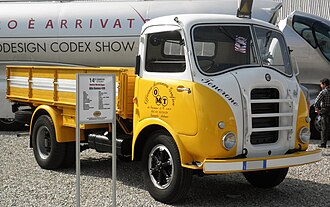
The Alfa Romeo 430 looked very different from the sleek passenger cars with which the manufacturer is now associated. Its design was dictated almost entirely by practical requirements. The truck featured a compact two-place cab and a forward-control configuration that helped maximize the usable length of the chassis.
Historical descriptions identify a short two-seat cab with doors that opened in the opposite direction to conventional modern truck doors. The front grille featured three horizontal bars, while the bumper was divided into two sections.
These details give the 430 a distinctly utilitarian appearance. The bodywork was not intended to create a fashionable image; instead, the cab had to provide the driver with a functional working environment while keeping the vehicle’s overall dimensions under control.
The cab-over approach also had practical advantages for military and urban transportation. By placing the driver closer to the front of the vehicle, designers could obtain a relatively long cargo area without requiring an excessively long wheelbase.
Built as a Versatile Platform
The 430 was not restricted to a single body style. Sources describe versions including a chassis, flatbed truck and tractor for road-train applications. The vehicle used a 4×2 axle configuration, with the rear wheels providing propulsion.
This flexibility was important because commercial trucks were often sold as chassis that could receive bodies according to the customer’s requirements. A flatbed could be used for general cargo, while a specialized body could transform the same basic vehicle into a completely different working machine.
The military version could likewise be adapted to specific roles. Some examples were converted into anti-aircraft vehicles carrying a 20 mm IF Scotti weapon, demonstrating that the 430 chassis had sufficient capacity to support equipment beyond ordinary cargo transportation.
The Alfa Romeo 430 Engine
A 5.8-Liter Four-Cylinder Diesel
The heart of the Alfa Romeo 430 was its 5,816 cc diesel engine. Unlike many large trucks of the period that used six- or eight-cylinder engines, the 430 employed a four-cylinder unit. It produced approximately 80 horsepower at 2,000 rpm.
At first glance, 80 horsepower seems extremely modest for a five-tonne truck. However, engine technology during the 1940s was very different from today’s. Diesel engines were designed to operate at comparatively low speeds, and their value came primarily from torque, durability and fuel economy rather than impressive specific power.
The relatively large 5.8-liter displacement allowed the four-cylinder engine to provide useful pulling power without requiring high engine speeds. This was particularly appropriate for a vehicle expected to carry heavy loads over imperfect roads.
The engine’s characteristics also helped define the 430’s driving style. The truck was not intended to accelerate rapidly or cruise at modern highway speeds. Instead, the driver would use the available torque carefully, selecting suitable gears and maintaining steady momentum.
Performance for Its Era
With approximately 80 horsepower, the Alfa Romeo 430 could reach a reported maximum speed of around 65 km/h. Its range was approximately 390 kilometers according to commonly cited historical specifications.
A 65 km/h top speed was entirely reasonable for a medium-duty truck of the early 1940s. Road infrastructure was considerably less developed than it is today, and heavy trucks were not expected to maintain the high cruising speeds associated with modern freight transportation.
The range figure was also useful for military logistics. A vehicle capable of traveling several hundred kilometers before refueling could perform meaningful transport missions without constant stops, although actual range would naturally depend on payload, road conditions, fuel consumption and driving style.
Transmission and Drivetrain
Four-Speed Gearbox With Two-Speed Transfer Gear
The 430 was equipped with a four-speed manual transmission combined with a two-speed transfer gearbox.
The additional transfer gearing is an interesting feature because it gave the truck greater flexibility than a simple four-speed road gearbox would have provided. Different ratios could be selected according to operating conditions, allowing the vehicle to balance road speed against pulling power.
For a loaded truck, low gearing is extremely valuable. A five-tonne vehicle climbing a steep gradient needs considerably more wheel torque than it does while cruising on level ground. The driver could therefore use the drivetrain’s lower gearing when necessary and return to higher gearing for normal road travel.
This mechanical arrangement also reflects the engineering philosophy of the era. Instead of relying on electronic control systems, the 430 gave the driver direct mechanical control over the truck’s power delivery.
The Alfa Romeo 430 During the Second World War
Military Logistics
The Second World War placed enormous demands on military transportation. Armies required trucks to move ammunition, food, fuel, personnel and equipment, and the effectiveness of these logistical networks could have a direct influence on military operations.
The Alfa Romeo 430 RE was therefore part of a much larger system. Its five-tonne capacity made it useful for carrying substantial quantities of supplies, while its relatively compact size allowed it to operate in situations where a larger heavy truck might have been less convenient.
Its use by the Regio Esercito illustrates the importance of domestic truck production to wartime Italy. Manufacturers were expected to produce vehicles that could meet military requirements while using resources efficiently.
Anti-Aircraft Conversions
One of the more unusual chapters in the 430’s history concerns its conversion into an anti-aircraft platform. Some vehicles were fitted with a 20 mm IF Scotti automatic weapon, transforming the ordinary transport truck into a mobile anti-aircraft vehicle.
This adaptation demonstrates the versatility of the chassis. A truck capable of carrying five tonnes of cargo had enough structural capacity to support additional military equipment, personnel and ammunition.
Such conversions were common in wartime because military organizations needed to make maximum use of existing vehicles. Instead of developing a completely new specialized chassis, an existing truck could be modified to perform a new task.
The 430 After the War
From Military Truck to Civilian Workhorse
Perhaps the most interesting aspect of the Alfa Romeo 430 is what happened after 1945. Many wartime vehicles quickly became obsolete or were retired as military requirements changed. The 430, however, found a second life in civilian transportation.
After the war, Italy faced the enormous task of rebuilding its infrastructure and economy. Roads, factories, farms, construction companies and logistics operators all needed practical transportation equipment. A five-tonne truck that was already in production could therefore be extremely useful.
Alfa Romeo continued producing the 430 in commercial form after the war, and both military and civilian versions remained in production until approximately 1950.
The truck was available with an open cargo platform and as a tractor for articulated or road-train applications. This allowed the same basic mechanical design to participate in the growing postwar freight economy.
An Important Transitional Vehicle
The postwar 430 can therefore be regarded as a transitional vehicle. Its engineering originated in the wartime period, but its later career belonged to a very different Italy.
The country was moving toward industrial modernization, urbanization and increasing road freight. Trucks would soon become more sophisticated, faster and more comfortable. The 430 still possessed the mechanical simplicity of an earlier era, but it could perform useful work during the crucial reconstruction years.
Its continued production demonstrates how valuable established mechanical designs could be during periods of economic difficulty. Manufacturers did not necessarily need to introduce an entirely new truck immediately; existing platforms could continue generating useful transportation capacity while newer designs were being developed.
Dimensions and Practicality
Compact by Heavy-Truck Standards
Published specifications give the Alfa Romeo 430 a length of approximately 5.955 meters, a width of around 2.130 meters and a height of approximately 2.580 meters. Its listed empty weight is around 3,350 kilograms, while its maximum loaded weight was approximately five tonnes.
These dimensions help explain why the truck was considered a medium-duty vehicle rather than one of Alfa Romeo’s largest trucks. It was substantial enough to carry a useful commercial payload but compact enough to remain maneuverable.
The relatively short overall length was particularly useful when the vehicle was configured as a rigid cargo truck. In military conditions, compact dimensions could make it easier to operate on narrow roads and in confined areas. In civilian work, the same characteristics would have helped the truck navigate urban streets and loading areas.
The Alfa Romeo 430 Compared With Earlier Alfa Trucks
A More Mature Commercial Design
Compared with the early Alfa Romeo 50, the 430 represented a different stage in the company’s commercial-vehicle development. The 50 had been a large, relatively slow truck influenced heavily by German design, while the 430 was a more compact and standardized vehicle intended to fit the requirements of a changing Italian truck market.
The 430 also reflected Alfa Romeo’s increasing familiarity with diesel power and commercial chassis engineering. Its four-cylinder diesel was smaller than the engines used in some earlier heavy Alfa trucks, but its performance was more appropriate to its five-tonne class.
Most importantly, the 430 demonstrated that Alfa Romeo’s commercial-vehicle strategy had become more flexible. It could serve military and civilian purposes, operate as a cargo truck or tractor, and accept specialist modifications.
Why the Alfa Romeo 430 Matters Today
A Forgotten Side of Alfa Romeo
The Alfa Romeo 430 is important partly because it challenges the modern perception of the Alfa Romeo brand. A company famous for the Giulia, Giulietta, 8C and other sporting automobiles also produced practical five-tonne diesel trucks.
This commercial-vehicle history reveals the industrial breadth of Alfa Romeo. The company was involved in transportation technology on a much wider scale than passenger cars alone, and its trucks served real economic and military purposes during some of Europe’s most difficult decades.
A Bridge Between Two Eras
The 430 is also historically interesting because its production crossed the boundary between war and peace. It began as a military-oriented vehicle during the Second World War and continued into the postwar civilian economy.
That makes it more than simply another old truck. It illustrates how automotive technology can be repurposed as society changes. The same chassis that once carried military supplies could later transport commercial goods during Italy’s economic reconstruction.
The model’s approximately eight-year production period also shows how manufacturers could extend the useful life of a successful platform. Rather than abandoning the vehicle immediately after the war, Alfa Romeo adapted it to the needs of civilian operators.
Alfa Romeo 430 Technical Specifications
The following figures summarize commonly published specifications for the Alfa Romeo 430. Historical sources occasionally use different terminology, particularly concerning weight and military versus civilian configurations, so these figures should be considered representative period specifications.
| Specification | Alfa Romeo 430 |
|---|---|
| Manufacturer | Alfa Romeo |
| Production period | 1942–1950 |
| Military designation | Alfa Romeo 430 RE |
| Vehicle class | Medium-duty commercial/military truck |
| Maximum loaded weight | Approximately 5,000 kg |
| Engine | Alfa Romeo diesel |
| Engine configuration | 4-cylinder inline diesel |
| Displacement | 5,816 cc / 5.8 L |
| Maximum power | Approximately 80 hp (60 kW) |
| Rated engine speed | 2,000 rpm |
| Transmission | 4-speed manual |
| Transfer gearbox | Two-speed |
| Drive configuration | 4×2 |
| Maximum speed | Approximately 65 km/h |
| Approximate range | 390 km |
| Length | 5.955 m |
| Width | 2.130 m |
| Height | 2.580 m |
| Listed empty weight | Approximately 3,350 kg |
| Body configurations | Chassis, flatbed and tractor |
| Typical applications | Military logistics, freight and postwar commercial transport |
| Special military conversion | Some examples converted to 20 mm anti-aircraft platforms |
Conclusion
The Alfa Romeo 430 is one of the most fascinating examples of the lesser-known side of Alfa Romeo’s history. Produced from 1942 to 1950, it was born as a military-oriented five-tonne truck but successfully crossed into the civilian world after the Second World War. Its relatively compact dimensions, 5.8-liter four-cylinder diesel engine, four-speed transmission and versatile chassis gave it the qualities necessary to perform a wide variety of transportation tasks. (Wikipedia)
Its military career demonstrates the importance of standardized truck production during wartime, while its postwar career shows how valuable such vehicles could become during economic reconstruction. The ability to use the 430 as a flatbed, chassis or tractor made it adaptable to changing transportation requirements, and the existence of specialized anti-aircraft conversions further demonstrated the flexibility of its underlying platform.
Perhaps the most memorable feature of the Alfa Romeo 430 is its place between two worlds. It belonged technologically to the era of simple mechanical diesel trucks, yet its production continued into the postwar period when European road transportation was beginning a dramatic transformation. It was therefore both a wartime machine and a reconstruction-era workhorse.
For enthusiasts familiar with Alfa Romeo’s sporting heritage, the 430 offers a fascinating alternative perspective. It shows that the company was capable of building much more than beautiful and fast automobiles. Alfa Romeo also produced machines designed to carry five tonnes of cargo, haul trailers, support military operations and help rebuild an economy after war. The 430 may never achieve the fame of an Alfa Romeo racing car, but as a piece of Italian commercial-vehicle history, it deserves a prominent place in the story of the marque.
