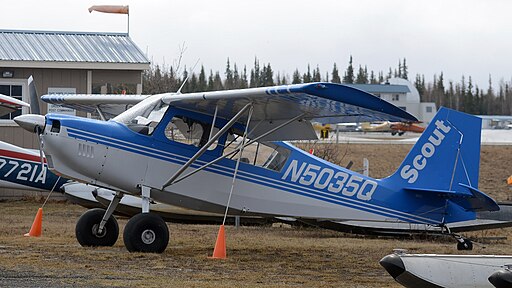
American Champion Scout
The American Champion Scout is a versatile light-sport bush plane designed for off-airport operations, aerial observation, and recreational backcountry flying. Revived by American Champion Aircraft in 2000, the Scout blends classic tube-and-fabric construction with modern avionics and robust landing gear. Its exceptional short-takeoff and landing (STOL) performance, combined with a generous cockpit and simple maintenance routines, make the Scout a favorite among bush pilots, flight schools, and private owners seeking rugged reliability.
Development and History
Origins of the Scout
American Champion introduced the Scout to fill a niche between its aerobatic Citabria and four-seat Champ series. Drawing inspiration from legendary bush planes, designers emphasized low-speed control, payload flexibility, and structural durability. Early prototypes debuting in 1998 underwent extensive field trials in mountainous and arctic conditions, validating the airframe’s strength and the wing’s high-lift effectiveness.
Market Position and Evolution
Since entering production in 2000, the Scout has carved out a reputation as a no-nonsense utility aircraft. Incremental improvements over two decades have included reinforced landing-gear attachments, factory-installed vortex generators, and available ballistic-parachute recovery systems. Today’s Scouts serve in pilot training, aerial survey, wildlife monitoring, and recreational exploration across five continents.
Airframe and Structure
Fuselage Construction
The Scout employs a welded 4130 chromoly steel tube fuselage wrapped in Ceconite fabric. This proven combination delivers:
- Exceptional crashworthiness and energy absorption
- Ease of repair in remote locations
- A light structure supporting a service life exceeding 12,000 flight hours
Modular fuselage sections permit quick replacement of damaged panels without extensive downtime.
Wing and Control Surfaces
High-lift, constant-chord wings feature:
- Single main spar of high-strength aluminum alloy
- Flaperons blending flaps and ailerons for uniform lift across the span
- Externally braced struts to minimize internal weight
- Leading-edge slats for improved stall behavior
Together, these elements yield stall speeds below 28 knots and controllable handling at approach speeds.
Powerplant and Propulsion
Engine Specifications
Standard Scouts are powered by the Lycoming O-360-A4K engine delivering 180 hp. Key parameters include:
- Four-cylinder, horizontally opposed layout
- Fuel-injected system for reliable operation in cold climates
- Dry weight of approximately 115 kg
- TBO (Time Between Overhaul) of 2,000 hours
An optional counterweighted, constant-speed propeller enhances climb performance and cruise efficiency.
Fuel System and Endurance
Fuel resides in two wet-wing tanks with a combined capacity of 154 liters. Features supporting bush operations include:
- Dual fuel selectors allowing independent tank isolation
- Low-fuel warning lights and float-type gauges for quick checks
- Capability to carry auxiliary bladder tanks in the baggage compartment
Standard fuel burns near 38 L/h in cruise, enabling over six hours of endurance with reserves.
Avionics and Onboard Systems
Flight Deck Layout
The Scout’s pilot-centric cockpit offers:
- Dual 10-inch multifunction displays (MFDs) with synthetic vision
- Digital engine monitoring and five-position flap indicator
- Hands-on throttle-and-stick (HOTAS) controls for precise maneuvering
- Optional autopilot with altitude-hold and heading-select modes
Ergonomic seats with five-point harnesses provide comfort and safety during extended cross-country or bush flights.
Communication and Navigation
Scouts can be equipped with:
- Dual-band VHF COM/NAV radios and Mode S ADS-B Out transponder
- WAAS-enabled GPS with moving-map display
- 406 MHz ELT with remote activation
- Intercom system featuring surge-suppressing headsets for noise reduction
Open-architecture wiring allows future avionics upgrades without major panel modifications.
Performance Characteristics
Speed, Range, and Endurance
- Maximum cruise speed: 215 km/h at 2,300 m
- Economy cruise (65% power): 185 km/h
- Range with 45-minute reserve: 890 km
- Endurance: 6.5 hours
Efficient aerodynamics and fuel-injected engine ensure both speed and economy.
Short-Field Capability
- Takeoff distance over 50 ft obstacle: 150 m
- Landing distance from 50 ft obstacle: 120 m
- Stall speed (flaperons deployed): 28 knots
Robust strut-braced wing and flaperon mix deliver superb control in tight valleys and unimproved strips.
Operational Roles and Variants
Scout 8GCBC
This primary production variant features:
- Lycoming O-360-A4K, 180 hp engine
- Constant-speed propeller
- Dual six-point harnesses
- Ballistic-parachute recovery system
Ideal for professional aerial survey, pipeline patrol, and executive transport.
Scout 8KCAB
Optimized for training and sport flying, the 8KCAB includes:
- 160 hp Lycoming O-320-D2J engine
- Fixed-pitch propeller for simplified operations
- Basic analog flight instruments with optional glass upgrade
- Lightweight seats for improved useful load
Suited for entry-level bush-flying instruction and recreational use.
Technical Specifications Summary
| Parameter | Scout 8GCBC |
|---|---|
| Crew and Passengers | 1 + 1 |
| Length | 6.70 m |
| Wingspan | 9.80 m |
| Height | 2.45 m |
| Wing Area | 16.8 m² |
| Empty Weight | 540 kg |
| Maximum Takeoff Weight | 930 kg |
| Powerplant | Lycoming O-360-A4K, 180 hp |
| Propeller | 3-blade constant-speed composite |
| Fuel Capacity | 154 L |
| Maximum Cruise Speed | 215 km/h |
| Economy Cruise Speed | 185 km/h |
| Stall Speed (flaperons down) | 28 knots |
| Takeoff Distance (50 ft obstacle) | 150 m |
| Landing Distance (50 ft obstacle) | 120 m |
| Service Ceiling | 4,800 m |
| Range (45 min reserve) | 890 km |
| Endurance | 6.5 h |
Conclusion
The American Champion Scout stands out as a modern interpretation of the classic bush plane, offering unmatched STOL performance, rugged durability, and a feature-rich cockpit. Whether conducting aerial surveys in remote regions or exploring wilderness strips for adventure, the Scout’s combination of proven airframe design and updated systems ensures safe, efficient, and enjoyable operations. Its multiple variants cater to both professional mission profiles and entry-level sport flying, reinforcing the Scout’s position as a cornerstone of light-sport aviation.
