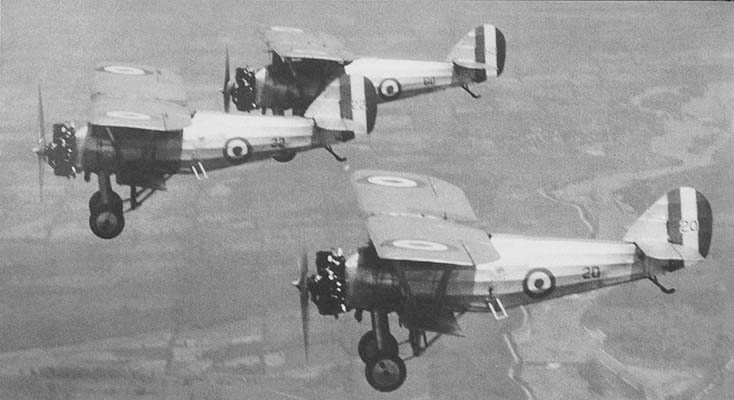
Armstrong Whitworth Siskin
The Armstrong Whitworth Siskin was a British single-seat sesquiplane fighter that became the Royal Air Force’s first all-metal fighter in the post-World War I era. It combined a welded steel-tube fuselage covered with duralumin panels and wooden or metal wings, offering a significant increase in structural strength and longevity over its fabric-covered predecessors.
Development and Design
Origins and Early Prototypes
The Siskin traces its roots to the Siddeley-Deasy S.R.2 Siskin, designed by Major F.M. Green to meet RAF Specification Type I, which called for a new single-seat fighter powered by the ABC Dragonfly radial engine. First flown in May 1919, this prototype demonstrated promising handling despite the Dragonfly’s severe reliability and performance shortcomings. A redesign under Air Ministry Specification 14/22 replaced wood with duralumin in the wing structure and optimized the fuselage for metal construction, leading to orders placed in 1922 and subsequent production of the Siskin Mk II and Mk III series.
Structural Innovations
The Siskin’s fuselage was built from welded steel tubes covered by duralumin sheets, a method that balanced high strength with straightforward repair and maintenance. Early variants retained wooden wings, but later Mk III models introduced all-metal, duralumin-skinned wings with removable panels for rapid transport and overhaul. Fixed undercarriage struts were faired in to reduce drag, and staggered wing bays with streamlined interplane struts minimized aerodynamic interference between the wings.
Powerplant Evolution
Initial Siskin prototypes used the 320 hp ABC Dragonfly engine, but chronic overheating and vibration led to its abandonment. On 20 March 1921, the first Siskin flight with the Armstrong Siddeley Jaguar IV nine-cylinder radial engine—delivering approximately 400 hp—validated the airframe’s potential. Later F.7A models employed the Jaguar VIC variant at 485 hp, improving climb rate and top speed while maintaining excellent reliability in service.
Operational History
Royal Air Force Service
Entering RAF service in 1923, the Siskin equipped frontline fighter squadrons such as Nos. 41, 56, and 111. Pilots praised its responsive controls, stable diving characteristics, and forgiving stall behavior, making it suitable for both intercept and aerobatic instruction. The type remained in RAF frontline service until October 1932, when it was phased out in favor of newer designs like the Bristol Bulldog.
Export and Canadian Service
Beyond Britain, the Siskin found customers in Canada and Sweden. The Royal Canadian Air Force acquired dozens of Mk III aircraft in 1929 to patrol coastal and northern regions, where the Jaguar engine’s robustness endured extreme cold. These Canadian Siskins remained in service until shortly after the outbreak of World War II. A small batch also served with the Royal Swedish Air Force in evaluation and demonstration roles.
Air Races and Demonstration Teams
During the 1920s, Siskins competed in numerous air races and flew in demonstration teams nicknamed “The Siskins,” showcasing their agility and performance at air displays. Their participation in civilian events highlighted the design’s aerobatic capabilities and helped sustain public interest in military aviation between the world wars.
Technical Specifications
| Parameter | Specification |
|---|---|
| Crew | 1 |
| Length | 7.62 m (25 ft 0 in) |
| Wingspan | 9.14 m (30 ft 0 in) |
| Height | 2.77 m (9 ft 1 in) |
| Wing Area | 23.6 m² (254 ft²) |
| Empty Weight | 948 kg (2,090 lb) |
| Gross Weight | 1,328 kg (2,926 lb) |
| Powerplant | 1 × Armstrong Siddeley Jaguar IV radial, 298 kW |
| Maximum Speed | 409 km/h (254 mph; 221 kt) |
| Range | 475 km (295 mi; 256 nmi) |
| Service Ceiling | 9,540 m (31,300 ft) |
| Rate of Climb | 8.1 m/s (1,600 ft/min) |
| Armament | 2 × 7.7 mm Vickers machine guns; up to 4 × 11 kg bombs |
Legacy and Preservation
Although replaced in frontline RAF service by more advanced monoplanes in the early 1930s, the Siskin’s pioneering metal construction influenced subsequent fighter designs. Surviving airframes have been restored by heritage groups in the UK and Canada, where they appear at airshows to demonstrate the leap from wood-and-fabric biplanes to all-metal fighters in the interwar period. These flying examples continue to honor the Siskin’s role in the evolution of military aviation technology.
