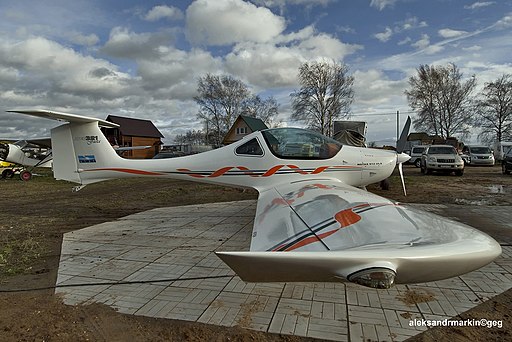
ATEC 321 Faeta
The ATEC 321 Faeta is a Czech ultralight and light-sport aircraft designed and produced by ATEC v.o.s. of Libice nad Cidlinou. Developed from the earlier ATEC 122 Zephyr 2000, it first flew in 2003 and is certified in Europe as an ultralight with a maximum takeoff weight (MTOW) of 525 kg and in the United States as a Special Light-Sport Aircraft (S-LSA) with an MTOW of 585 kg.
Design and Development
Origins and Lineage
The Faeta traces its roots to the success of the ATEC 122 Zephyr 2000, preserving its streamlined fuselage concept while introducing an all-composite wing built from carbon fiber sandwiches over a laminated wooden spar. This new wing planform and airfoil deliver higher cruise speeds and lower stall characteristics compared to its predecessor.
Certification and Production
After prototype testing in 2003, the Faeta obtained European ultralight approval at 525 kg MTOW and U.S. S-LSA certification at 585 kg MTOW under the designation ATEC 322 Faeta. Production continues in ready-to-fly and kit-built forms to serve both private owners and flight schools.
Airframe and Structure
Composite Fuselage Shell
The fuselage is a bonded carbon fiber shell reinforced with composite sandwich bulkheads combining carbon and aramid fibers. Wall thicknesses range from 1.5 mm upward, achieving a high strength-to-weight ratio. Modular forward, center, and aft fuselage sections allow rapid inspection and maintenance access.
Wing Architecture
The 9.60 m semi-tapered wing spans 10.07 m² and employs a laminar-flow UA-2 airfoil that remains efficient up to 250 km/h. Carbon fiber skins bonded to plywood ribs and a laminated wooden spar yield a maximum glide ratio exceeding 50 : 1. Plain flaps lower stall speeds for safe landings, and mass-balanced ailerons provide crisp roll control.
Tail and Control Surfaces
A T-tail layout uses carbon composite elevators and rudder with mechanical trim systems for precise force balancing. Optional integral water ballast tanks of 2×45 L enable pilots to adjust wing loading for varied thermal conditions during soaring flights.
Landing Gear
Fixed Tricycle Arrangement
The Faeta features fixed tricycle landing gear with faired aluminum legs and elastomeric shock absorption. Main wheels are fitted with disc brakes and Kevlar-reinforced tires, and the steerable nosewheel enhances ground handling on grass and paved strips alike.
Hydraulics and Safety Fixtures
A central mono-wheel undercarriage skid and wingtip support braces protect the airframe in uneven field conditions. Hydraulic damping in the main gear ensures consistent energy absorption across a range of touchdown speeds.
Cockpit and Avionics
The side-by-side cockpit affords 1.10 m of width under a large bubble canopy for panoramic visibility. Standard instruments include airspeed indicator, altimeter, vertical speed indicator, tachometer, and engine gauges. Optional equipment spans glass-cockpit EFIS, GPS/MFD installations, ADS-B transponders, intercoms, and ballistic parachute systems for enhanced safety and mission flexibility.
Powerplant and Performance
A 100 hp Rotax 912ULS four-cylinder, liquid-and-air-cooled engine drives a three-bladed composite propeller. This powerplant yields a cruise speed of 227 km/h, maximum speed of 270 km/h, climb rate of 7 m/s, and service ceiling above 4 500 m while burning approximately 18 L/h from its 70 L wing-integral fuel tanks. Range reaches up to 1 600 km with standard fuel, extendable by optional tanks.
Variants
ATEC 321 Faeta
Certified for European ultralight operation at 525 kg MTOW, optimized for soaring performance and recreational touring.
ATEC 322 Faeta
Enhanced for U.S. S-LSA rules with an MTOW of 585 kg, providing increased payload capacity for avionics or baggage.
Aerotow and Banner Towing
Both Faeta variants are approved to aerotow gliders up to 750 kg MTOW and tow banners, making them popular in gliding clubs due to their high power-to-weight ratio and stable low-speed handling.
Technical Parameters
| Parameter | Specification |
|---|---|
| Crew | 1 pilot, 1 passenger |
| Wingspan | 9.60 m (31 ft 6 in) |
| Wing Area | 10.07 m² (108.4 ft²) |
| Airfoil | UA-2 laminar-flow |
| Empty Weight | 278 kg (613 lb) |
| Maximum Takeoff Weight | 472.5 kg (1 042 lb) |
| Fuel Capacity | 70 L (18 US gal) |
| Powerplant | Rotax 912ULS, 100 hp |
| Maximum Speed (VNE) | 270 km/h (150 kt; 170 mph) |
| Cruise Speed | 227 km/h (123 kt; 141 mph) |
| Stall Speed | 52 km/h (28 kt; 32 mph) |
| Rate of Climb | 7 m/s (1 400 ft/min) |
| Range | 1 600–1 800 km (865–973 nmi) |
| Service Ceiling | 4 500 m (14 764 ft) |
| Wing Loading | 46.78 kg/m² (9.58 lb/ft²) |
Operational Use and Community
Since its introduction, over 200 Faetas have been delivered to private pilots, flight schools, and gliding clubs across Europe and North America. Operators value its low costs, high aerodynamic efficiency, and versatility for touring, training, and glider towing. U.S. S-LSA status has broadened its appeal, with active owner groups sharing modifications and hosting fly-ins annually.
.jpg)