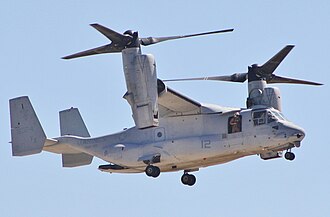
Bell Boeing V-22 Osprey – The Revolutionary Tiltrotor That Changed Military Aviation
Throughout the history of aviation, only a handful of aircraft have truly transformed the way military forces think about mobility. The helicopter made it possible to reach places without runways. The transport airplane made it possible to move troops and cargo over vast distances at high speed. For decades, however, engineers dreamed of combining the best characteristics of both concepts into a single aircraft. They imagined a machine capable of taking off and landing vertically like a helicopter while flying as fast and as efficiently as a conventional airplane.
That dream eventually became reality in the form of the Bell Boeing V-22 Osprey.
The V-22 Osprey is unlike any other operational military aircraft in the world. It belongs to a unique category known as the tiltrotor, a design in which massive engine nacelles and rotors rotate between vertical and horizontal positions. During takeoff and landing, the aircraft behaves much like a helicopter, generating lift through its upward-facing rotors. Once airborne, the nacelles rotate forward, transforming the Osprey into a turboprop airplane capable of flying at speeds that traditional helicopters simply cannot achieve.
The concept may sound straightforward, but creating an aircraft that could successfully combine two entirely different methods of flight required decades of research, countless engineering breakthroughs, and enormous determination. The V-22 program became one of the most ambitious and controversial aviation projects ever undertaken by the United States military.
Critics questioned its complexity and cost, while supporters argued that no other aircraft could provide its unique operational advantages. After years of testing, redesigns, and overcoming tragic setbacks, the Osprey entered operational service and ultimately proved that tiltrotor technology could work on a large scale.
Today, the Bell Boeing V-22 Osprey serves with the United States Marine Corps, the United States Air Force, the United States Navy, and the Japan Ground Self-Defense Force. It has participated in combat operations, humanitarian missions, disaster relief efforts, and special operations deployments around the globe.
More than simply another transport aircraft, the Osprey represents one of the boldest technological leaps in modern military aviation.
The Origins of the Tiltrotor Dream
The idea of combining vertical takeoff with high-speed forward flight is almost as old as helicopter aviation itself.
Engineers recognized early that helicopters possessed one major limitation: speed. Conventional rotorcraft are extremely versatile, but aerodynamic effects eventually limit how fast they can safely fly. As helicopters accelerate, the advancing rotor blade encounters much greater airflow than the retreating blade, creating instability and limiting maximum performance.
Fixed-wing aircraft do not suffer from this problem, but they require prepared runways for takeoff and landing.
The tiltrotor concept promised to overcome both limitations.
Experimental aircraft exploring similar ideas appeared as early as the 1950s. Bell Aircraft developed the XV-3, followed by the highly successful XV-15 experimental tiltrotor during the 1970s.
The XV-15 demonstrated that the concept was not only technically feasible but also practical. It could hover like a helicopter, transition smoothly into forward flight, and cruise at airplane-like speeds.
These successful tests attracted the attention of the United States military, which was searching for a new transport aircraft capable of replacing aging helicopters.
Lessons Learned from Operation Eagle Claw
One of the most significant events influencing the development of the V-22 occurred in 1980 during Operation Eagle Claw.
The mission was an attempt by the United States military to rescue American hostages held in Iran.
The operation required helicopters to travel long distances across difficult terrain under extremely challenging conditions.
Mechanical failures, navigation difficulties, and operational complications ultimately contributed to the mission’s failure.
Military planners recognized that existing helicopters lacked the combination of speed, range, and flexibility needed for such demanding operations.
An aircraft capable of vertical takeoff while cruising much faster than a helicopter could dramatically improve future mission success.
This realization added momentum to the development of the V-22 program.
The Birth of the Bell Boeing Partnership
Developing an aircraft as revolutionary as the Osprey required the combined expertise of two major aerospace companies.
Bell Helicopter brought decades of rotary-wing experience, including its pioneering work on tiltrotor technology through the XV-15.
Boeing contributed extensive knowledge of large military aircraft design and production.
Together, the companies formed the Bell Boeing partnership to develop what would become the V-22 Osprey.
The program officially began during the early 1980s under the Joint-service Vertical Take-off/Landing Experimental program.
The goal was ambitious: create a transport aircraft capable of replacing several different helicopter types while offering substantially improved performance.
Understanding Tiltrotor Technology
The defining characteristic of the V-22 Osprey is its tiltrotor system.
Large three-bladed proprotors are mounted at the tips of the aircraft’s wings. Each rotor is powered by a Rolls-Royce AE 1107C turboshaft engine housed within a rotating nacelle.
During takeoff and landing, the nacelles point upward, allowing the rotors to generate vertical lift like a helicopter.
Once sufficient altitude is reached, the nacelles slowly rotate forward.
As they approach the horizontal position, the aircraft transitions into airplane mode. The wings begin generating aerodynamic lift while the rotors function as propellers.
This transformation allows the Osprey to fly at speeds exceeding 500 kilometers per hour, nearly twice as fast as many conventional military helicopters.
Perhaps even more impressive is the aircraft’s range.
Because the wings support most of the aircraft’s weight during cruise flight, fuel efficiency is significantly improved compared with traditional rotorcraft.
The result is a machine capable of reaching distant objectives quickly without sacrificing vertical landing capability.
Engineering Challenges
Building the V-22 was far more difficult than simply attaching rotating engines to an airplane wing.
Engineers faced numerous technical challenges.
The transition between helicopter and airplane flight required sophisticated flight control computers capable of continuously managing aerodynamic forces.
Unlike traditional aircraft, where the pilot directly controls many flight surfaces, the Osprey relies heavily on computerized systems that automatically coordinate rotor pitch, engine power, wing control surfaces, and nacelle position.
Another unique feature is the interconnecting driveshaft that links both engines.
If one engine fails, the remaining engine can power both rotors, significantly improving survivability.
This system adds complexity but provides an important safety advantage.
The aircraft also incorporates advanced composite materials that reduce weight while maintaining structural strength.
Approximately forty percent of the Osprey’s structure consists of composite components.
Development Difficulties and Controversy
Few military aviation programs have experienced as much scrutiny as the V-22.
The aircraft encountered delays, budget overruns, and several tragic accidents during testing and early development.
These incidents sparked intense public debate over whether the program should continue.
Critics argued that the aircraft was too complicated and too expensive.
Supporters maintained that revolutionary technology often requires overcoming substantial obstacles.
Over time, extensive redesigns, improved pilot training, and software refinements significantly increased safety and reliability.
The Osprey eventually matured into a highly capable operational platform.
Its successful service record during combat and humanitarian operations helped change public perception of the aircraft.
Entering Operational Service
The United States Marine Corps became the first branch to operate the V-22 operationally.
The MV-22B variant replaced the aging CH-46 Sea Knight helicopter, dramatically improving the Corps’ ability to conduct long-range amphibious operations.
Soon afterward, the United States Air Force introduced the CV-22B, a specialized version designed for special operations missions.
The CV-22 incorporates terrain-following radar, enhanced communications systems, additional fuel capacity, and sophisticated electronic warfare equipment.
The United States Navy later adopted the CMV-22B to replace the C-2A Greyhound for carrier onboard delivery missions.
Japan also became the first international customer, recognizing the aircraft’s unique suitability for island defense and rapid deployment operations.
Performance That Redefined Expectations
Perhaps the greatest strength of the V-22 lies in its extraordinary performance.
Traditional transport helicopters typically cruise between 220 and 280 kilometers per hour.
The Osprey routinely cruises at approximately 450 kilometers per hour and can exceed 500 kilometers per hour under certain conditions.
Its operational range is similarly impressive.
Without aerial refueling, the aircraft can travel more than 1,600 kilometers.
With in-flight refueling capability, its effective range becomes virtually unlimited.
The cabin can accommodate twenty-four combat-equipped troops or substantial cargo loads.
An external cargo hook allows transportation of heavy equipment beneath the aircraft.
These capabilities provide commanders with operational flexibility unmatched by conventional helicopters.
Cockpit and Avionics
The V-22 features a modern digital glass cockpit equipped with multifunction displays and advanced flight management systems.
Two pilots sit side by side, supported by sophisticated computerized flight controls.
The aircraft’s fly-by-wire system continuously manages stability during all phases of flight.
Navigation systems incorporate GPS, inertial guidance, moving maps, and secure communications equipment.
Military variants also feature advanced defensive systems capable of detecting and countering missile threats.
Night vision goggle compatibility allows operations in darkness or adverse weather.
Together, these technologies enable the Osprey to perform highly demanding missions with exceptional precision.
Military Roles
Assault Transport
The Marine Corps primarily uses the MV-22 to transport troops from amphibious assault ships to inland objectives.
Its speed reduces exposure to enemy defenses while extending operational reach.
Special Operations
The CV-22 variant supports elite special operations units.
Its long range and aerial refueling capability make it ideal for covert infiltration and extraction missions.
Carrier Onboard Delivery
The Navy’s CMV-22B transports personnel, supplies, and critical spare parts between shore bases and aircraft carriers.
Its vertical landing capability eliminates the need for catapult launch systems.
Humanitarian Assistance
The aircraft has participated in disaster relief missions following earthquakes, hurricanes, and other natural disasters.
Its ability to reach isolated areas without runways makes it highly valuable during emergencies.
Combat Search and Rescue
The Osprey can rapidly insert rescue teams and recover isolated personnel from hostile environments.
Its speed significantly reduces response times.
Combat Experience
The V-22 has accumulated extensive operational experience.
Marine Corps Ospreys served in Iraq and Afghanistan, where their speed and range proved especially valuable.
The aircraft often transported troops and supplies across vast distances that would have required multiple helicopter refueling stops.
Special operations variants have conducted sensitive missions requiring long-range infiltration capabilities.
The Osprey has also supported evacuation operations during international crises, rapidly extracting civilians and military personnel from dangerous situations.
These missions demonstrated that the aircraft’s unique characteristics provide genuine operational advantages.
Strengths and Criticisms
The V-22 offers several undeniable strengths.
Its speed nearly doubles that of traditional helicopters.
Its range significantly expands operational possibilities.
Its vertical takeoff capability allows access to locations without runways.
However, critics continue to point out certain limitations.
The aircraft is mechanically complex and requires extensive maintenance.
Operating costs remain relatively high compared with conventional helicopters.
Its large rotor diameter can complicate operations in confined spaces.
Nevertheless, for missions requiring a combination of speed, range, and vertical landing capability, no direct equivalent currently exists.
The Future of Tiltrotor Aviation
The success of the Osprey has inspired interest in future tiltrotor designs.
Military planners increasingly recognize the advantages offered by aircraft capable of combining helicopter flexibility with airplane performance.
Bell has continued developing next-generation tiltrotor concepts, including the V-280 Valor.
Many of the technologies pioneered by the V-22 are likely to influence future military and civilian aircraft designs.
As flight control computers, composite materials, and propulsion systems continue to improve, tiltrotor technology may become increasingly common.
The Osprey has effectively proven that such aircraft are not experimental curiosities but practical operational machines.
Legacy of the V-22 Osprey
The Bell Boeing V-22 Osprey occupies a special place in aviation history.
It represents the successful realization of a concept that engineers pursued for decades.
Its development required overcoming enormous technical challenges and surviving intense public scrutiny.
Today, it stands as one of the most recognizable and technologically advanced military aircraft in service.
Like the helicopter itself once did, the Osprey has changed military doctrine by creating entirely new possibilities for rapid deployment and expeditionary warfare.
Its influence extends beyond its own operational success, shaping the future direction of vertical flight technology.
Conclusion
The Bell Boeing V-22 Osprey is much more than an aircraft—it is a demonstration of what becomes possible when engineers challenge conventional limitations.
By successfully combining the vertical takeoff capabilities of a helicopter with the speed and range of a turboprop airplane, the Osprey created an entirely new category of military aviation.
Its journey from ambitious concept to operational success was long and difficult, marked by technical obstacles, controversy, and perseverance.
Today, it serves around the world in combat, humanitarian assistance, special operations, and logistical support roles, proving the value of the tiltrotor concept.
As future generations of aircraft build upon its innovations, the V-22 Osprey will likely be remembered as one of the most important breakthroughs in modern aviation history.
Technical Specifications
| Parameter | Value |
|---|---|
| Manufacturers | Bell Textron and Boeing Defense, Space & Security |
| Designation | V-22 Osprey |
| Type | Tiltrotor military transport aircraft |
| Crew | 3–4 (mission dependent) |
| Troop Capacity | Up to 24 combat-equipped troops |
| Cargo Capacity | Up to 9,070 kg internal or external |
| Length | 17.5 m |
| Wingspan | 14.0 m |
| Rotor Diameter | 11.6 m (each rotor) |
| Height | 6.7 m |
| Empty Weight | Approximately 15,000 kg |
| Maximum Takeoff Weight | 27,440 kg |
| Engines | 2 × Rolls-Royce AE 1107C-Liberty turboshaft engines |
| Engine Output | Approximately 6,150 shp each |
| Prop-Rotor Configuration | Three-blade fully articulated tiltrotors |
| Maximum Speed | 565 km/h |
| Cruise Speed | Approximately 446 km/h |
| Combat Radius | Approximately 722 km |
| Ferry Range | Over 1,600 km |
| Service Ceiling | 7,620 m |
| Rate of Climb | Approximately 11.8 m/s |
| Aerial Refueling Capability | Yes |
| External Cargo Hook | Yes |
| First Flight | 19 March 1989 |
| Entered Operational Service | 2007 (U.S. Marine Corps) |
| Main Variants | MV-22B, CV-22B, CMV-22B |
| Primary Operators | United States Marine Corps, United States Air Force, United States Navy, Japan Ground Self-Defense Force |
| Distinctive Feature | Rotating engine nacelles enabling helicopter and airplane flight modes |
