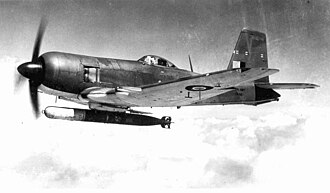
The Second World War accelerated aviation technology at an unprecedented pace. Between 1939 and 1945, aircraft evolved from relatively modest piston-engine machines into highly sophisticated combat platforms capable of carrying heavy weapons at remarkable speeds. Many aircraft that entered development before the war were already outdated by the time they reached operational service, while others were repeatedly redesigned to keep pace with rapidly changing military requirements. Few British naval aircraft illustrate this process better than the Blackburn Firebrand, one of the most ambitious and technically challenging carrier-based aircraft ever produced for the Royal Navy’s Fleet Air Arm.
Originally conceived as a high-performance naval fighter, the Firebrand underwent numerous design revisions before eventually emerging as a single-seat strike fighter and torpedo bomber. During its long development, requirements changed repeatedly, more powerful enemy aircraft appeared, and carrier warfare itself evolved dramatically. As a result, the aircraft that finally entered service differed substantially from the original concept envisioned by Blackburn Aircraft.
The Firebrand possessed many impressive characteristics. Powered by one of the most powerful piston engines fitted to a British naval aircraft, it carried a formidable weapons load that included torpedoes, bombs, rockets, and cannon. Its rugged construction made it suitable for demanding carrier operations, while its long range and heavy payload offered considerable offensive capability. Yet despite these strengths, the Firebrand never achieved the fame of aircraft such as the Fairey Swordfish, Hawker Sea Fury, or Supermarine Seafire.
Its operational career was relatively brief, and it never participated extensively in wartime combat. Nevertheless, the Firebrand occupies an important position in aviation history. It represents the Royal Navy’s determination to develop a truly modern carrier strike aircraft capable of combining fighter performance with heavy anti-shipping capability. Although circumstances prevented it from fulfilling its original wartime potential, the aircraft contributed valuable experience that influenced later generations of British naval aviation.
Today, the Blackburn Firebrand is remembered as an aircraft of enormous promise—a machine whose engineering ambition reflected both the opportunities and the difficulties of designing advanced naval aircraft during one of history’s most demanding periods.
The Origins of the Blackburn Firebrand
The origins of the Firebrand can be traced to the late 1930s, when the Royal Navy sought a new generation of carrier-based fighters. Existing Fleet Air Arm aircraft, while dependable, lacked the speed and firepower necessary to compete with the rapidly advancing fighters entering service throughout Europe.
The Air Ministry therefore issued a requirement for a powerful single-seat naval fighter capable of operating from aircraft carriers while carrying significantly heavier armament than previous designs.
Blackburn Aircraft responded with a modern low-wing monoplane powered by the Napier Sabre engine, one of the most advanced piston engines then under development.
At the time, this appeared to be an excellent solution.
The Sabre promised extraordinary power.
Its sleeve-valve design offered exceptional performance.
Combined with a streamlined airframe, the proposed aircraft appeared capable of rivaling the world’s best fighters.
However, events soon complicated the project.
Changing Requirements During Wartime
Aircraft development rarely proceeds exactly as originally planned, and the Firebrand became one of the clearest examples of this reality.
As the Second World War progressed, the Royal Navy’s operational priorities evolved.
Carrier aircraft increasingly required long range, heavy strike capability, and versatility rather than pure fighter performance.
At the same time, development of the Napier Sabre engine encountered significant technical difficulties.
Rather than abandoning the project entirely, Blackburn redesigned the aircraft repeatedly.
Eventually, the Firebrand transitioned from an interceptor into a strike fighter optimized for carrying torpedoes and bombs.
This redesign fundamentally altered the aircraft’s character.
The large airframe originally intended for high-speed combat became an exceptionally capable weapons platform.
Design Philosophy
The Firebrand ultimately reflected a philosophy emphasizing offensive capability above absolute speed.
Rather than serving solely as a fleet defense fighter, it became a multi-role aircraft capable of attacking enemy ships, coastal installations, and ground targets.
Designers sought to combine several demanding qualities within a single aircraft.
It needed sufficient power to launch from aircraft carriers carrying heavy external weapons.
It required rugged landing gear for repeated deck landings.
Its wings had to fold efficiently for storage aboard crowded carriers.
The aircraft also needed excellent low-speed handling despite possessing a very large engine and considerable overall weight.
Balancing these conflicting requirements proved extraordinarily difficult.
Airframe Construction
Structurally, the Firebrand represented one of Blackburn’s most advanced aircraft.
The fuselage employed all-metal stressed-skin construction built primarily from aluminum alloys.
This method distributed structural loads throughout the aircraft’s outer skin, producing a strong yet relatively lightweight airframe.
The large low-mounted wing incorporated folding mechanisms that allowed compact storage aboard aircraft carriers.
Hydraulically operated flaps improved takeoff and landing performance.
The landing gear itself featured wide-track geometry, increasing stability during carrier recoveries.
The aircraft’s robust construction reflected the severe demands of naval aviation.
Unlike land-based fighters, carrier aircraft routinely endured hard landings, saltwater corrosion, and heavy operational loads.
The Firebrand’s structure successfully addressed these challenges.
The Engine: Enormous Power, Significant Challenges
Perhaps no aspect of the Firebrand’s development proved more influential than its engine.
Early prototypes employed the Napier Sabre H-24 engine.
The Sabre possessed remarkable potential.
Producing well over 2,000 horsepower, it ranked among the world’s most powerful piston engines.
Unfortunately, the engine’s complexity delayed development.
Reliability problems slowed production.
Maintenance requirements proved demanding.
As a result, Blackburn eventually redesigned production aircraft around the Bristol Centaurus radial engine.
The Centaurus offered several important advantages.
It delivered comparable power while providing much greater reliability.
Its air-cooled radial configuration also simplified maintenance and increased battle survivability.
Although this redesign altered the aircraft’s appearance substantially, it transformed the Firebrand into a dependable operational machine.
Cockpit and Pilot Environment
The Firebrand featured a single enclosed cockpit positioned well forward within the fuselage.
Pilots enjoyed comprehensive instrumentation suitable for both daytime and nighttime naval operations.
Visibility during flight proved generally satisfactory.
However, the aircraft’s large engine created a long nose that somewhat restricted forward visibility during carrier landings.
Carrier approaches therefore demanded careful technique.
Experienced pilots learned to compensate by flying curved approach patterns that improved deck visibility.
The cockpit incorporated armor protection together with modern radio and navigation equipment appropriate for long-range strike missions.
Despite the aircraft’s considerable size, cockpit ergonomics received generally favorable reviews.
Armament
The Blackburn Firebrand carried one of the most impressive weapon loads of any British piston-engine naval aircraft.
Its primary fixed armament consisted of four powerful 20 mm Hispano cannons mounted within the wings.
These weapons alone provided formidable firepower against aircraft, ships, and ground targets.
The aircraft’s external payload proved even more impressive.
Depending upon mission requirements, the Firebrand could carry:
- an aerial torpedo,
- conventional bombs,
- rocket projectiles,
- auxiliary fuel tanks,
- combinations of strike weapons.
This flexibility made the aircraft suitable for numerous operational scenarios.
Whether attacking merchant shipping, escort vessels, coastal defenses, or infrastructure, the Firebrand possessed substantial offensive capability.
Flight Characteristics
Flying the Blackburn Firebrand required skill and experience.
Its large engine generated considerable torque during takeoff.
Carrier launches demanded careful power management and precise control inputs.
Once airborne, however, the aircraft demonstrated stable handling characteristics appropriate for long-range strike missions.
Its large wing produced good lift while carrying heavy external loads.
At cruising speeds the Firebrand remained comfortable for extended flights.
However, overall maneuverability could not match contemporary dedicated fighters.
This reflected its evolution into a strike aircraft rather than a pure interceptor.
Low-speed handling remained particularly important because carrier operations depended upon predictable landing behavior.
Although never considered effortless to fly, the Firebrand generally performed satisfactorily within its intended operational role.
Carrier Operations
Operating large aircraft from relatively small aircraft carriers always presents unique engineering and piloting challenges.
The Firebrand incorporated numerous features specifically addressing these demands.
Its folding wings minimized storage space.
Strong arrestor hook attachments withstood repeated deck recoveries.
Wide landing gear improved stability during landings.
Powerful flaps reduced approach speeds.
Nevertheless, the aircraft’s considerable weight required careful carrier handling.
Pilots needed extensive training before becoming fully proficient.
Despite these challenges, the Firebrand demonstrated that heavy strike aircraft could successfully operate from British aircraft carriers.
Development Variants
The Firebrand underwent more revisions than almost any other Blackburn aircraft.
Firebrand F.Mk I
The earliest prototypes reflected the original fighter concept powered by the Napier Sabre engine.
Only limited numbers appeared before changing requirements halted development.
Firebrand TF.Mk II and III
Subsequent versions introduced numerous structural refinements as the aircraft evolved toward a strike role.
These variants remained transitional designs.
Firebrand TF.Mk IV
The adoption of the Bristol Centaurus engine dramatically improved reliability.
The aircraft now approached the configuration that would enter operational service.
Firebrand TF.Mk V
The final production model became the definitive Firebrand.
It incorporated improved handling, strengthened structure, enhanced systems, and optimized torpedo capability.
Most operational Firebrands belonged to this version.
Operational Service
By the time the Firebrand entered Fleet Air Arm service, the Second World War had ended.
Consequently, the aircraft never participated extensively in wartime combat.
Instead, it served primarily during the immediate postwar period.
Fleet Air Arm squadrons used the Firebrand for anti-shipping exercises, carrier qualification, weapons development, and operational evaluation.
The aircraft demonstrated impressive payload capability while validating many of the Royal Navy’s postwar strike doctrines.
Although soon overshadowed by emerging jet aircraft, it represented one of the most capable piston-engine strike fighters Britain ever operated.
Strengths of the Firebrand
The Blackburn Firebrand possessed several outstanding qualities.
Its payload capacity ranked among the best of contemporary carrier aircraft.
The Bristol Centaurus engine delivered excellent reliability together with abundant power.
Heavy cannon armament provided exceptional offensive capability.
Its rugged structure tolerated demanding carrier operations remarkably well.
Operational range allowed effective maritime strike missions over considerable distances.
The aircraft also displayed excellent stability while carrying torpedoes and bombs.
These characteristics made it particularly well suited to anti-shipping operations.
Weaknesses
Despite its strengths, the Firebrand exhibited several limitations.
Development delays prevented wartime combat service.
The aircraft remained relatively heavy.
Carrier handling demanded experienced pilots.
Forward visibility during landing could be challenging.
Its maneuverability proved inferior to dedicated naval fighters.
By the late 1940s, rapid advances in jet propulsion rendered large piston-engine strike fighters increasingly obsolete.
Thus, even before the Firebrand reached operational maturity, aviation technology had begun moving beyond it.
Comparison with Contemporary Naval Aircraft
The Firebrand occupied an interesting position among postwar carrier aircraft.
Compared with the Fairey Firefly, it offered greater payload but somewhat less versatility.
Compared with the Hawker Sea Fury, it emphasized strike capability rather than fighter performance.
Against American aircraft such as the Douglas AD Skyraider, the Firebrand shared many conceptual similarities, although the Skyraider ultimately achieved far greater operational success.
These comparisons illustrate how naval aviation increasingly favored powerful single-engine strike aircraft during the closing years of the piston-engine era.
Historical Importance
Although the Firebrand never achieved widespread fame, its historical contribution remains significant.
The aircraft demonstrated Blackburn’s ability to design highly capable all-metal naval aircraft incorporating powerful engines, folding wings, heavy armament, and substantial payload capacity.
It also illustrated the immense difficulties of adapting aircraft designs to changing wartime requirements.
The Firebrand’s evolution from interceptor to strike fighter reflected broader changes occurring throughout naval aviation.
Carrier aircraft increasingly required flexibility.
Attack missions assumed greater importance.
Anti-shipping capability expanded.
The Firebrand anticipated many of these developments.
Legacy
The Blackburn Firebrand represents the final stage of Blackburn’s long tradition of designing carrier strike aircraft for the Royal Navy.
Beginning with biplane torpedo bombers such as the Ripon, Baffin, and Shark, continuing through aircraft like the Skua and Roc, Blackburn steadily refined its understanding of naval aviation.
The Firebrand brought these decades of experience together within a single powerful aircraft.
Although jets soon replaced piston engines aboard aircraft carriers, lessons learned from the Firebrand influenced later strike aircraft development.
Engineering solutions concerning folding wings, heavy weapon carriage, carrier handling, and structural durability continued informing British naval aircraft well into the jet age.
Conclusion
The Blackburn Firebrand occupies a unique place in British aviation history as one of the most ambitious carrier-based piston-engine aircraft ever developed for the Royal Navy. Conceived initially as a high-performance naval fighter, it evolved through years of redesign into a heavily armed strike fighter capable of delivering torpedoes, bombs, rockets, and cannon fire against a wide range of maritime and land targets. Although changing wartime priorities and prolonged development prevented it from participating in major combat operations during the Second World War, the Firebrand ultimately emerged as a technically sophisticated aircraft that showcased Blackburn Aircraft’s extensive experience in naval aviation.
Its powerful Bristol Centaurus engine, rugged all-metal construction, folding wings, and impressive payload capacity made it one of the most capable British carrier strike aircraft of the piston-engine era. Yet its story also highlights the challenges of military aircraft development during a period when technology advanced at extraordinary speed. By the time the Firebrand reached operational maturity, jet aircraft were already transforming naval aviation, limiting its opportunity to demonstrate its full potential in front-line service.
Nevertheless, the Firebrand should not be judged solely by the timing of its career. It served as an important bridge between wartime piston-engine strike aircraft and the increasingly specialized carrier attack aircraft that followed. For historians and aviation enthusiasts, it remains a compelling example of engineering ambition, adaptability, and the continual pursuit of more capable naval aviation during one of the most innovative periods in aerospace history.
Technical Parameters of the Blackburn Firebrand TF.Mk V
| Parameter | Specification |
|---|---|
| Aircraft name | Blackburn Firebrand TF.Mk V |
| Manufacturer | Blackburn Aircraft |
| Country of origin | United Kingdom |
| Aircraft type | Carrier-based strike fighter and torpedo bomber |
| First flight | 27 February 1942 (prototype) |
| Entered service | 1947 |
| Primary operator | Royal Navy Fleet Air Arm |
| Crew | 1 |
| Airframe construction | All-metal stressed-skin low-wing monoplane |
| Engine | 1 × Bristol Centaurus IX air-cooled radial engine |
| Engine power | Approximately 2,520 hp (1,879 kW) |
| Propeller | Four-bladed constant-speed propeller |
| Length | 11.45 m (37 ft 7 in) |
| Wingspan | 15.16 m (49 ft 9 in) |
| Height | 4.28 m (14 ft 1 in) |
| Wing area | Approximately 37.2 m² |
| Empty weight | Approximately 5,420 kg |
| Maximum takeoff weight | Approximately 8,390 kg |
| Maximum speed | Approximately 560 km/h (348 mph) |
| Cruising speed | Approximately 370 km/h (230 mph) |
| Operational range | Approximately 2,090 km (1,300 miles) |
| Service ceiling | Approximately 9,450 m (31,000 ft) |
| Rate of climb | Approximately 13.7 m/s |
| Fixed armament | Four 20 mm Hispano Mk V cannons |
| External payload | One aerial torpedo, bombs, rockets, or auxiliary fuel tanks |
| Landing gear | Retractable tailwheel undercarriage |
| Wing configuration | Folding low-wing monoplane |
| Primary roles | Anti-shipping strike, torpedo attack, ground attack, maritime strike |
| Notable feature | One of the Royal Navy’s most powerful piston-engine carrier strike aircraft |
| Historical significance | Final major Blackburn-designed carrier attack aircraft before the transition to the jet age |
