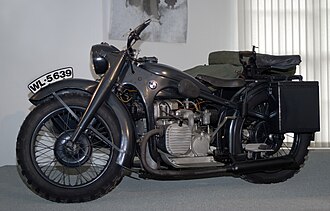
A Milestone in Motorcycle History
The BMW R12, introduced in 1935, represents a groundbreaking achievement in the early history of motorcycle engineering. It was one of the first production motorcycles to feature a telescopic front fork, a major technological innovation at the time, and it established BMW as a leader in high-performance, reliable motorcycles. Designed for both civilian and military use, the R12 combined practicality with advanced engineering, offering a smooth, stable ride and long-term durability. Its single-cylinder predecessors had paved the way, but the R12’s boxer twin engine and shaft drive marked a new era in German motorcycle design.
The R12 was used extensively during World War II, serving as a workhorse for both the military and law enforcement. It offered excellent handling and reliability even under harsh conditions, thanks to its robust frame, durable engine, and innovative suspension system. This motorcycle is remembered not only for its technological advancements but also for its iconic design and historical significance.
Historical Context: Germany and Motorcycle Innovation in the 1930s
The early 1930s were a transformative period for the European motorcycle industry. Economic pressures demanded vehicles that were affordable, efficient, and versatile. BMW had already earned a reputation for precision engineering through aircraft engines and earlier motorcycles such as the R32 and R42. With the introduction of the R12, BMW sought to combine performance, innovation, and durability in a motorcycle that could serve both civilian and military needs.
During this period, motorcycles were becoming essential for personal transport and military operations. The R12’s design reflected the need for a reliable, all-weather motorcycle capable of handling various terrains. Its military applications during the late 1930s and early 1940s cemented its status as one of BMW’s most influential motorcycles.
Design Philosophy and Engineering Principles
The BMW R12 was conceived as a robust, versatile motorcycle for the mid-1930s market. Its engineering philosophy centered on durability, reliability, and ease of maintenance. The R12 featured a 745 cc horizontally opposed twin-cylinder engine, commonly known as a boxer engine, which provided smooth power delivery, excellent cooling, and a low center of gravity for improved stability.
A key design principle was simplicity combined with innovation. BMW engineers focused on creating a motorcycle that could withstand long distances and varied road conditions while requiring minimal maintenance. The inclusion of a shaft drive instead of a traditional chain drive was a revolutionary choice, reducing wear, maintenance, and oil contamination. The frame was constructed from rigid steel tubing, ensuring strength without excessive weight, while the motorcycle’s ergonomics prioritized rider comfort for long journeys.
Engine and Transmission
The heart of the BMW R12 was its 745 cc OHV flat-twin boxer engine. This configuration allowed the cylinders to extend outward on either side of the motorcycle, improving cooling and stability. The engine produced approximately 18–20 horsepower at 5000 rpm, sufficient to propel the motorcycle to speeds of up to 95 km/h. Its torque characteristics favored mid-range performance, ideal for both urban and rural riding.
Power was transmitted through a 3-speed manual gearbox. The gear ratios were designed to maximize acceleration from low speeds while providing adequate top-end performance. The shaft drive, a hallmark of BMW engineering, connected the engine to the rear wheel through a bevel gear mechanism. This system was enclosed in a housing filled with oil, dramatically reducing wear and maintenance compared to traditional chain drives.
Frame and Chassis
The BMW R12 utilized a tubular steel frame with a pressed steel rear section. This hybrid construction combined rigidity with lightness, providing a stable platform for the rider. The frame geometry was designed to optimize handling and comfort, with a wheelbase of approximately 1,400 mm providing stability at high speeds without compromising maneuverability.
The R12’s low center of gravity, thanks to the horizontally opposed engine, contributed to predictable handling and enhanced cornering stability. The frame also accommodated both solo and sidecar configurations, making it versatile for civilian or military applications.
Front Fork Suspension: A Revolutionary Innovation
One of the most significant innovations of the R12 was its telescopic front fork, introduced to production motorcycles for the first time. Prior to this, motorcycles relied on rigid forks or rudimentary spring systems, which provided poor comfort and stability. BMW’s telescopic fork allowed the front wheel to move independently from the frame, absorbing bumps and maintaining tire contact with the road.
This innovation greatly improved handling, braking performance, and rider comfort, setting a standard for all modern motorcycles. The fork incorporated internal springs and hydraulic damping, a concept decades ahead of its time. For military riders, the improved suspension translated into better control on uneven terrain, which proved invaluable during wartime operations.
Rear Suspension and Ride Comfort
The rear of the R12 used a rigid frame design typical of the era, with rider comfort largely provided by a sprung leather saddle. While modern motorcycles rely on rear suspension systems, the R12’s design balanced simplicity with reliability. The combination of a rigid rear frame and front telescopic fork provided a controlled ride without excessive complexity, minimizing points of failure.
Rider ergonomics emphasized long-distance comfort. Handlebars were positioned to allow an upright posture, reducing fatigue during extended rides. Foot pegs and gearshift placement were optimized for ease of control, reflecting BMW’s commitment to rider-centric engineering.
Wheels, Tires, and Braking
The BMW R12 was fitted with wire-spoke wheels and balloon-style tires, which were standard for the period. These tires provided adequate grip on paved roads and dirt tracks alike. The wheels were robust, designed to endure the rigors of wartime and daily commuting.
Braking was provided by drum brakes mounted on both the front and rear wheels. While the braking technology was rudimentary by modern standards, it offered sufficient stopping power for the motorcycle’s top speed and weight. The combination of drum brakes and telescopic front suspension significantly enhanced stability during deceleration, particularly in emergency situations.
Fuel System and Efficiency
The R12 used a BMW-designed carburetor, calibrated for precise fuel-air mixture control. Fuel consumption averaged around 4–5 liters per 100 km, making it relatively efficient for its size and era. The fuel tank capacity of approximately 17 liters allowed for extended travel without frequent refueling.
The carburetor design and engine configuration allowed the R12 to perform reliably under various weather conditions, including cold starts in winter. This reliability was a key factor in its military adoption.
Electrical System and Ignition
The BMW R12 featured a basic 6-volt electrical system for ignition and lighting. Early models used magneto-based ignition, which was highly reliable and did not depend on battery power. The headlamp was electrically powered, sufficient for nighttime riding, while the tail light provided basic rear visibility.
The simple electrical system minimized maintenance and reduced the risk of failure, critical for both civilian riders and military operators in remote locations.
Military Use and Modifications
The BMW R12 became a standard motorcycle for the German military in the late 1930s. Its rugged design, reliability, and adaptability made it ideal for dispatch duties, reconnaissance, and transport of personnel and light equipment. Military variants often included sidecar attachments, additional storage compartments, and modified fenders for off-road use.
The motorcycle’s robustness under harsh conditions demonstrated the effectiveness of BMW’s engineering philosophy. Soldiers relied on the R12 for both urban and rural operations, and its performance contributed to its reputation as a durable and dependable machine.
Collectibility and Historical Significance
Today, the BMW R12 is a highly sought-after classic motorcycle. Its historical significance, innovative engineering, and role in pre-war and wartime Germany make it a prized collector’s item. Surviving R12 motorcycles are rare, and restoration requires careful attention to authenticity, particularly for the shaft drive and front telescopic fork.
Collectors value the R12 for its combination of technology, history, and design. Its influence on subsequent BMW motorcycles, including later military and civilian models, cannot be overstated.
Legacy and Influence on Modern Motorcycles
The BMW R12 set a precedent for motorcycle engineering that continues to influence BMW and other manufacturers. Its introduction of the telescopic fork, shaft drive, and boxer engine layout established standards for stability, reliability, and ease of maintenance.
The R12’s design philosophy—prioritizing durable engineering, rider comfort, and versatility—remains central to BMW’s motorcycle lineup. Modern BMW motorcycles still reflect many of the principles first embodied in the R12, including low center of gravity, smooth torque delivery, and innovative suspension solutions.
Technical Specifications of the BMW R12 (1935)
| Parameter | Specification |
|---|---|
| Model | BMW R12 |
| Production Year | 1935 |
| Engine Type | Flat-twin boxer, OHV, 4-stroke |
| Displacement | 745 cc |
| Bore x Stroke | 68 mm x 68 mm |
| Compression Ratio | 5.8:1 |
| Max Power | 18–20 hp at 5000 rpm |
| Max Torque | 35 Nm at 3000 rpm |
| Transmission | 3-speed manual |
| Final Drive | Shaft drive |
| Frame Type | Tubular steel rigid frame |
| Front Suspension | Telescopic fork with internal springs |
| Rear Suspension | Rigid frame, sprung saddle |
| Brakes | Drum brakes front and rear |
| Wheelbase | 1,400 mm |
| Seat Height | 790 mm |
| Dry Weight | 170 kg |
| Fuel Tank Capacity | 17 liters |
| Top Speed | ~95 km/h |
| Fuel Consumption | 4–5 L/100 km |
| Tires | 3.50 x 19 inches, wire-spoke |
.jpg)