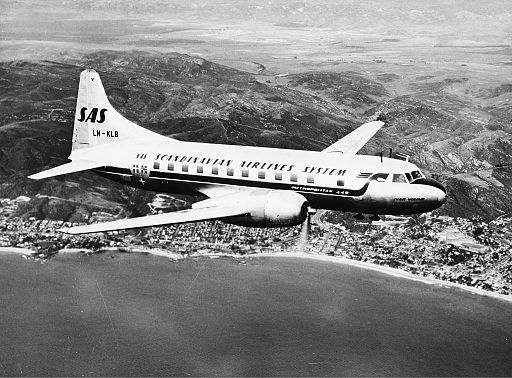
Convair CV-240 family
The Convair CV-240 family emerged in the post-World War II era as a modern successor to aging piston-airliner designs. Conceived to meet rising demands for speed, comfort, and reliability, the series blended all-metal construction, pressurization, and powerful radial engines. Over two decades, Convair evolved the basic CV-240 into larger and more capable siblings—the CV-340 and CV-440—while spin-off military and corporate versions extended its service life into the jet age. This article explores the design journey, variant lineup, operational record, and detailed technical specifications of one of mid-century aviation’s most versatile families.
Development and Design
Origins and Concept
Following WWII, American carriers sought modern airliners to replace Douglas DC-3s and war-surplus transports. Convair’s response centered on a clean-sheet design optimized for medium-haul routes. With inputs from major operators, the CV-240 promised pressurization up to 6.75 psi, seating for around 40 passengers, and cruising speeds exceeding 300 mph—ambitions that set new benchmarks for efficiency and comfort.
Structural Innovations
The CV-240’s airframe featured low-wing, twin-tailboom layout with a semi-monocoque fuselage reinforced for pressurization cycles. Wing spars employed aluminum alloy extrusions, and the cabin floor integrated sound-dampening panels. Large rounded windows improved passenger outlook while reducing stress concentrations compared to square openings. Landing gear retracted into splayed nacelles, preserving wing cleanliness and easing maintenance.
Variants
CV-240
- Introduced in 1947
- Powered by two Pratt & Whitney R-2800-CB16 radial engines (2,400 hp each)
- Typical seating: 40–44 passengers
- Maximum range: 1,500 mi
CV-340
- Stretched fuselage (+8 ft) for 44–52 seats
- Upgraded Pratt & Whitney R-2800-CB17 engines
- Enhanced fuel capacity and cabin pressurization
- Entered service in 1951
CV-440 “Metropolitan”
- Aerodynamic improvements: NACA cowlings and redesigned wing tips
- Noise-reduction insulation in cabin and nacelles
- 44–52 passenger layout
- Certified in 1955, with quieter flow and slightly improved performance
Military and Special Variants
- C-131 Samaritan: USAF medical evacuation and transport, multiple subtypes
- R3Y Tradewind: Maritime patrol prototype with turboprops
- XG-26A Glider Tug: Modified CV-240 for assault glider towing tests
- Business conversions with luxury interiors and extended range tanks
Operational History
Civil Service
Major airlines—American, United, Eastern—adopted CV-240s to modernize fleets. Its speed and pressurization allowed airlines to schedule tighter turnarounds and service new city-pair markets. Regional carriers used later CV-340 and CV-440 models extensively until jets like the Boeing 727 displaced them in the 1960s and ’70s.
Military Service
The USAF fleet of C-131s supported medevac, VIP, and crew-trainer roles through the Vietnam War. Naval versions (VC-131, RC-131) undertook electronic reconnaissance and logistics missions. Survivors remained in military or government service into the 1980s, valued for rugged simplicity.
Later Use and Legacy
Corporate and charter houses converted hundreds into executive transports, freighters, or firefighting “airtankers.” A few CV-440s still fly classic-airliner routes today under vintage-aircraft operators. The design’s influence can be traced to Convair’s later turboprop programs and to industry standards for comfort and speed in piston airliners.
Technical Specifications
General Characteristics
| Characteristic | CV-240 | CV-340 | CV-440 Metropolitan |
|---|---|---|---|
| Crew | 2 (pilot, co-pilot) | 2 | 2 |
| Capacity | 40–44 passengers | 44–52 passengers | 44–52 passengers |
| Length | 71 ft 1 in (21.66 m) | 79 ft 0 in (24.08 m) | 79 ft 0 in (24.08 m) |
| Wingspan | 93 ft 0 in (28.35 m) | 93 ft 0 in (28.35 m) | 93 ft 0 in (28.35 m) |
| Height | 23 ft 2 in (7.06 m) | 24 ft 2 in (7.37 m) | 24 ft 2 in (7.37 m) |
| Empty Weight | 28,658 lb (13,000 kg) | 32,400 lb (14,700 kg) | 33,500 lb (15,200 kg) |
| Max Takeoff Weight | 49,200 lb (22,310 kg) | 53,000 lb (24,040 kg) | 56,000 lb (25,401 kg) |
| Powerplant | 2× P&W R-2800-CB16, 2,400 hp | 2× P&W R-2800-CB17, 2,500 hp | 2× P&W R-2800-CB17, 2,500 hp |
Performance
| Metric | CV-240 | CV-340 | CV-440 Metropolitan |
|---|---|---|---|
| Cruise Speed | 280 kt (322 mph; 518 km/h) | 290 kt (334 mph; 538 km/h) | 292 kt (336 mph; 541 km/h) |
| Maximum Speed | 300 kt (345 mph; 556 km/h) | 310 kt (357 mph; 575 km/h) | 315 kt (362 mph; 583 km/h) |
| Range | 1,500 nmi (1,725 mi; 2,780 km) | 1,800 nmi (2,070 mi; 3,330 km) | 2,050 nmi (2,357 mi; 3,797 km) |
| Service Ceiling | 25,000 ft (7,620 m) | 25,000 ft (7,620 m) | 25,000 ft (7,620 m) |
| Rate of Climb | 1,500 ft/min (7.6 m/s) | 1,600 ft/min (8.1 m/s) | 1,650 ft/min (8.4 m/s) |
Capacity and Amenities
- Main cabin sound levels around 78 dB, reduced to 72 dB in CV-440
- Pressurization differential up to 6.75 psi for high-altitude comfort
- Optional galley and lavatory modules fitted at rear
- Cargo pallet or bulk freight conversions available
Operators
Major airlines worldwide flew CV-240 family aircraft, including:
- American Airlines
- United Airlines
- Eastern Air Lines
- British European Airways
- KLM
- Air France
Military and government operators spanned the USAF, USN, Royal Canadian Air Force, and numerous air forces in Latin America and Asia.
Legacy and Influence
The Convair CV-240 series forged new expectations for turboprop replacements and shaped airline product standards for over a decade. Its blend of speed, reliability, and cabin comfort bridged wartime designs to the jet era. Lessons learned in aerodynamics, noise control, and pressurization informed Convair’s later turboprop and jetliner projects. Today, surviving examples delight enthusiasts and stand as a testament to mid-century aeronautical innovation.
