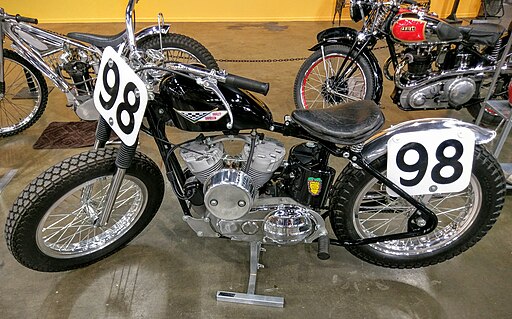
The Harley-Davidson KR is one of the most iconic and revered motorcycles in the history of American motorcycling, particularly celebrated for its racing pedigree. Introduced in the early 1950s, the KR series was Harley-Davidson’s response to the increasing dominance of British and European motorcycles in the competitive flat track racing scene. The KR was specifically engineered to excel on the dirt oval tracks of American speedways, focusing on optimized performance, agility, and reliability in grueling race conditions. It marked a significant departure from Harley-Davidson’s standard road bikes, incorporating specialized components and design philosophies aimed at maximizing speed and handling on loose surfaces. The KR became the motorcycle of choice for many champions, cementing Harley-Davidson’s legacy in the world of flat track racing for decades.
Engine and Powertrain Specifications
At the heart of the Harley-Davidson KR lies a high-performance 45 cubic inch (approximately 742 cc) overhead valve (OHV) V-twin engine, a significant evolution from the company’s traditional flathead powerplants. The overhead valve configuration allowed for improved airflow, higher compression ratios, and better combustion efficiency, all of which contributed to increased horsepower and torque essential for competitive racing.
The KR engine typically produced around 55 horsepower at a high rpm range, a substantial output for the era and the displacement class. The engine featured dual overhead valves per cylinder, actuated by pushrods and rocker arms, and employed forged pistons and hardened cylinder liners to withstand the stresses of racing. Compression ratios varied but were generally higher than those found in street motorcycles, often exceeding 10:1, enabling aggressive combustion and enhanced power delivery.
The engine was air-cooled, utilizing finned aluminum heads and cast iron cylinders designed for efficient heat dissipation during extended high-speed runs. The ignition system was optimized with racing-grade magnetos or coil-and-battery setups to ensure precise timing and spark delivery under demanding conditions.
Carburation and Fuel Delivery
The Harley-Davidson KR employed a high-capacity carburetor, often a specialized racing Linkert or similar model, designed to provide a rich air-fuel mixture essential for rapid acceleration and sustained high speeds on dirt tracks. The carburetor was carefully tuned to maximize throttle response and minimize hesitation, giving riders the ability to modulate power precisely during tight cornering and throttle slides.
An important aspect of the fuel system was its simplicity and adjustability, allowing mechanics and riders to make quick jetting changes on race day to accommodate different track conditions such as dust, moisture, and temperature. Fuel delivery was gravity-fed from a streamlined racing fuel tank positioned high on the frame to maintain consistent fuel flow regardless of the motorcycle’s lean angle.
Transmission and Drivetrain
The KR utilized a four-speed manual transmission, a notable upgrade over the three-speed gearboxes common in earlier Harley models. This transmission offered closer gear ratios to keep the engine within its optimal power band during acceleration out of turns and on the straights. Gear selection was foot-operated with a hand-operated clutch, giving riders quick and precise control over power delivery.
Power was transmitted via a chain final drive to the rear wheel, chosen for its light weight, simplicity, and ease of maintenance compared to shaft or belt drives. The rear sprocket size was adjustable, allowing racers to tailor the bike’s acceleration and top speed characteristics to specific track lengths and surface conditions.
The KR’s drivetrain was designed to minimize power loss and provide direct, reliable power transfer under the rapid acceleration and deceleration typical of flat track racing. Heavy-duty sprockets and reinforced chains were employed to withstand the rigors of competition without failure.
Chassis and Frame Design
The KR’s frame was a specially engineered tubular steel structure optimized for rigidity and lightness, ensuring maximum stability at high speeds while allowing agile handling through tight corners. Unlike standard Harley-Davidson frames, the KR’s chassis featured a lower center of gravity and reinforced areas to handle the lateral forces experienced during sliding turns on dirt tracks.
The frame geometry included a steeper rake angle and a shorter wheelbase compared to touring or cruiser models, enhancing responsiveness and quick directional changes. The rear section of the frame was designed to accommodate a rigid setup, as rear suspension was typically absent or minimal in flat track motorcycles of the era to maximize power transfer and predictability.
Suspension System
The front suspension of the KR consisted of a telescopic fork, which provided more consistent and controlled damping compared to the springer forks found on many other Harley-Davidson motorcycles of the period. The telescopic fork offered improved shock absorption and handling stability on rough dirt tracks, helping riders maintain control over uneven surfaces and during aggressive cornering.
The rear suspension was rigid, lacking any shock absorbers, a common design choice in flat track racing to reduce complexity, weight, and energy losses through suspension movement. This rigid rear end meant riders had to rely heavily on body positioning and skill to manage traction and stability, adding to the KR’s reputation as a challenging yet rewarding machine to ride.
Wheels, Tires, and Braking
The KR was equipped with lightweight spoked wheels, typically 19 inches in diameter, fitted with specially designed racing tires that balanced grip and durability on dirt surfaces. The tires featured a tread pattern optimized for controlled sliding, enabling riders to maintain traction while executing power slides through corners.
Braking systems on the KR were minimalistic but effective, generally featuring drum brakes on the front and rear wheels. The brakes were engineered to provide sufficient stopping power without compromising the motorcycle’s overall light weight and handling characteristics. Racing conditions demanded precise and modulated braking, and the drum brakes, while limited compared to modern disc brakes, were adequate for the speeds and track conditions of the time.
Ergonomics and Rider Interface
The Harley-Davidson KR featured a stripped-down, purpose-built cockpit designed to facilitate rider control and feedback during intense racing conditions. The seat was a narrow, solo saddle positioned low and forward to improve the rider’s center of gravity and allow quick weight shifts. The handlebars were relatively wide and low, providing leverage for aggressive cornering and precise throttle control.
Instrumentation was minimal, often limited to a tachometer and speedometer if any, as racers relied primarily on feel and engine sound to judge performance. Foot pegs and controls were positioned to allow for aggressive body positioning, enabling riders to hang off the bike during turns and maintain maximum traction.
Racing Heritage and Legacy
The Harley-Davidson KR’s technical design and engineering excellence made it a dominant force in American flat track racing throughout the 1950s and into the 1960s. It became synonymous with winning, used by many championship riders who appreciated its powerful engine, nimble handling, and reliability. The KR helped Harley-Davidson maintain its competitive edge in a racing world increasingly challenged by nimble British and European motorcycles.
The KR’s legacy extends beyond racing, influencing Harley-Davidson’s approach to performance and engineering in subsequent decades. It remains a highly prized collector’s motorcycle today, celebrated not only for its historical significance but also for its technical sophistication and raw racing character.
