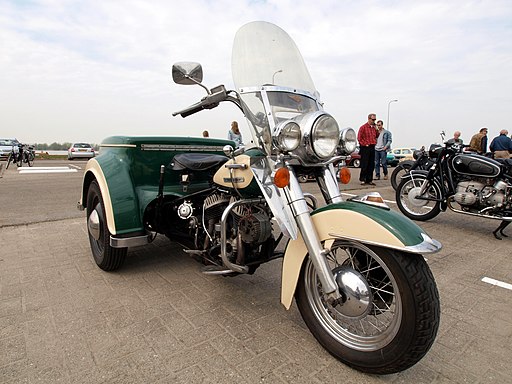
The Harley-Davidson Servi-Car was introduced in 1932 as a response to the growing demand for compact, motorized utility vehicles capable of operating in dense urban environments. Unlike conventional motorcycles, the Servi-Car was conceived primarily as a commercial and municipal work tool rather than a recreational machine. It was intended for tasks such as parking enforcement, light cargo delivery, industrial transport, and police service, where stability at low speeds and the ability to carry loads were more important than agility or speed. Production continued for several decades, with the model evolving gradually while retaining its fundamental design principles.
The Servi-Car occupied a unique position in the Harley-Davidson lineup, blending motorcycle engineering with automotive practicality. Its three-wheeled configuration provided inherent stability, allowing operators to stop and start frequently without placing their feet on the ground. This feature made it particularly attractive to city departments and service industries, where ease of operation and reduced rider fatigue were critical considerations.
Engine Configuration and Output Characteristics
Power for the Harley-Davidson Servi-Car was supplied by a flathead V-twin engine derived from the company’s proven motorcycle platforms. Early models utilized a 45 cubic inch engine, equivalent to approximately 739 cc, while later versions adopted the larger 74 cubic inch engine displacing around 1,207 cc. The flathead design, with valves positioned alongside the cylinders, was selected for its mechanical simplicity, durability, and ability to operate reliably under sustained low-speed, high-load conditions.
Horsepower output varied depending on engine displacement and production year, typically ranging from the low 20-horsepower range for the smaller engine to approximately 40 horsepower in later, larger-displacement configurations. Compression ratios remained conservative, allowing the Servi-Car to run on readily available fuel grades and reducing thermal stress. The engine was air-cooled, relying on finned cylinders and heads, and was tuned to deliver strong low-end torque rather than high rotational speed, a critical attribute for hauling loads and climbing inclines at modest speeds.
Fuel System and Induction Design
The fuel system of the Servi-Car was designed with reliability and serviceability as primary goals. A single carburetor, commonly sourced from Linkert, was used to supply the air-fuel mixture. This carburetor featured straightforward mechanical adjustments, making it easy to tune and repair without specialized tools. The fuel tank was mounted in a central position, feeding the carburetor via gravity, which eliminated the need for a fuel pump and further reduced system complexity.
Air filtration was handled through an oil-bath or later dry-element filter, depending on the production period. These systems were effective at trapping dust and debris, particularly important for vehicles operating in industrial environments where airborne contaminants were common. Exhaust gases were expelled through a dual-pipe system with mufflers designed to reduce noise, an important consideration for urban service applications.
Transmission and Drivetrain Layout
One of the most distinctive technical aspects of the Harley-Davidson Servi-Car is its drivetrain configuration. Power from the engine is transmitted through a three-speed manual transmission, similar in basic design to those used in two-wheeled Harley-Davidson motorcycles of the era. Gear selection is typically accomplished via a hand-operated shifter, while a foot-operated clutch engages and disengages power.
From the transmission, power is delivered to the rear axle through a driveshaft rather than a chain or belt. This enclosed shaft drive system improves durability and reduces maintenance requirements, particularly in dirty or wet environments. The rear axle incorporates a differential, allowing the two rear wheels to rotate at different speeds when turning. This automotive-style feature significantly improves handling stability and tire longevity compared to a solid axle design.
Frame Construction and Chassis Geometry
The Servi-Car is built around a heavy-duty steel frame designed to support both the powertrain and substantial cargo loads. The front portion of the frame resembles that of a traditional motorcycle, while the rear section extends into a rigid platform supporting the axle, cargo box, or passenger compartment. This hybrid construction reflects the vehicle’s dual identity as both motorcycle and light utility vehicle.
Suspension is minimal by modern standards. The front wheel is supported by a springer-style fork, providing limited shock absorption, while the rear axle is rigidly mounted to the frame with no suspension travel. This rigid design enhances load-carrying capability and simplifies construction but results in a firm ride, particularly on uneven surfaces. The long wheelbase and low center of gravity contribute to stable handling, especially at low speeds.
Braking System and Wheel Arrangement
Braking on the Harley-Davidson Servi-Car is achieved through mechanically actuated drum brakes. Early models used drum brakes on the front wheel only, while later versions incorporated braking on the rear wheels as well. These brakes are operated via cables and rods, requiring periodic adjustment to maintain effective stopping performance.
The three-wheel configuration consists of a single front wheel and two rear wheels mounted on a common axle. Wheel sizes vary by production year, but all are constructed from steel and fitted with durable, load-rated tires. The rear wheels are positioned wide apart, increasing lateral stability and reducing the likelihood of tipping during cornering or when carrying uneven loads.
Electrical System and Instrumentation
The electrical system of the Servi-Car operates on a 6-volt architecture in early models, later transitioning to 12 volts in more modern iterations. Power is generated by an engine-driven generator and stored in a battery mounted within the frame. Wiring is intentionally simple and robust, minimizing potential failure points.
Instrumentation is sparse, typically including a speedometer and basic indicator lights. Lighting systems are designed for visibility and safety in urban traffic, with headlamps, tail lamps, and brake lights meeting contemporary road-use requirements. Some service and police variants included additional lighting or signaling equipment to suit their specific operational roles.
Cargo Capacity and Functional Adaptations
A defining characteristic of the Harley-Davidson Servi-Car is its adaptability to a wide range of tasks. The rear platform could be fitted with a cargo box, flatbed, enclosed trunk, or specialized equipment depending on the intended use. Load capacity is substantial for a vehicle of its size, allowing it to transport tools, parcels, or enforcement equipment efficiently.
Police and municipal versions often featured lockable storage compartments, radio mounts, and weather protection for the operator. Commercial variants were commonly used by warehouses, factories, and delivery services, benefiting from the vehicle’s maneuverability in confined spaces and its ability to operate continuously throughout the workday.
Technical Legacy and Engineering Impact
The Harley-Davidson Servi-Car stands as a unique example of purpose-driven engineering within the motorcycle industry. Its technical parameters emphasize stability, durability, and practicality rather than performance or style. By incorporating features such as a differential-equipped rear axle and shaft drive, Harley-Davidson effectively bridged the gap between motorcycle and small utility vehicle design.
