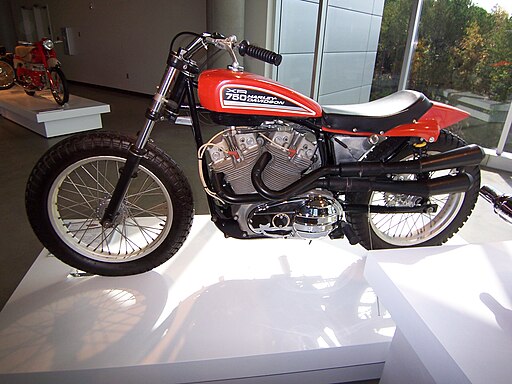
The Harley-Davidson XR-750 is widely regarded as one of the most legendary motorcycles in the history of American flat track racing. Introduced in 1970, the XR-750 was developed in response to the growing competitiveness of dirt track racing and the need for a machine that could maintain American dominance in this high-adrenaline sport. It replaced earlier Harley-Davidson models such as the KR and featured groundbreaking design and engineering improvements tailored specifically to the demands of dirt oval racing. Over the years, the XR-750 became synonymous with numerous national and international championships, solidifying its place as an iconic racing motorcycle and an enduring symbol of Harley-Davidson’s commitment to performance innovation.
Engine and Performance Specifications
At the core of the XR-750 is a 748 cc V-twin engine with an overhead valve (OHV) configuration, designed explicitly for racing purposes. The engine layout features two cylinders arranged at a 45-degree angle, a Harley-Davidson trademark that contributes to the motorcycle’s distinctive power delivery and sound. Unlike traditional Harley-Davidson engines used in street bikes, the XR-750 engine was optimized for high-rev performance, featuring lightweight pistons, high-compression forged aluminum heads, and dual overhead valves per cylinder actuated via pushrods.
The compression ratio was elevated, generally around 11:1 to 12:1, enabling the engine to produce a significant power output for its displacement. Peak horsepower was estimated to be between 70 and 75 hp at a high engine speed near 8,000 rpm. This power output was a considerable leap compared to previous Harley-Davidson flat track engines and gave the XR-750 a competitive edge in acceleration and top speed. The engine was air-cooled and equipped with finned aluminum cylinder heads and barrels to dissipate heat efficiently during intense racing conditions.
Fuel Delivery and Carburetion
Fueling the XR-750 was a single large-diameter racing carburetor, usually a Mikuni or similar high-performance unit capable of delivering a precise and dense air-fuel mixture to support aggressive throttle response and high RPM operation. The carburetor’s jetting could be finely tuned to match track conditions such as dust, humidity, and temperature, giving riders and mechanics crucial adaptability for race-day performance optimization.
The fuel system was gravity-fed from a slim, lightweight fuel tank positioned for optimal weight distribution. The air intake incorporated high-flow filters designed to prevent debris ingestion while minimizing airflow restriction. This setup ensured consistent engine breathing under the demanding circumstances of high-speed cornering and rapid throttle modulation.
Transmission and Drivetrain
The XR-750 was fitted with a close-ratio four-speed manual transmission engineered for rapid gear changes and durability. The transmission allowed riders to keep the engine within its narrow, high-power RPM band, maximizing acceleration out of corners and on straights. The gearbox was paired with a multi-plate clutch designed to handle the increased power and torque loads generated during racing.
Power was transmitted to the rear wheel via a conventional chain final drive. The rear sprocket size was adjustable, permitting racers to tailor the bike’s acceleration and top speed characteristics to suit specific track lengths and surface conditions. The chain and sprocket components were constructed from high-strength materials to endure the stresses of racing and frequent gear changes.
Frame and Chassis Engineering
The frame of the XR-750 was a lightweight tubular steel design optimized for rigidity and agility. Harley-Davidson engineers focused on reducing weight while maintaining enough structural integrity to withstand the shocks and forces of dirt track racing. The geometry featured a relatively short wheelbase and steep rake angle, contributing to sharp handling and quick directional changes essential for maneuvering tight turns on oval tracks.
The XR-750’s frame incorporated a reinforced backbone and gussets to improve torsional stiffness without significant weight gain. This approach helped riders maintain stability during high-speed cornering and ensured precise feedback from the tires. The rear section of the frame was designed to mount the swingarm and support the lightweight racing seat, which was positioned to keep the rider low and centered for optimal control.
Suspension System
The XR-750 employed a telescopic front fork with hydraulic damping, a significant advancement over earlier springer forks. This suspension setup offered superior shock absorption, improved front-end stability, and enhanced rider confidence over rough and uneven dirt track surfaces. The fork travel was limited compared to modern motorcycles but adequate for the relatively smooth dirt oval racing environment.
The rear suspension utilized dual shock absorbers mounted to a steel swingarm. These shocks were adjustable for preload and damping, allowing racers to fine-tune suspension behavior according to track conditions and rider preferences. The combination of front and rear suspension improvements made the XR-750 more manageable and faster through turns, reducing rider fatigue during long race events.
Wheels, Tires, and Braking
The XR-750 was equipped with lightweight spoked wheels measuring 19 inches front and rear, fitted with specialized flat track racing tires. These tires featured a unique tread pattern designed to provide maximum lateral grip while allowing controlled slides through corners—a fundamental skill in dirt track racing. Tire compounds were chosen to balance durability and traction on dirt and clay surfaces.
Braking was provided by drum brakes on both wheels, with the front drum typically larger to offer greater stopping power. While drum brakes are less effective than modern disc brakes, the XR-750’s brake system was sufficient for the demands of flat track racing, where controlled sliding and throttle modulation are often used to manage speed rather than heavy braking.
Ergonomics and Rider Interface
The XR-750 was designed with a minimalist, race-focused cockpit. The solo seat was narrow and positioned low to help the rider maintain a low center of gravity and shift weight efficiently during cornering. Handlebars were wide and low, providing excellent leverage for aggressive steering inputs and balance control during high-speed slides.
Instrumentation was minimal or absent, focusing the rider solely on race control and machine feedback rather than distractions. Foot pegs were positioned rearward and relatively high, enabling an aggressive riding posture that facilitated maximum control during quick transitions and high lean angles.
Racing Legacy and Impact
The Harley-Davidson XR-750’s technical excellence and race-proven performance made it one of the most successful motorcycles in American flat track racing history. It dominated the sport throughout the 1970s and beyond, winning countless national championships and securing Harley-Davidson’s position as a leader in competitive motorcycle racing.
Its influence extended beyond the racetrack, inspiring a generation of custom builders and enthusiasts who admired its blend of raw power, mechanical simplicity, and racing pedigree. The XR-750’s design philosophy—balancing lightweight construction, high-performance engineering, and rider-focused ergonomics—has informed subsequent developments in Harley-Davidson’s performance motorcycles.
