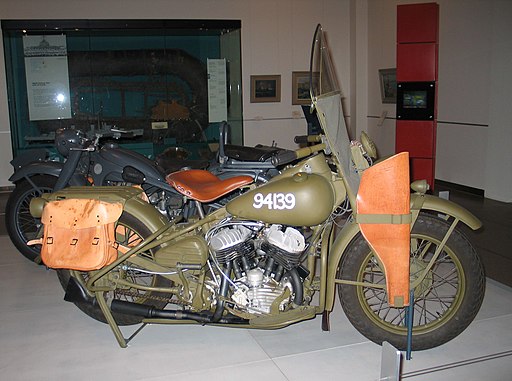
The Harley-Davidson WLA was developed at the beginning of the 1940s in response to the urgent military requirements created by the Second World War. Based on the civilian Harley-Davidson WL platform, the WLA was adapted specifically for army use, emphasizing durability, ease of maintenance, and operational reliability under extreme conditions. The designation itself reflects its purpose, with W indicating the 45 cubic inch flathead engine series, L representing the high-compression variant within that family, and A signifying Army specification. Large production volumes were achieved between 1941 and 1945, making the WLA one of the most recognizable military motorcycles ever built.
The motorcycle was designed to operate across a wide range of environments, including deserts, forests, urban areas, and muddy battlefields. This versatility required numerous modifications compared to civilian models, such as improved air filtration, protective skid plates, blackout lighting, and fittings for military equipment. The WLA became a standard dispatch and reconnaissance vehicle, valued for its mechanical simplicity and predictable handling rather than outright speed or modern refinement.
Engine Architecture and Performance Characteristics
At the heart of the Harley-Davidson WLA is a 739 cc V-twin flathead engine, also known as a side-valve configuration. The cylinders are arranged at a 45-degree angle, a signature Harley-Davidson layout that contributes to the engine’s compact design and distinctive firing order. The flathead valve arrangement places the valves beside the cylinders rather than overhead, simplifying construction and improving reliability under poor maintenance conditions, although at the cost of reduced thermal efficiency and peak power.
The engine produces approximately 23 to 25 horsepower at around 4,600 rpm, which was adequate for military tasks such as courier duties and light cargo transport. Compression ratio is relatively low, typically around 5.0:1, allowing the engine to operate on lower-octane fuels commonly available in wartime conditions. Cooling is achieved through air flow over the finned cylinders and heads, with the engine’s conservative tuning helping to prevent overheating even during extended low-speed operation.
Fuel, Induction, and Exhaust Systems
Fuel delivery on the WLA is handled by a single downdraft carburetor, commonly a Linkert model, which was favored for its robust construction and straightforward adjustment. The carburetor is paired with an oil-bath air cleaner designed to trap dust and debris, a critical feature for off-road and desert environments. This system required periodic servicing but offered excellent filtration compared to simpler dry-element designs of the era.
The exhaust system consists of dual pipes exiting from each cylinder, routed along the right side of the motorcycle. The pipes are equipped with military-style mufflers designed to reduce noise signature while maintaining acceptable exhaust flow. Heat shielding and careful routing were employed to minimize the risk of burns to the rider and to prevent damage to attached gear.
Transmission, Final Drive, and Power Delivery
The Harley-Davidson WLA uses a three-speed manual transmission with a foot-operated clutch and a hand-operated gear selector mounted on the fuel tank. This configuration, often referred to as tank shifting, was standard for Harley-Davidson motorcycles of the period and allowed for precise gear engagement even when wearing heavy military boots. Gear ratios were selected to provide strong low-end torque and controlled acceleration rather than high top speed.
Power is transmitted to the rear wheel via a chain final drive, chosen for its simplicity and ease of repair in the field. Chain tension adjustment is straightforward, and replacement could be performed with basic tools. The overall drivetrain design emphasizes mechanical robustness, with generous tolerances that allowed the motorcycle to continue operating despite dirt, wear, and limited lubrication.
Frame Design and Suspension System
The WLA is built around a rigid steel frame, often referred to as a hardtail design, with no rear suspension. While this configuration results in a harsh ride on uneven terrain, it offers superior strength, fewer moving parts, and reduced maintenance requirements. Front suspension is provided by a springer-style fork with a central spring and link arrangement, which offers limited but effective shock absorption for the front wheel.
Wheelbase measures approximately 57 inches, contributing to stable handling at moderate speeds and predictable behavior on loose surfaces. Ground clearance is sufficient for off-road travel, aided by a skid plate mounted beneath the engine to protect critical components from rocks and debris.
Braking System and Wheels
Braking on the Harley-Davidson WLA is handled by mechanically actuated drum brakes at both the front and rear wheels. These brakes are cable-operated and require careful adjustment to maintain effective stopping performance. While drum brakes are susceptible to fade under heavy use, the modest weight and performance of the WLA keep braking demands within reasonable limits.
The motorcycle rides on 18-inch steel wheels fitted with relatively narrow tires, optimized for durability and ease of replacement rather than maximum traction. Tire selection was often dependent on theater of operation, with tread patterns chosen to suit mud, sand, or paved surfaces. Spoked wheels provide flexibility and strength, allowing them to absorb impacts without catastrophic failure.
Electrical System and Lighting Equipment
The electrical system of the WLA operates on a 6-volt configuration, powered by a generator and storage battery. Wiring is kept simple and well-protected, reducing the likelihood of failures in wet or dirty conditions. One of the most distinctive features of the military specification is the blackout lighting system, which includes reduced-intensity headlamps and marker lights designed to minimize visibility to enemy forces during nighttime operations.
Instrumentation is minimal, typically limited to a speedometer and basic indicator lights. This sparse approach reduces distractions for the rider and enhances reliability, as fewer components are susceptible to failure.
Military Equipment and Functional Additions
The Harley-Davidson WLA is equipped with numerous fittings to support military operations. These include mounts for ammunition boxes, leather or canvas saddlebags, a rear luggage rack, and a scabbard for a rifle or submachine gun. A windshield was sometimes fitted, depending on operational requirements, to reduce rider fatigue during long-distance travel.
Paint and finish are strictly utilitarian, usually consisting of olive drab coatings with minimal reflective surfaces. Chrome plating is largely eliminated in favor of parkerized or painted components, reducing glare and corrosion risk.
Legacy and Technical Significance
The Harley-Davidson WLA remains a landmark in motorcycle engineering due to its role in large-scale military service and its emphasis on functional design. Technically, it represents a culmination of pre-war motorcycle engineering principles, prioritizing mechanical simplicity, field serviceability, and rugged construction over innovation or performance extremes. Its influence can be seen in later utility motorcycles and in the enduring reputation of Harley-Davidson as a manufacturer capable of producing machines suited for demanding real-world conditions.
