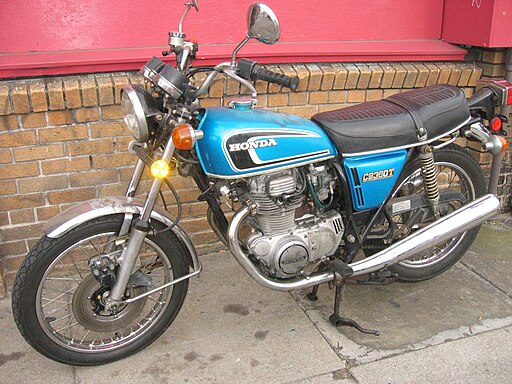
Honda CB360
The Honda CB360 emerged in 1974 as a sophisticated evolution of the beloved CB350. Built to bridge the gap between entry-level twins and larger displacement machines, the CB360 delivered a refined riding experience with upgraded handling, improved power, and modern aesthetics. Its combination of a twin-cylinder engine, competent chassis, and everyday usability makes it a standout model in Honda’s 1970s lineup.
Historical Context
Transition from CB350 to CB360
Honda’s CB350 had set the standard for light, fun, and reliable motorcycles in the late 1960s. By the early 1970s, riders sought more performance without a drastic jump in weight or complexity. Honda responded by enlarging the CB350’s powerplant to 356 cc, adding a six-speed gearbox, and refining the chassis. The result, launched in late 1973 for the 1974 model year, was the CB360.
Market Position and Production
Positioned between the CB350 twin and the heavier CB450, the CB360 targeted riders who wanted a sprightly commuter that could also handle spirited weekend rides. Production ran from 1974 through 1976, after which Honda shifted focus toward four-stroke singles and larger multi-cylinder models. Although only around 17,000 units were built, the CB360 gained acclaim for its balanced performance.
Engine and Powertrain
Engine Architecture
- Configuration: Parallel-twin, SOHC, 8-valve, air-cooled
- Displacement: 356 cc
- Bore × Stroke: 67 mm × 50.6 mm
- Compression Ratio: 9.3 : 1
- Crankshaft: 180° firing order
The 180° crank firing interval gives the CB360 a distinctive pulse and smooth low-end torque, ideal for city riding and light touring.
Carburation and Induction
Each cylinder is fed by a 28 mm Keihin constant-velocity carburetor. Vacuum-actuated slides ensure precise throttle response, while small intake snorkels with foam filters help keep dust and debris out when riding on backroads.
Power Output
- Maximum Power: 34 hp at 9,500 rpm
- Peak Torque: 2.9 kg·m at 8,000 rpm
- Top Speed: Approximately 150 km/h
- 0–100 km/h Acceleration: Around 7.8 seconds
This midrange-focused power delivery delivers usable thrust in everyday situations yet rewards riders who explore the upper rev range.
Transmission and Final Drive
A six-speed constant-mesh gearbox keeps the engine in its sweet spot across diverse conditions. Power reaches the rear wheel through a #530 O-ring chain. Stock sprockets (18 teeth front, 42 teeth rear) strike a balance between acceleration and highway cruising comfort.
Chassis and Suspension
Frame Design
The CB360 uses a double-cradle tubular steel frame that’s rigid yet light. Stress points around the headstock and swingarm pivot are reinforced to handle spirited riding. A wheelbase of 1,350 mm and a rake of 27° with 95 mm of trail offer a neutral handling platform.
Front Suspension
A conventional telescopic fork features 37 mm stanchions and 140 mm of travel. Spring and damping rates were tuned for a responsive feel, minimizing dive under braking while still smoothing out potholes and road irregularities.
Rear Suspension
Dual chrome-plated shocks provide 120 mm of travel. Adjustable preload collars let riders dial in ride height for solo or two-up riding. Progressive springs and hydraulic damping keep the chassis composed in corners and over bumps.
Brakes, Wheels, and Tires
Braking System
- Front Brake: 276 mm hydraulic disc with single-piston caliper
- Rear Brake: 130 mm leading-trailing drum
Combining a front disc with a rear drum was state-of-the-art in the mid-1970s for mid-size bikes, offering strong stopping power without excessive weight.
Wheels and Tires
- Front Wheel: Spoked 19 × 1.60 in rim, 3.00-19 tire
- Rear Wheel: Spoked 18 × 2.15 in rim, 3.50-18 tire
Spoked rims contribute to a comfortable ride by flexing microscopically. Tire choices of the era provided a good compromise between grip on paved roads and predictability on gravel.
Electrical System and Instrumentation
Charging and Ignition
The CB360 runs a 12 V electrical system powered by a 90 W alternator. A point-type ignition with electronic advance module ensures consistent spark timing across the rev range. A 6 Ah maintenance-free battery is housed under the seat.
Lighting and Controls
- Headlight: 12 V, 60 W/55 W halogen bulb
- Taillight: 12 V incandescent
- Turn Signals: Amber lenses with sealed bulb units
- Switchgear: Intuitive layout on handlebars with ergonomic levers
Dashboard
- Speedometer: Up to 180 km/h
- Tachometer: Up to 12,000 rpm
- Indicator Lights: Neutral, high-beam, turn signals
Large, clear gauges make at-a-glance monitoring easy, even when revving toward redline.
Ergonomics and Rider Interface
Seating Position
A low, 770 mm seat height and tapered saddle give riders of average stature confidence when stopped. The seat foam strikes a balance between support and comfort for rides lasting multiple hours.
Handlebar and Controls
Moderately raised handlebars with 25 mm pull-back promote an upright posture that relieves wrist and lower back strain. Adjustable clutch and brake levers accommodate varying hand sizes.
Footpeg Placement
Slightly rear-set pegs encourage a sporty stance without cramping the knees. Rubber inserts damp vibration while still providing solid grip when cornering.
Dimensions, Weight, and Capacities
Key Measurements
| Specification | Measurement |
|---|---|
| Overall Length | 2,085 mm |
| Overall Width | 800 mm |
| Overall Height | 1,080 mm |
| Wheelbase | 1,350 mm |
| Ground Clearance | 165 mm |
| Seat Height | 770 mm |
Weight and Fuel Capacity
| Specification | Measurement |
|---|---|
| Dry Weight | 157 kg |
| Wet Weight | 165 kg |
| Fuel Capacity | 12.5 L (incl. 1.5 L reserve) |
| Fuel Range | Up to 220 km |
A sub-170-kg wet weight makes the CB360 nimble in traffic and easy to maneuver at low speeds.
Customization and Aftermarket Support
Though only in production for a few years, the CB360 enjoys healthy aftermarket support. Popular modifications include:
- Electronic ignition conversions for maintenance-free operation
- Upswept twin exhausts in scrambler or café racer styles
- Modern tubeless-compatible rims for reliability
- LED lighting that retains classic appearance
- Performance carburetors and exhaust headers for increased midrange torque
Riders often restore CB360s to factory specification or transform them into personalized retro machines.
Legacy and Collectability
The CB360 represents a pivotal moment in Honda’s twin-cylinder lineage. It combined approachable performance with modern features that foreshadowed later middleweight motorcycles. Today, well-kept CB360s command respect among vintage enthusiasts for their reliability, balanced handling, and period charm.
Conclusion
The Honda CB360 remains an icon of mid-1970s engineering, offering a harmonious blend of performance, comfort, and style. Its refinements over the CB350 set new benchmarks for mid-size motorcycles, and its moderate production numbers make surviving examples a sought-after prize. Whether you’re seeking a weekend classic or a canvas for custom creativity, the CB360 delivers timeless appeal and a rewarding riding experience.
