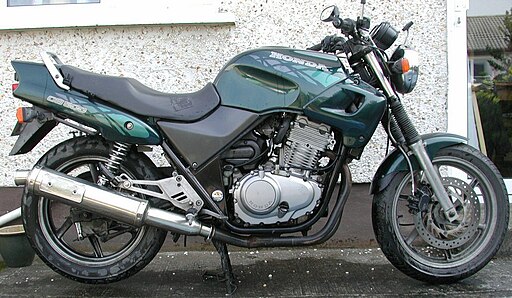
Honda CB500 twin
The Honda CB500 Twin carved a niche for itself in the mid-1990s as a no-nonsense, middleweight roadster. With a torquey parallel-twin engine, approachable ergonomics and a simple steel-tube frame, it struck an ideal balance between daily usability, spirited performance and long-term reliability. Riders from beginners to seasoned commuters found the CB500 Twin’s blend of modern technology and classic styling impossible to resist.
History and Evolution
Development Roots
Honda’s engineers set out to create a versatile 500 cc machine that combined the reliability of their liquid-cooled twins with refined chassis dynamics. Borrowing lessons from the successful VFR and CB series, they packaged a compact, DOHC parallel twin into a straightforward double-cradle frame. The result was a machine that felt both familiar and refreshingly direct.
Market Reception
Launched in 1994 and produced until 2002, the CB500 Twin quickly gained praise for its linear power delivery and forgiving nature. Motorcycle magazines of the era lauded its ability to accelerate smoothly from low rpm without hesitation, while owners celebrated its easy maintenance and durable build. Over time, it developed a cult following among riders seeking a versatile, all-rounder.
Design and Ergonomics
Chassis and Styling
The CB500 Twin’s steel tubular cradle frame provides a rigid backbone with just enough flex for rider feedback. Minimalist bodywork—featuring a teardrop-shaped fuel tank, compact side covers and a flat single-piece seat—emphasizes functionality over flash. Subtle angular lines and polished engine casings nod to Honda’s engineering heritage, while wire-spoke wheels maintain a timeless look.
Rider Position
Handlebars sit at a moderate height, offering an upright posture that reduces fatigue on long rides. Footpegs are placed to allow a natural bend at the knee, granting both comfort in traffic and leverage when leaning into corners. The 775 mm seat height accommodates a wide range of rider statures, making heel-toe shifts and ground stops feel intuitive.
Engine and Performance
Powerplant Architecture
At the heart of the CB500 Twin lies a 499 cc liquid-cooled parallel twin with double overhead camshafts. Each cylinder features four valves arranged to optimize airflow and combustion. A pair of 32 mm Keihin CV carburetors feeds the mixture, while electronic CDI ignition ensures precise timing across the rev range. A six-speed transmission and chain final drive complete the drivetrain.
Power Output and Drive
The engine produces approximately 58 hp (42 kW) at 9 500 rpm and 47 Nm (31 lb-ft) of torque at 8 000 rpm. Owners note the smooth midrange thrust that makes overtaking effortless, paired with enough top-end to cruise comfortably at highway speeds. The gearbox delivers clean, positive shifts, and the assist-style clutch offers light lever pull without sacrificing feedback.
Chassis Dynamics
Suspension Setup
- Front: 37 mm hydraulic telescopic forks with 120 mm of travel provide a balanced blend of bump absorption and steering precision.
- Rear: Twin adjustable shocks with 118 mm of travel allow riders to tailor preload for solo or two-up riding, keeping the rear wheel firmly planted through corners.
This suspension package offers surprisingly agile handling for a 500 cc standard, instilling confidence in both tight urban environments and sweepers.
Brakes and Wheels
A single front disc offers solid stopping power with a dual-piston caliper, while the rear employs a matching single-disc setup for consistent deceleration. Standard 17-inch wire-spoke wheels wear 110/80-17 tires up front and 130/80-17 at the rear, combining vintage aesthetics with modern rubber compounds for secure grip.
Dimensions and Capacities
Weight and Size
- Wheelbase: 1 400 mm
- Rake/Trail: 26°/95 mm
- Seat Height: 775 mm
- Dry Weight: 170 kg
These compact dimensions yield a nimble footprint, making low-speed maneuvers and parking a breeze. Wet weight climbs to around 188 kg once fuel and fluids are aboard, preserving the bike’s flickable character.
Fuel and Range
An 18 L fuel tank provides a practical riding range of over 300 km on mixed roads. Average fuel consumption hovers around 5.5 L/100 km, translating to economical daily commuting and weekend adventures alike.
Complete Technical Specifications
| Specification | Detail |
|---|---|
| Engine | 499 cc liquid-cooled parallel twin |
| Valvetrain | DOHC, 4 valves per cylinder (8 total) |
| Bore × Stroke | 73 mm × 59 mm |
| Compression Ratio | 10.5 : 1 |
| Induction | 2 × 32 mm Keihin CV carburetors |
| Ignition | CDI |
| Transmission | 6-speed, chain final drive |
| Frame | Tubular steel double cradle |
| Front Suspension | 37 mm telescopic fork, 120 mm travel |
| Rear Suspension | Dual adjustable shocks, 118 mm travel |
| Front Brake | Single disc, dual-piston caliper |
| Rear Brake | Single disc |
| Front Tire | 110/80-17 |
| Rear Tire | 130/80-17 |
| Wheelbase | 1 400 mm |
| Rake/Trail | 26°/95 mm |
| Seat Height | 775 mm |
| Dry Weight | 170 kg |
| Wet Weight | ~188 kg |
| Fuel Capacity | 18 L |
| Fuel Consumption | ~5.5 L/100 km |
| Top Speed | ~186 km/h (116 mph) |
Conclusion
The Honda CB500 Twin remains a standout in the middleweight segment for its combination of accessible power, satisfying chassis dynamics and enduring Honda build quality. Whether carving backroads, commuting through the city or learning the ropes on two wheels, the CB500 Twin delivers a user-friendly package that continues to attract riders seeking that perfect blend of practicality and spirited fun.
