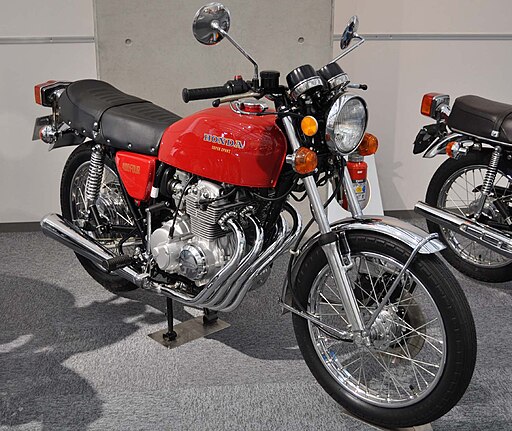
Honda CB400F
The Honda CB400F emerged in 1975 as a pinnacle of middleweight motorcycle design, marrying a high-revving four-cylinder engine with lean, agile handling. Known for its distinctive four-into-one upswept exhaust and minimalist yet purposeful styling, the CB400F captured the café racer aesthetic even before the term entered popular vernacular. Decades later, it remains celebrated for its blend of mechanical precision, rider engagement, and timeless looks.
Historical Context
Origins and Development
Honda’s engineers sought to create a 400 cc machine that felt and sounded like a full-size superbike while remaining accessible to everyday riders. By scaling down the CB750’s SOHC inline-four into a compact, 408 cc package, they delivered a motor that produced smooth power up to a 10 000 rpm redline. A tubular steel cradle frame and road-focused ergonomics complemented the engine’s performance, resulting in a versatile machine suited for both spirited street riding and light touring.
Market Reception
Launched primarily in European and Japanese markets, the CB400F quickly earned a devoted following. Riders praised its precise throttle response, surprising acceleration, and the unique exhaust bark that set it apart from parallel-twin competitors. Its limited production run until 1977 and subsequent rarity on the used market propelled it into collector territory, with well-preserved examples commanding premium prices.
Engine and Drivetrain
Air-Cooled Inline-Four Powerplant
The CB400F’s heart is a 408.2 cc, air-cooled, SOHC inline-four cylinder engine. Bore and stroke measure 51 mm × 50 mm, delivering nearly square dimensions that favor high-revving characteristics. A compression ratio of 9.2 : 1, combined with four Mikuni carburetors, generates a peak output of 39 hp at 9 500 rpm and torque of 31 Nm at 8 000 rpm. Its redline at 10 000 rpm invites riders to exploit the upper rev band for exhilarating pull.
Carburation and Ignition
Each cylinder is fed by an individual 26 mm Mikuni flat-slide carburetor, tuned for rapid throttle transitions and crisp top-end response. A conventional points-based ignition system offers simplicity and ease of maintenance, while an advance mechanism ensures spark timing aligns with engine speed for optimal combustion.
Transmission and Final Drive
A five-speed gearbox channels power through a wet multi-plate clutch featuring light lever action. Final drive is managed by a robust 530-series chain, protected by a half-height guard. Close-ratio gearing keeps the engine within its sweet spot, making rapid acceleration and swift overtakes feel intuitive.
Chassis and Suspension
Frame Architecture
The CB400F employs a tubular steel cradle frame that balances torsional rigidity with controlled flex. Its geometry—a 27° rake and 112 mm trail—favours quick steering response without sacrificing high-speed stability. The overall wheelbase of 1 335 mm yields an agile feel in tight corners and confidence on sweeping roads.
Front Suspension
Telescopic forks with 35 mm stanchions provide 120 mm of travel. Internally, simple damping circuits strike a balance between bump absorption and precise feedback, giving riders a direct connection to the road surface.
Rear Suspension
Twin shock absorbers with seven-stage preload adjustment offer 110 mm of rear wheel travel. Progressive-rate springs and dual damping circuits maintain composure under acceleration, braking, and loaded touring conditions.
Braking System
Front braking is handled by a single 275 mm disc and a dual-piston caliper. At the rear, a 180 mm drum brake with a full-width shoe provides smooth, predictable slowing power. While modest by modern standards, the setup was lauded in its era for balanced feel and fade resistance.
Dimensions and Weight
| Specification | Metric | Imperial |
|---|---|---|
| Wheelbase | 1 335 mm | 52.6 in |
| Seat Height | 780 mm | 30.7 in |
| Ground Clearance | 160 mm | 6.3 in |
| Fuel Capacity | 13 L | 3.4 US gal |
| Dry Weight | 177 kg | 390 lb |
| Wet Weight | 192 kg | 423 lb |
| Overall Length | 1 995 mm | 78.5 in |
| Overall Width | 740 mm | 29.1 in |
| Overall Height | 1 025 mm | 40.4 in |
Electrical and Instrumentation
A 6 V electrical system powers a halogen headlamp, incandescent taillight, and turn signals. The cockpit features twin analog gauges—tachometer and speedometer—flanked by indicator lights for neutral, high beam, and turn signals. A single fuse protects the minimalist wiring loom, easing troubleshooting.
Performance Characteristics
The CB400F’s character is defined by a smooth yet urgent power delivery. Low-end torque feels modest, but the engine’s eagerness to rev makes every gear change a rewarding event. Its narrow profile and moderate mass allow rapid direction changes, while the firm suspension setup ensures the chassis remains communicative even when pushed beyond leisurely speeds.
Maintenance and Common Upkeep
Routine service is remarkably straightforward. Oil and filter changes every 3 000 km preserve engine longevity, while valve clearance checks at 6 000 km ensure the SOHC timing remains precise. Carburetor synchronization and periodic points adjustments are easily performed trackside. Common wear items include fork seals and chain tensioners, both of which are user-serviceable.
Legacy and Collector Appeal
Though produced for only three years, the CB400F left an outsized impression on motorcycle culture. Its combination of exotic engine layout, distinctive exhaust, and classic lines set a template for modern retro roadsters. Today, passionate enthusiasts restore and preserve CB400Fs, often customizing them with period-correct café racer touches while retaining the bike’s original soul.
Conclusion
The Honda CB400F stands as a testament to the art of motorcycle engineering at its most refined. Its compact four-cylinder engine, purposeful chassis, and enduring style continue to captivate riders and collectors alike. More than four decades after its debut, the CB400F remains an icon of middleweight mastery and a timeless expression of the café racer spirit.
