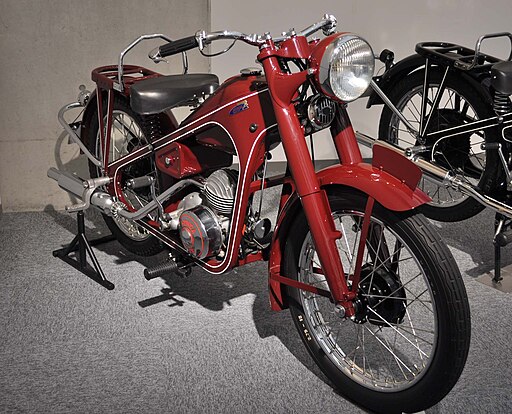
Honda D-Type
The Honda D-Type—often referred to as the Dream D or simply the D-Type—was the first full-fledged motorcycle manufactured by Honda. Introduced in 1949 and produced until 1951, it represented a major departure from earlier motorized bicycles that relied on auxiliary engines. Instead, the D-Type was conceived as a complete motorcycle, constructed with its own dedicated engine, frame, suspension, and other components. Its design was aimed at mass production for a postwar Japan in need of affordable and reliable transportation. Today, the Honda D-Type is celebrated not only for its historical importance but also for its ingenious simplicity and enduring charm.
Engine and Performance
Engine Design and Specifications
At the heart of the Honda D-Type is a modest yet innovative two-stroke, single-cylinder engine with a displacement of 98 cc. Designed at a time when companies were just beginning to develop proprietary motorcycle engines, Honda’s engineers focused on creating a unit that was both reliable and easy to manufacture. Key technical specifications include:
- Displacement: 98 cc
- Bore x Stroke: Approximately 50 mm × 50 mm
- Compression Ratio: About 6.5:1
- Cooling: Air-cooled for simplicity and reliability
- Power Output: Roughly 3 horsepower (2.2 kW) at around 5,000 rpm
- Torque: Approximately 3.15 lb-ft (4.27 N·m)
These modest power figures provided enough performance for urban commuting and short-range travel, while the engine’s high-revving character gave it a lively feel despite its small size. The design is a testament to Honda’s early commitment to producing machines that balance efficiency, durability, and ease of maintenance.
Transmission and Drivetrain
The Honda D-Type employs a simple yet effective transmission system:
- Transmission: 2-speed manual gearbox
- Operation: Gear changes are controlled via a foot-operated mechanism, offering riders a straightforward riding experience
- Starter: Primarily equipped with a kickstarter—although on some versions an electric starter was also introduced later
Power is transmitted to the rear wheel through a conventional chain drive, which was a common and proven method at the time. This system provides direct and efficient transfer of power from the engine, contributing to the motorcycle’s overall reliability and ease of use.
Chassis, Suspension, and Braking
Frame and Construction
The chassis of the Honda D-Type is built around a pressed steel frame—a design choice that reflects the era’s manufacturing techniques. Salient features include:
- Frame Material: Pressed steel, which offers a good balance of strength and low cost
- Structure: The frame was designed to be both lightweight and rigid, ensuring adequate stability and handling
- Weight: With a dry weight of approximately 80 kg (around 180 lb), the D-Type was built to be nimble and accessible to a wide range of riders
The simplicity of the frame design, combined with its functionality, helped position the D-Type as an affordable choice without sacrificing durability.
Suspension and Wheels
To handle the varied conditions envisioned for its use, the D-Type features a minimalistic suspension setup:
- Front Suspension: Conventional telescopic forks absorb minor road imperfections and provide stability during cornering
- Rear Suspension: The motorcycle utilizes a rigid (hardtail) rear end, meaning there is no rear swingarm or shock absorbers—this design was common in early motorcycles
- Wheels and Tires: It rides on distinctive 24-inch wire-spoked (driven) wheels, typically fitted with tires sized around 2.00 x 3.00. These components contribute both to its classic appearance and its functional performance on unpaved as well as paved roads
This configuration, while simple, delivers adequate performance for the modest speeds and light-duty conditions for which the bike was intended.
Braking System
The Honda D-Type is equipped with a straightforward braking system:
- Brakes: Drum brakes are installed on both the front and rear wheels
- Performance: While drum brakes do not offer the same stopping power as modern disc brakes, in the context of the D-Type’s low speeds (with a top speed of around 60 km/h) they provided reliable and predictable stopping performance
The choice of drum brakes reflects the technology of the day and underscores the motorcycle’s focus on simplicity and ease of maintenance.
Design, Ergonomics, and Practical Features
Exterior Design and Styling
The visual appeal of the Honda D-Type lies in its unpretentious, functional design that also carries a distinct sense of style:
- Bodywork: Simple, with elegant curves and smooth lines that complemented the overall practicality of the motorcycle
- Fuel Tank: A uniquely shaped fuel tank features the Honda logo prominently, symbolizing the company’s new venture into complete motorcycle design
- Exhaust and Details: The exhaust system was mounted in a position that not only optimized engine performance but also contributed to the aesthetic of the bike—its unobtrusive elegance set it apart from competitors built using more rudimentary designs
This classic styling laid the foundation for a design language that Honda would continue to evolve in subsequent models.
Ergonomics and Rider Comfort
The D-Type was engineered to offer a practical and comfortable riding posture suitable for everyday use:
- Riding Position: An upright seating position ensures good visibility and ease of control—even for inexperienced riders
- Seat Design: The seat and overall ergonomics were designed to accommodate a diverse range of riders, making the bike accessible for mass-market use
- Instrumentation: Minimal yet effective instrumentation provided essential information (such as speed and fuel level), keeping the focus on the riding experience without unnecessary complexity
The ergonomics of the Honda D-Type reflect its purpose as a utilitarian motorcycle, built for reliability and ease of use in everyday scenarios.
Fuel Capacity and Practicality
Efficiency and practicality were central to the design of the D-Type:
- Fuel Capacity: The motorcycle typically features a fuel tank capacity of around 7 liters, which was sufficient for urban commuting and short trips
- Economic Operation: The combination of a small displacement engine and light weight results in impressive fuel economy—a critical factor in postwar Japan when resources were scarce
Together, these features helped make the D-Type an economical choice for a broad audience.
Legacy and Impact
Pioneering Innovation at Honda
The Honda D-Type was more than just a motorcycle; it was a statement of ambition and a breakthrough in engineering for its manufacturer. It represented Honda’s first foray into building complete motorcycles from the ground up rather than adapting auxiliary engines to bicycles. This bold move paved the way for the future “Dream” series of motorcycles that would eventually gain international acclaim.
Influence on Motorcycle Design
The technical and design philosophies introduced with the D-Type have left a lasting impact:
- Design Principles: Many elements of the D-Type’s design—such as its simple frame construction, emphasis on maintenance-friendly components, and economical engineering—became hallmarks of Honda’s approach to motorcycle development.
- Collectible Status: Today, the D-Type is highly prized among collectors and restorers for its historical value and simplicity. It remains a symbol of Honda’s innovative spirit and the ingenuity required to succeed in a challenging postwar market.
Conclusion
The Honda D-Type stands as a landmark in the history of motorcycles—a machine that boldly transitioned Honda from manufacturing auxiliary motorized bicycles to creating a fully integrated motorcycle. With its 98 cc, two-stroke single-cylinder engine delivering around 3 horsepower at 5,000 rpm, a simple 2-speed manual transmission operated via a kickstarter, and a lightweight pressed steel frame, the D-Type embodies the principles of simplicity, efficiency, and rugged reliability.
Its minimalist suspension, drum brakes, and utilitarian design ensured that it was not only easy to manufacture and maintain, but also perfectly suited for the economic and social demands of its time. As Honda’s first full-scale motorcycle, the D-Type laid the foundation for a legacy that would eventually transform the landscape of motorcycling worldwide.
