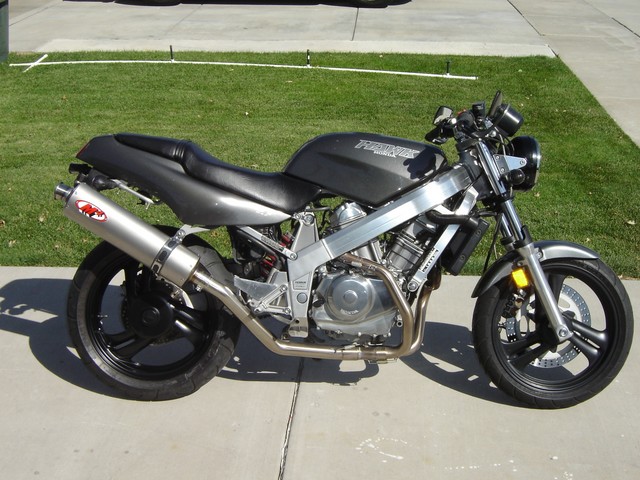
Honda NT650
The Honda NT650, commonly known as the Hawk GT in many markets, blends approachable V-twin character with naked sport touring agility. Debuting in the late 1980s, it forged a niche as a comfortable commuter, weekend canyon carver, and light tourer all in one. With its user-friendly ergonomics, maintenance-friendly design, and distinctive styling, the NT650 remains celebrated among riders seeking a reliable middleweight.
Historical Background
Development and Launch
Honda set out to create a mid-size machine that married the tractable torque of a V-twin with the nimble chassis dynamics typical of their sport bikes. The result was a 647 cc, 52° V-twin powered machine introduced in 1988. Engineers focused on rubber-mounted engine mounts to isolate vibration, Pro-Link rear suspension for ride comfort, and a minimalist bikini fairing for wind protection without excess bulk.
Market Reception
Upon release, the NT650’s smooth torque delivery, simple maintenance requirements, and upright riding position won immediate praise. It appealed to a broad demographic: new riders valued its friendly manners, experienced commuters relished its low-speed tractability, and sport-touring enthusiasts appreciated its light luggage-carrying capability. Its enduring production run until the early 2000s testifies to its widespread appeal.
Powertrain
Engine Configuration
At its core, the NT650 houses a 647 cc liquid-cooled, 52° V-twin featuring dual overhead camshafts and four valves per cylinder. Bore and stroke measure 78 mm × 67.2 mm, yielding a compression ratio of 9.0 : 1. Rubber engine mounts dampen vibration, while the DOHC layout and gear-driven cams ensure precise valve timing up to its 9 000 rpm redline.
Performance Metrics
| Specification | Figure |
|---|---|
| Peak Power | 58 hp (43 kW) @ 8 200 rpm |
| Peak Torque | 55 Nm (40 lb·ft) @ 6 000 rpm |
| Carburation | Two 35 mm CV Keihin carburetors |
| Ignition | Capacitor Discharge Ignition (CDI) |
| Transmission | 5-speed manual |
| Final Drive | 520-series chain |
Transmission and Final Drive
A five-speed gearbox features close-ratio gearing to keep the V-twin in its optimal torque band. A wet, multi-plate clutch offers light lever action for urban stop-and-go traffic. The 520-series chain drive balances durability with ease of maintenance, while a simple adjustable chain tensioner streamlines routine service.
Chassis and Suspension
Frame Design
The NT650 employs a steel diamond-type frame designed for torsional rigidity and predictable flex characteristics. Its geometry—34° rake, 114 mm trail, 1 475 mm wheelbase—strikes a balance between stability at speed and agility in tight corners.
Front Suspension
Telescopic forks with 41 mm stanchions provide 150 mm of travel. Preload adjustment on each leg lets riders fine-tune the front end for solo or two-up riding. Internally, simple damping circuits deliver compliant response over urban potholes.
Rear Suspension
Honda’s Pro-Link single-shock setup also offers 150 mm of travel and five levels of spring preload adjustment. The rising-rate linkage soaks up small irregularities and firm up progressively under heavier loads, maintaining composure under acceleration and braking.
Braking and Safety Features
The NT650’s braking package comprises a single 296 mm front disc mated to a dual-piston caliper and a single 256 mm rear disc with a single-piston caliper. Early models featured steel-braided lines at the front to enhance lever feel. Combined with a modest curb weight, the braking system delivers confident stopping power without intimidation.
Dimensions and Weight
| Specification | Metric | Imperial |
|---|---|---|
| Wheelbase | 1 475 mm | 58.1 in |
| Seat Height | 785 mm | 30.9 in |
| Ground Clearance | 160 mm | 6.3 in |
| Fuel Capacity | 17 L | 4.5 US gal |
| Dry Weight | 193 kg | 425 lb |
| Wet Weight (full) | 210 kg | 463 lb |
| Overall Length | 2 150 mm | 84.6 in |
| Overall Width | 720 mm | 28.3 in |
| Overall Height | 1 190 mm | 46.9 in |
Electrical and Instrumentation
Ignition and Charging
A CDI ignition system delivers reliable spark timing across all rpm ranges. Charging duties fall to a 310 W stator feeding a 12 V, 8 Ah battery, ensuring stable power for lighting and accessories.
Instrument Cluster and Lighting
An analog tachometer and speedometer flank a digital LCD for odometer, trip meter, and fuel warning. Indicator lights for neutral, high beam, and turn signals sit along the top. Halogen headlights and an incandescent taillight deliver adequate visibility for urban and suburban riding.
Ride and Handling
On-Road Performance
With its low center of gravity and narrow profile, the NT650 darts through traffic and carve twisty pavement with ease. The V-twin’s torquey nature allows smooth roll-on acceleration from low revs, while its chassis offers reassuring feedback when pushing the pace.
Ergonomics
An upright seating position, wide handlebar, and mid-mounted footpegs create a relaxed posture ideal for all-day riding. The lightly faired bikini nose reduces windblast without forcing the rider into a crouch, striking a versatile balance between sport and comfort.
Maintenance and Reliability
Routine servicing on the NT650 is straightforward: oil changes every 6 000 km, valve clearance checks every 12 000 km, and carburetor synchronization annually or after extended storage. Common wear items include fork seals and chain adjustment hardware, both easily serviced with basic tools. Its simple electrical layout and accessible engine architecture contribute to its reputation for bullet-proof reliability.
Variants and Legacy
During its production, Honda introduced region-specific variants such as the fully faired NT650V Deauville, featuring integrated panniers and centerstand. The Hawk GT’s blend of bulletproof V-twin performance and minimal upkeep has inspired modern reinterpretations and enduring aftermarket support. Today’s collectors prize well-kept examples for their versatility and unpretentious character.
Conclusion
The Honda NT650 stands as a testament to balanced motorcycle design. Its approachable V-twin torque, agile chassis, and easy maintenance created a machine equally at home in urban sprawls and scenic byways. Decades after its introduction, it remains a beloved choice for riders seeking reliable performance without complexity.
