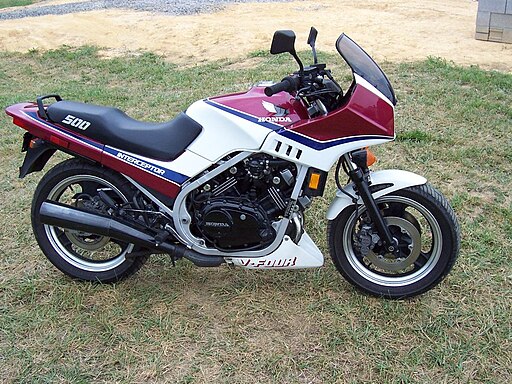
Honda VF500F
The Honda VF500F emerged in 1984 as a cutting-edge middleweight sportbike, known in North America as the Interceptor. It married a sophisticated V4 engine with agile chassis dynamics, earning acclaim for precision handling and vibrant performance. Over its three-year production run, the VF500F set new benchmarks for 500 cc machines by combining track-inspired technology with street-friendly ergonomics. Its blend of smooth power delivery, responsive brakes, and crisp steering continues to attract riders and collectors.
Historical Context
Development Origins
Honda’s engineering team leveraged lessons from larger Interceptor models to create a 498 cc V4 configuration optimized for weight distribution and compact packaging. The radial design placed two cylinders forward and two rearward, allowing for a narrow crankcase and slim overall profile. Mechanical rocker arms, adjustable at the top of the engine, enabled precise valve timing and reduced reciprocating mass. This advanced layout distinguished the VF500F from more conventional twins and triples of its era.
Market Reception
Upon launch, the VF500F drew praise for its refined power curve and exceptional cornering stability. Sport-bike reviews highlighted its ability to hold lines through fast sweepers and maintain composure under hard braking. Sales figures in Europe and North America reflected strong interest from riders seeking a balance between everyday usability and weekend track thrills. By the time production ceased in 1986, the Interceptor had cemented its reputation as one of the finest handling motorcycles of the decade.
Design and Styling
Bodywork and Fairing
Honda clothed the VF500F in a half-cover fairing with a lower cowl protecting the engine sump. The integrated wind screen and aerodynamic side panels reduced rider fatigue at speed and funneled airflow around the twin front discs. A sculpted 22 L fuel tank features subtle knee indents for rider grip, while the slender tail section tapers into a compact pillion pad. Color-matched accents and graphic stripes reinforce the bike’s sporty character.
Rider Ergonomics
The VF500F’s riding posture leans slightly forward without causing undue strain on the wrists or back. Wide, clip-on style handlebars attach to low-rise risers, striking a balance between tuck-in aerodynamics and urban maneuverability. Footpegs are positioned to allow a firm leg bend for cornering leverage, yet remain comfortable for extended commuting. A seat height of 800 mm caters to a range of rider statures, and a well-padded cushion offers support on longer jaunts.
Engine and Performance
V4 Powerplant
At its heart lies a liquid-cooled, 498 cc four-stroke V4 with a 90° cylinder angle. Four valves per cylinder, actuated by DOHC via mechanical adjustable rocker arms, maximize air intake and exhaust flow. Bore and stroke measure 60.0 × 44.0 mm, favoring a high-revving character while maintaining strong midrange thrust. A semi-dry sump lubrication system ensures consistent oil delivery under high lean angles, critical for spirited riding.
Power and Torque Figures
Peak output stands at approximately 68 hp at 11 500 rpm, with maximum torque of 30.4 lb-ft achieved around 10 500 rpm. That power curve rewards riders who keep the tachometer needle climbing, yet the V4’s overlapping powerbands deliver tractable response at lower revs. Throttle connection remains smooth thanks to constant-velocity carburetors, allowing for precise modulation during tight maneuvers. The engine’s top-end rush and crisp exhaust staccato helped define the Interceptor’s sporting image.
Fuel Delivery and Cooling
Four 32 mm CV carburetors meter the air-fuel mixture under vacuum-operated slides, providing strong off-idle punch and easy starting. A full fairing directs cooling air across the twin radiators mounted at the front of the crankcase. Thermostatic control and an electric fan maintain optimal engine temperature without compromising performance. Fuel efficiency hovers near 5 L/100 km when ridden conservatively, making the large fuel tank’s 22 L capacity both practical and confidence-inspiring.
Transmission and Final Drive
A close-ratio six-speed gearbox channels power through a roller-chain final drive. Gear ratios blend brisk acceleration in the lower gears with relaxed engine speeds at cruising velocity. A multi-plate wet clutch offers a light lever pull and positive engagement, while the six-speed spread encourages riders to explore the full sweep of the V4’s powerband. Maintenance intervals remain generous, with valve adjustments around every 16 000 km.
Chassis and Suspension
Frame Geometry
The VF500F uses a twin-loop tubular steel frame featuring a large-section down tube that doubles as an oil reservoir. This design lowers the center of gravity and tightens mass centralization. A wheelbase of 1 420 mm and a rake of 27° result in a stable yet agile platform, suited to both backroad carving and highway cruising. Controlled flex in the frame provides rider feedback without sacrificing high-speed stability.
Front Suspension
Upside-down telescopic forks with 37 mm stanchions offer 140 mm of travel and employ adjustable air preload to tailor front-end firmness. A TRAC anti-dive mechanism reduces fork dive under hard braking, preserving chassis geometry through deceleration. The integrated fork brace enhances torsional rigidity, translating into crisp turn-in and precise feedback at lean angles.
Rear Suspension
At the rear, a Pro-Link mono-spring/damper arrangement mounts to a cast aluminum swingarm. Four-position adjustable rebound damping and air-assisted preload setup accommodate solo riders or two-up touring. Rear wheel travel of 115 mm strikes a compromise between compliance over rough surfaces and firmness under cornering loads. The rising-rate linkage system ensures consistent traction under acceleration.
Brakes, Wheels and Tires
The VF500F matches dual 255 mm front discs with two-piston sliding calipers for confident stopping power. A single 255 mm rear disc with a single-piston caliper balances braking force and maintains rear-end stability. Cast alloy wheels measure 16 inches up front and 18 inches at the rear to reduce rotational inertia and quicken steering response. Stock tire sizes of 100/90-16 at the front and 110/90-18 at the rear provide a blend of vintage appearance and modern compound performance.
Dimensions, Capacity and Weight
Overall length reaches 2 075 mm, width spans 760 mm and height climbs to 1 175 mm. Seat height sits at 800 mm, and ground clearance measures 140 mm. Dry weight registers around 184 kg, rising to approximately 201 kg when fully fueled. The combination of a long wheelbase and low center of gravity yields confidence at speed, while the bike’s relatively modest curb weight keeps it agile in tight confines.
Technical Specifications
| Parameter | Specification |
|---|---|
| Engine | 498 cc liquid-cooled 90° V4, DOHC, 16 valves |
| Bore × Stroke | 60.0 mm × 44.0 mm |
| Compression Ratio | 11.0 : 1 |
| Carburetion | 4 × 32 mm constant-velocity |
| Ignition | Transistorized CDI |
| Transmission | 6-speed, multi-plate wet clutch |
| Final Drive | Roller chain |
| Frame | Tubular steel twin-loop, oil-in-frame design |
| Front Suspension | 37 mm inverted forks, 140 mm travel, TRAC |
| Rear Suspension | Pro-Link monoshock, air preload, 115 mm travel |
| Front Brake | Dual 255 mm discs, 2-piston calipers |
| Rear Brake | Single 255 mm disc, 1-piston caliper |
| Front Tire | 100/90-16 |
| Rear Tire | 110/90-18 |
| Wheelbase | 1 420 mm |
| Rake / Trail | 27° / 104 mm |
| Seat Height | 800 mm |
| Dry Weight | 184 kg |
| Fuel Capacity | 22 L |
| Top Speed | Approximately 206 km/h |
Riding Experience and Legacy
The VF500F continues to impress riders with its balanced handling, brisk acceleration, and durable design. On winding roads, the nimble chassis and progressive suspension inspire confidence, while the smooth V4 engine delivers a thrilling top-end rush. Its innovative frame and anti-dive forks influenced later sportbike architectures, and the Interceptor name lives on in modern Honda models. Today, well-maintained VF500Fs remain coveted for their blend of classic looks, cutting-edge 1980s technology, and everyday usability.
Conclusion
Honda’s VF500F Interceptor set a new standard for 500 cc sportbikes by marrying a sophisticated V4 powerplant with race-inspired chassis features. Its enduring appeal stems from an intoxicating mix of torque-rich performance, precise handling, and rider-friendly ergonomics. More than three decades after its debut, the VF500F holds a celebrated place in motorcycle history and continues to delight enthusiasts who seek a true classic with modern heart.
