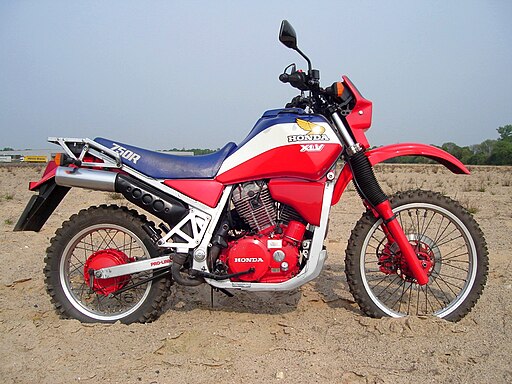
The Honda XLV750R debuted in 1983 as one of the first V-twin dual-sport motorcycles from a Japanese manufacturer. Blending adventure-ready suspension, a smooth V-twin engine, and Honda’s signature build quality, the XLV750R offered riders reliable on-road manners with genuine off-road capability. This article explores the XLV750R’s engineering highlights, performance figures, maintenance considerations, and its enduring appeal for enthusiasts.
Historical Context and Design Goals
Honda conceived the XLV750R to capture growing demand for versatile machines capable of touring, commuting, and light off-road riding. Development priorities included:
- A compact 52° V-twin powerplant for narrow width and broad torque
- Shaft final drive to minimize lubrication chores and keep the rear wheel clean
- Long-travel suspension to handle gravel tracks and forest trails
- A rugged steel cradle frame for durability under heavy use
By marrying these attributes, Honda created a motorcycle that remained comfortable on pavement yet confident when the tarmac ended.
Engine Architecture
Configuration and Dimensions
- Type: Liquid-cooled, four-stroke, 52° V-twin
- Displacement: 754 cc
- Bore × Stroke: 82.0 mm × 71.0 mm
- Compression Ratio: 9.0 : 1
Valvetrain and Induction
- Valvetrain: Single overhead camshaft (SOHC) per cylinder bank; four valves per cylinder (8 total)
- Cam Drive: Toothed belt with hydraulic tensioners
- Carburetion: 2 × Mikuni constant-velocity 30 mm carburetors
- Intake: Tuned airbox with dual resonance chambers
Soul-satisfying low-end torque is delivered smoothly thanks to the V-twin layout and progressive slide carbs, while the 9:1 compression ratio balances performance with pump-fuel friendliness.
Cooling and Lubrication
- Radiator: 3-row aluminum core with thermostatic electric fan
- Coolant Capacity: 2.8 L
- Oil System: Wet sump; total capacity 4.2 L
- Oil Filter: Spin-on cartridge under right crankcase cover
Dedicated coolant passages through each bank prevent hot spots, and the front-mounted oil cooler keeps oil temperatures in check during extended off-road runs.
Drivetrain
- Transmission: 5-speed constant-mesh gearbox
- Clutch: Wet multi-plate, cable-actuated
- Final Drive: Fully enclosed shaft with single universal joint
The 5-speed ratios favor low-speed tractability and highway cruising, while the shaft drive requires only periodic oil changes—no chain adjustment or lubrication.
Chassis and Geometry
- Frame Type: High-tensile steel double-cradle
- Wheelbase: 1 535 mm
- Rake / Trail: 27° / 110 mm
- Seat Height: 815 mm
- Ground Clearance: 265 mm
- Wet Weight: 230 kg
A reinforced cradle frame and relatively long wheelbase deliver stable handling on gravel or asphalt, with generous ground clearance to clear obstacles on forest tracks.
Suspension and Wheels
Front Suspension
- Forks: 43 mm telescopic, oil-damped, non-adjustable
- Travel: 270 mm
Rear Suspension
- Swingarm: Steel box-section with Pro-Link single shock
- Shock Adjustments: Spring preload only
- Travel: 120 mm
Wheels and Tires
- Front: 21 × 1.60 in; tire 90/90-21
- Rear: 17 × 2.15 in; tire 120/90-17
Long-travel forks soak up washboard trails, while the Pro-Link linkage offers rising-rate damping to balance comfort with mid-corner support.
Braking System
- Front Brake: Single 296 mm disc with two-piston caliper
- Rear Brake: Single 240 mm disc with single-piston caliper
- Brake Lines: Factory-rubber, upgradeable to braided steel
Adequate stopping power comes from large-diameter rotors and well-balanced calipers. Front bias ensures predictable lever feel on loose surfaces.
Electrical and Instrumentation
- Battery: 12 V / 11 Ah sealed lead-acid
- Alternator: 260 W at 5 000 rpm
- Ignition: Transistorized electronic CDI
- Lighting: 60 W halogen headlamp; LED tail conversion common
- Dash: Analog speedometer, tachometer, fuel gauge; warning lights for neutral and high beam
A simple wiring harness and blade fuses under the seat make troubleshooting straightforward in remote locations.
Performance Figures
- Peak Power: 63 hp (47 kW) @ 6 800 rpm
- Peak Torque: 65 Nm @ 5 500 rpm
- Top Speed: 165 km/h
- 0–100 km/h: 8.2 s
- Fuel Economy: 5.8 L/100 km at steady 90 km/h
- Fuel Capacity: 22 L (including 3 L reserve)
The XLV750R shines in its usable torque band, providing confident roll-on acceleration on road or trail without taxing the rider with abrupt power surges.
Maintenance Best Practices
- Valve Clearance: Check every 16 000 km; belt-driven cams simplify timing inspections
- Carburetor Synchronization: Balance every 8 000 km for smooth idle and equal fueling
- Coolant Service: Flush and replace every two years; inspect hoses for swelling
- Shaft Drive Oil: Change every 12 000 km; monitor for leaks around seals
- Brake Fluid: Flush annually with DOT 4 to avoid moisture-induced corrosion
- Suspension: Inspect fork seals and shock linkage bushings every 12 000 km; protect bearings with freshwater rinses after off-road use
Rigorous adherence to these intervals ensures the XLV750R’s hallmark reliability in demanding conditions.
Technical Specification Summary
| Parameter | Specification |
|---|---|
| Engine Type | Liquid-cooled 52° V-twin |
| Displacement | 754 cc |
| Bore × Stroke | 82.0 mm × 71.0 mm |
| Compression Ratio | 9.0 : 1 |
| Valvetrain | SOHC per bank; 4 valves/cylinder |
| Carburetion | 2 × Mikuni CV 30 mm |
| Transmission | 5-speed constant mesh |
| Final Drive | Enclosed shaft |
| Frame | Steel double-cradle |
| Front Suspension | 43 mm telescopic, 270 mm travel |
| Rear Suspension | Pro-Link single shock, 120 mm travel |
| Wheelbase | 1 535 mm |
| Wet Weight | 230 kg |
| Fuel Capacity | 22 L (3 L reserve) |
| Peak Power | 63 hp @ 6 800 rpm |
| Peak Torque | 65 Nm @ 5 500 rpm |
| Top Speed | 165 km/h |
Legacy and Aftermarket Support
Although produced for just a few years, the XLV750R has a dedicated following. Key factors sustaining its appeal include:
- Continued availability of genuine carburetor kits, rotor seals, and cam belts
- Aftermarket enhancements like upgraded fork cartridges and LED lighting conversions
- Progressive suspension rebuilds using modern damping emulators and uprated springs
- Active owner forums sharing wiring diagrams, torque settings, and trail-tested modification advice
These resources keep the XLV750R both capable on adventures and competitive in vintage rallies.
Conclusion
The Honda XLV750R remains an icon of early adventure motorcycling, offering a harmonious blend of a torquey V-twin, low-maintenance shaft drive, and true dual-sport chassis. With careful upkeep and selective upgrades, it continues to deliver versatile performance—from winding mountain roads to rugged backcountry tracks—solidifying its place in Honda’s storied heritage.
_1.jpg)