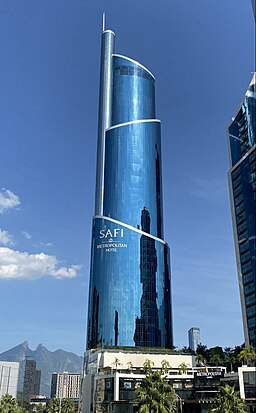
Metropolitan Center Complex (Monterrey)
The Metropolitan Center Complex in Monterrey is a landmark mixed-use development that redefines urban density in the Valle Oriente district. Completed in phases between 2014 and 2020, the project brings together residential towers, office space, a hotel, retail podium, and landscaped public areas within a single, integrated master plan [2].
Site and Urban Context
Location
The complex occupies a 24-acre site along Avenida Lázaro Cárdenas in San Pedro Garza García, one of Monterrey’s most dynamic growth corridors. Nestled at the edge of Valle Oriente, it connects high-rise living to adjacent commercial and residential neighborhoods [2].
Urban Integration
A multi-level podium anchors the towers, providing 25,000 m² of retail and dining outlets at street level. Extensive plazas, covered arcades, and green courtyards encourage pedestrian flows, activating the public realm and integrating seamlessly with the city’s transit network [2].
Master Plan and Components
The development comprises three primary towers and a shared podium:
- Tower I: Residential
- Tower II: Residential
- Tower III (Safi Metropolitan): Hotel and office
- Retail podium with five levels of shops and restaurants
- Three levels of underground parking supporting over 1,200 vehicles
Tower Profiles
| Tower Name | Height (m) | Floors Above Ground | Primary Function | Floor Area (m²) |
|---|---|---|---|---|
| Tower I | 181 | 43 | Residential | 44,000 |
| Tower II | 126 | 31 | Residential | 56,500 |
| Tower III (Hotel Safi Metropolitan) | 233 | 56 | Hotel & Office | 29,750 |
Technical Parameters
| Parameter | Specification |
|---|---|
| Gross Floor Area | 155,250 m² (entire complex) |
| Structural System | Reinforced concrete core with shear walls and flat slabs |
| Foundation | Deep-bored piles up to 60 m into bedrock |
| Façade System | High-performance curtain wall with low-iron insulated glass |
| Vertical Transportation | 24 high-speed elevators (up to 6 m/s) |
| Parking | 3 basement levels plus podium garages; > 1,200 stalls |
| HVAC | Central chillers with variable-refrigerant-flow fan coils |
| Energy Management | Integrated BMS with real-time monitoring |
| Sustainability Certification | LEED Silver for Towers II & III |
Structural System
The towers utilize a reinforced-concrete framed core that houses elevators, stairwells, and mechanical shafts. Flat slab floor plates span between shear walls, delivering column-free interiors. The deep-pile foundation, reinforced by a raft slab, transfers loads past soft alluvial soils into competent strata, ensuring seismic resilience in this high-risk zone [1][2].
Façade and Envelope
A unitized curtain-wall system wraps each tower, combining low-iron tempered glass panels with thermally broken aluminum mullions. Solar-control coatings and exterior shading fins reduce heat gain by as much as 35 percent, while insulated cavities enhance acoustic insulation from the busy arterial road below [1][2].
Building Services
Mechanical and Electrical
Centralized chillers feed variable-refrigerant-flow fan-coil units on each floor, optimizing energy use under varying occupancy loads. Heat-recovery wheels and demand-controlled ventilation minimize power draw, while LED lighting with occupancy sensors cuts lighting energy by nearly half.
Water and Waste Management
Rainwater harvesting systems collect runoff for irrigation and cooling-tower makeup. Low-flow plumbing fixtures and leak-detection sensors reduce potable water demand by over 30 percent. A dedicated waste-sorting facility within the podium streamlines recycling operations.
Sustainability Strategies
Towers II and III achieved LEED Silver certification through integrated design:
- High-efficiency building envelope and shading devices
- Smart metering and real-time energy dashboards
- Green roofs and bioretention planters on podium terraces
- Dedicated bike parking, shower facilities, and EV charging
Amenities and Programming
Residents enjoy private sky lounges, infinity pools, and fitness centers located atop their respective towers. The Hotel Safi Metropolitan (Tower III) features 200 guest rooms, banquet facilities, and a rooftop bar overlooking the Monterrey skyline. Office tenants benefit from column-free floor plates, flexible retail spaces, and on-site conference facilities.
Conclusion
The Metropolitan Center Complex exemplifies how a master-planned cluster of mixed-use towers can generate a vibrant, 24-hour urban environment. By marrying technical innovation in structure, envelope, and services with thoughtful public realms, the project sets a benchmark for high-rise, mixed-use developments in seismic Latin American cities.
