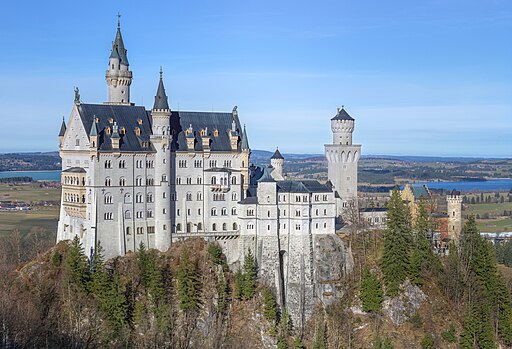
Schloss Neuschwanstein
Schloss Neuschwanstein perches on a rugged limestone ridge above the village of Hohenschwangau in the Bavarian Alps. Conceived by King Ludwig II of Bavaria as an idealized medieval retreat and homage to Richard Wagner’s operas, construction began in 1869 and carried on until the king’s untimely death in 1886. Though never fully completed, the castle’s soaring towers, decorative balconies and romantic interior spaces define it as a masterpiece of 19th-century historicism and engineering ambition.
Neuschwanstein today attracts over a million visitors a year who come to explore its mythic exterior, ascend its spiral staircases and marvel at the technical ingenuity that brought modern amenities into a fairy-tale setting.
Architectural and Technical Parameters
General Layout and Dimensions
- Plan footprint of main buildings: approximately 100 meters east–west by 60 meters north–south
- Number of levels: four main floors plus service mezzanines and a raised basement
- Signature elements: palas (residential block) with tower complex on the eastern ridge, gatehouse on the western approach, forecourt with curtain wall and turrets
Structural Engineering
- Foundation system: stepped concrete raft resting on bedrock excavated into the limestone hill, with reinforced concrete footings at load concentrations beneath towers
- Load-bearing walls: 1.2-meter-thick masonry of native limestone blocks and brick infill, faced with stucco and carved detailing
- Tower support: internal steel skeleton of I-beams and riveted girders hidden behind stone cladding to carry vertical loads and resist lateral wind forces
- Floor framing: laminated spruce beams spaced at 0.75-meter centers, supporting double-tongue-and-groove floorboards designed to meet strength and acoustic criteria
Materials and Construction Techniques
- Exterior facing: hand-cut Allgäu limestone set in lime-cement mortar, dressed into neo-Romanesque arcades and corbel tables
- Roof covering: patterned slate tiles on mansard surfaces, copper sheeting on conical spires with decorative finials
- Decorative stucco: synthetic gypsum enriched with horsehair fiber for fire resistance, molded on site into cartouches, friezes and medallions
- Ironwork: wrought-iron balcony railings and gate grilles forged with floral motifs, galvanized and hand-painted with lead-free enamel
Mechanical Systems and Utilities
- Central heating: steam boilers housed in the lower basement, distributing heat through cast-iron radiators concealed behind wooden grilles in reception halls
- Hot water supply: gravity-fed cistern system collecting spring water from the Alpsee, heated in copper storage tanks adjacent to the kitchen wing
- Sanitation: early flush toilets connected via sealed drain pipes to a gravity-driven sewage channel carved into the mountain slope
- Electrical wiring: one of the first royal residences wired for alternating current in the early 1880s, powering ornate brass light fixtures and an intercom system between floors
- Elevating platform: hidden dumb-waiter shaft rising three stories to feed the dining room from the kitchen below
History and Context
Concept and Patronage
Ludwig II envisioned a castle that embodied chivalric ideals and Wagnerian myth. His collaboration with theatrical set designer Christian Jank produced fanciful architectural sketches, which were translated into stone by architects Eduard Riedel, Georg von Dollmann and later Julius Hofmann. The king funded the project from personal means and loans, bypassing state budgets to maintain creative freedom.
Construction Phases
- 1869–1873: Site preparation, excavation and construction of the gatehouse, lower palace core and initial service wings
- 1874–1880: Rise of the principal palas and tower cluster, assembly of structural steel supports, installation of heating apparatus
- 1880–1886: Interior finishes, painting of murals in the Throne Room and Singers’ Hall, testing of electrical lighting, limited occupation by the king
Unfinished Aspirations
At the time of Ludwig’s death in 1886, only about a dozen of the projected 200 rooms were fully furnished. Subsequent Bavarian authorities opened the castle to the public, and simplified tower roofs and some plaster ornamentation were completed in the 1890s to stabilize the structure for tourists.
Interior and Decorative Features
Great Halls and Reception Rooms
- Throne Room: vaulted chamber modeled on Byzantine basilicas, featuring star-studded ceiling, porphyry columns and a gypsum mosaic floor
- Singers’ Hall: two-story assembly space with timbered roof trusses, painted panels illustrating Parsifal and Tannhäuser legends
Private Apartments
- King’s Bedroom: paneled in carved Swiss pine, outfitted with an automated Venetian glass chandelier and hand-woven tapestry drapes
- Study and Salon: walnut-paneled walls, neogothic furniture, wall paintings depicting Lohengrin’s swan-knight saga
Service and Support Areas
- Kitchen Complex: arranged on two levels with cast-iron stoves, copper pans, dumb-waiter access and storage vaults kept at 10 °C
- Staff Quarters: compact chambers with dormer windows, simple plaster finishes and communal sanitary blocks
Conservation and Restoration
Risks and Mitigation
- Freeze-thaw cycles threaten exposed limestone. Conservation teams install discreet roof drainage spouts and apply breathable consolidants to vulnerable joints.
- Visitor traffic accelerates wear on stairs and floors. Protective rubber runners and monitored access limit abrasion in high-use corridors.
Modern Upgrades
- Climate control: by 2005, installation of humidity-controlled ventilation in key exhibition rooms to preserve mural paint and stucco relief
- Structural reinforcement: post-2000 steel bracing added behind fragile parapets, anchored into new micropile foundations to resist seismic vibrations
How to Get Here
By Car
Enter “Hohenschwangau” or “Neuschwanstein Castle” into your navigation system. From Munich, drive south on the A96 to exit Landsberg am Lech and continue on B17 toward Füssen. Follow signs to Schwangau; public parking is available in four lots adjacent to the village center.
By Train and Bus
Board the regional train from Munich Hauptbahnhof toward Füssen (approx. two-hour journey). At Füssen station, transfer to bus lines 73 or 78 bound for Hohenschwangau. Disembark at the “Hohenschwangau Neuschwanstein Castles” stop.
From the Ticket Center to the Castle
- On foot: a 1.5 km uphill walk along Neuschwansteinstraße takes roughly 40 minutes.
- Shuttle bus: regular minibuses shuttle between the ticket center and the Marienbrücke viewpoint for a small fee; a 10-minute downhill walk from there leads to the entrance.
- Horse-drawn carriage: available at Hotel Müller, the carriage climbs halfway to the castle; a final 400 m uphill walk completes the journey.
Visiting Information
Guided tours run year-round in German and English, departing every five minutes once inside. Photography inside is prohibited but allowed on terraces and bridge viewpoints. Restroom facilities and a café are located at the ticket center; an elevator provides barrier-free access to the main reception floor.
Schloss Neuschwanstein remains a testament to one monarch’s dream and the technical prowess of late 19th-century engineers and artisans. Whether admired from below, explored within or photographed from Marienbrücke, its combination of fantasy and mechanical innovation continues to captivate visitors from around the world.
