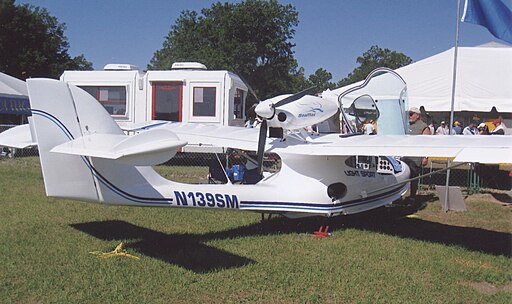
Seamax M-22
The SeaMax M-22 is a two-seat amphibious Light Sport Aircraft (LSA) that blurs the line between sleek sport plane and high-performance flying boat. Developed in Brazil and certified in the US in 2004 as the first factory-built S-LSA flying boat, the M-22 combines agile handling, efficient Rotax power, and a fully marine-capable hull. Whether you’re hopping between lakes or making that daring seaside dash, the SeaMax M-22 delivers unmatched freedom and versatility.
Design & Development
Origins and Certification
SeaMax began design work in 1998, aiming to create an LSA that would meet both FAA Light-Sport rules and European microlight standards. The prototype first flew in 2001, and by 2004 the U.S. FAA had granted Special-Light Sport Aircraft certification—making the M-22 the first factory-built amphibian approved under the new LSA category.
Airframe Layout
At its heart is a composite hull that doubles as a boat’s planing surface, complete with integrated spray rails and chine steps for smooth water handling. Above that sits a carbon-fiber, strut-braced wing and a torsion-rigid tailboom, giving the M-22 its signature clean lines and responsive control feel.
Airframe & Construction
Hull and Floats
• Fiberglass-composite hull with integrated spray rails for minimal water spray to prop and struts • Retractable main wheels that fold into belly fairings, preserving the hull’s smooth underwater profile • Reinforced chine step at the stern for quick transition from displacement to planing mode
Wing and Empennage
• High-wing, strut-braced design with 12.24 m² (131.8 ft²) wing area • 8.75 m (28 ft 8 in) wingspan for compact storage yet stable cruise • Electro-mechanical flaps spanning 20% chord, delivering low-speed lift for water landings • Boom-mounted cruciform tail with all-composite rudder and elevator
Technical Specifications
Dimensions & Weights
• Crew/Passengers: 1 + 1 • Wingspan: 8.75 m (28 ft 8 in) • Length overall: 6.05 m (19 ft 10 in) • Height: 2.70 m (8 ft 10 in) • Empty weight: 300 kg (661 lb) • Maximum gross weight: 520 kg (1 146 lb)
Powerplant & Fuel
• Engine: 1 × Rotax 912ULS, 75 kW (101 hp), four-cylinder, air- and liquid-cooled four-stroke • Propeller: Three-blade composite, ground-adjustable pitch • Fuel capacity: 96 L (25 US gal) in fuselage tanks
Performance
• Maximum speed (Vne): 113 kt (209 km/h) • Cruise speed: 100 kt (185 km/h) at 75% power • Stall speed (flaps down): 31 kt (57 km/h) • Rate of climb: 1 000 ft/min (5 m/s) • Range: approx. 500 NM (925 km) with reserves • Service ceiling: 15 000 ft (4 570 m) • Takeoff distance (land): 400 ft (122 m); (water): 600 ft (183 m) • Landing distance (land): 500 ft (152 m); (water): 700 ft (213 m)
Cockpit & Avionics
Ergonomics and Visibility
The SeaMax cockpit features wraparound glazing, giving nearly unobstructed panoramic views both in flight and at the dock. Seats are adjustable fore-and-aft, accommodating a wide range of pilot sizes, and a center-mount joystick and optional rudder-trim brake simplify foot-pedal management.
Standard Equipment
• Full dual-analog flight instruments: airspeed, altimeter, VSI, turn coordinator • Engine monitor: RPM, oil temperature/pressure, cylinder head temperature, exhaust gas temperature • GPS-NAV/COM with built-in traffic and terrain options • Garmin Aera-style touchscreen upgrade available
Amphibious Capabilities
Water Handling
Spray rails and a stepped hull let the M-22 break free of the water’s surface in under 200 m run-on. The boat-approved hull shape ensures predictable braking and tight turns on water, while self-bailing scuppers drain any deck water in seconds.
Shore Operations
Manually retractable main gear tuck neatly against aerodynamic fairings. Nose-wheel steering aids dockside maneuvering, and a fold-down boarding ladder on the starboard side eases entry from dinghies or piers.
Safety Features
Structural Integrity
• Full-airframe crashworthiness meets ASTM international standards for LSAs • Sponson-style wing tips add buoyancy and roll stability on water • Energy-absorbing seats and four-point harnesses protect occupants in hard landings
Emergency Systems
• Optional ballistic-parachute airframe recovery system (BRS) deploys on command and can lower the entire aircraft under canopy • Automatic CO detector and fire-resistant fuel lines
Operating Costs & Maintenance
Fuel Efficiency
Thanks to the Rotax 912ULS’s frugal consumption (approx. 15 L/hr at cruise), the M-22’s direct operating cost hovers around $50–$60 USD per hour (fuel at $1.50 USD/L).
Routine Maintenance
• 100-hour engine inspection interval (standard Rotax TBO: 2 000 h) • Annual hull inspection for seal integrity and sponson wear • Flap and gear actuator lubrication every 100 h
Buying and Ownership Tips
Pre-Purchase Checklist
• Verify full logbook: engine, hull, propeller, spars, and avionics records • Check water-testing logs: hull step integrity, spray rail attachment, scupper functionality • Inspect corrosion-protected fittings, especially around hull fasteners and gear linkages
Training Recommendations
• Amphibious-specific flight training to master water-speed judgment, glass conditions, and docking techniques • Sea survival and ditching drills if you’ll operate beyond marked waterways
Conclusion
The SeaMax M-22 stands out as a true amphibian LSA: refined, efficient, and ready to explore both tarmacs and quiet coves. Its combination of light sport simplicity, robust construction, and marine-grade hull design makes it an ideal choice for pilots seeking a single-engine aircraft that can turn any lake into a runaway and any quiet strip into a waterfront aerodrome. Whether for weekend adventures, flight school seaplane ratings, or simply the thrill of splash-and-go, the M-22 delivers a uniquely liberating flying experience.
