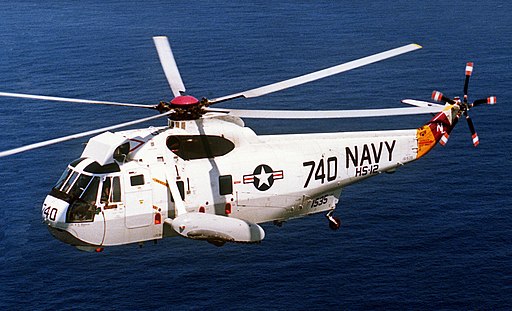
Sikorsky SH-3 Sea King
Sikorsky SH-3 Sea King: The Naval Workhorse That Redefined Maritime Helicopter Operations
The Sikorsky SH-3 Sea King was a revolutionary maritime helicopter that reshaped naval aviation and anti-submarine warfare (ASW) during the Cold War. Designed and manufactured by Sikorsky Aircraft, the SH-3 was the first helicopter in the world capable of performing all-weather, day-and-night ASW missions from aircraft carriers and frigates. It also became the world’s first amphibious helicopter, featuring a watertight hull that allowed it to land on water — a unique attribute that added layers of versatility to its operational use.
Introduced in the early 1960s, the SH-3 Sea King remained in service for over five decades with navies around the world. Its adaptability, long-range capabilities, and robust design made it a platform for not only ASW but also search and rescue (SAR), transport, mine countermeasures, and even VIP transport — famously including U.S. Presidential duty.
This article explores the technical depth, operational evolution, and enduring legacy of the SH-3 Sea King.
Historical Context
The development of the SH-3 began in the late 1950s, as the U.S. Navy sought a helicopter that could detect, localize, and engage Soviet submarines far from fleet formations. At the time, ASW relied heavily on shipborne systems and short-range aircraft that lacked endurance and comprehensive capability.
Sikorsky’s solution, the S-61, was selected by the U.S. Navy as the basis for a new ASW platform. The Navy designated it SH-3A, and it first flew in March 1959, entering operational service in 1961.
The SH-3 Sea King’s introduction represented several firsts:
- First twin-turbine helicopter to enter U.S. Navy service
- First amphibious rotary-wing ASW platform
- First to combine detection, tracking, and attack capabilities in one airframe
Airframe and Design Features
The SH-3 was built with durability and versatility in mind. It featured a boat-shaped fuselage, allowing water landings and enabling long overwater missions with enhanced survivability in the event of engine failure or fuel exhaustion.
Structural Overview
- Fuselage construction: Semi-monocoque aluminum alloy frame with watertight lower hull
- Length (overall): 22.15 meters (72 ft 8 in) with rotors turning
- Fuselage length: 17.02 meters (55 ft 10 in)
- Height: 5.13 meters (16 ft 10 in)
- Main rotor diameter: 18.90 meters (62 ft 0 in)
- Tail rotor diameter: 2.59 meters (8 ft 6 in)
- Empty weight: ~5,820 kg (12,833 lb)
- Max takeoff weight: ~9,707 kg (21,400 lb)
Amphibious Features
- Hull-shaped lower fuselage with sponsons for buoyancy
- Self-sealing compartments
- Corrosion-resistant materials and sealing for extended maritime operations
The main rotor system had five blades and was fully articulated, featuring automatic blade folding to facilitate shipboard storage. The tail rotor was mounted on the port side of the vertical stabilizer.
Propulsion and Powerplant
The SH-3 was powered by two General Electric T58 turboshaft engines, mounted on either side of the top of the fuselage.
Engine Specifications
- Model: General Electric T58-GE-10 (in later models)
- Type: Free-turbine turboshaft
- Power output: 1,400 shp (1,044 kW) each
- Transmission: Single main gearbox driving both main and tail rotors
- Fuel capacity: Up to 1,768 liters (467 US gallons)
- Range: Approx. 1,000 km (620 miles)
- Endurance: Up to 4.5 hours (with standard internal fuel)
The twin-engine configuration gave the SH-3 excellent redundancy and survivability over long stretches of open ocean, a key factor for ASW missions.
Avionics and Sensor Suite
One of the most defining characteristics of the SH-3 was its integrated ASW sensor suite, allowing it to detect and engage submarines independently.
ASW Equipment
- Dipping sonar: AN/AQS-13 (later AN/AQS-18)
- Deployable sonar transducer with variable depth
- Sonobuoy dispenser system: Capable of launching passive and active buoys
- Magnetic anomaly detector (MAD): Tail-mounted boom to detect submarine magnetic signatures
- Radar: Search radar (e.g., AN/APS-88 or APS-124), mounted in the nose for surface search
- ESM (Electronic Support Measures): To detect radar and communications emissions
Cockpit Avionics
- Dual-pilot IFR cockpit
- Doppler navigation system
- TACAN and VOR receivers
- Autopilot and stability augmentation
- Night vision-compatible instrument lighting (in later variants)
Crew and Internal Configuration
A typical SH-3 carried a crew of four to five, including:
- Pilot
- Co-pilot
- Tactical coordinator (TACCO)
- Sensor operator(s) / sonar operator
- Optional rescue swimmer or loadmaster depending on mission
The cabin could be configured for ASW equipment, stretchers and rescue gear (SAR), or VIP seating. It had a rear sliding door on the starboard side and provisions for cargo loading and external sling operations.
Armament and Payload
While the SH-3 was not a heavily armed aircraft, it had provisions to carry a variety of ASW and rescue equipment.
Weapons Loadout (ASW Configuration)
- Torpedoes:
- 2 × Mk 44 or Mk 46 lightweight ASW torpedoes
- Depth charges:
- Mk 54 depth bombs (less common)
- External stores:
- Carried on fuselage-mounted pylons under the sponsons
Rescue Equipment (SAR Configuration)
- Rescue hoist with 270 kg (600 lb) lift capacity
- Medical stretchers and seating for casualties
- Life rafts and survival kits
The aircraft could also carry external cargo slings for logistics missions.
Performance Specifications
| Parameter | Value |
|---|---|
| Max Speed | 267 km/h (166 mph, 144 knots) |
| Cruise Speed | 230 km/h (143 mph) |
| Range | 1,000 km (620 mi) |
| Combat Radius | 370 km (230 mi) with loiter time |
| Endurance | Up to 4.5 hours |
| Service Ceiling | 4,600 m (15,100 ft) |
| Rate of Climb | 7.9 m/s (1,550 ft/min) |
| Hover Ceiling (OGE) | 1,830 m (6,000 ft) |
Operational History
The SH-3 Sea King served with distinction in a wide array of operational contexts:
- U.S. Navy: Core ASW platform from the 1960s through the 1990s
- Presidential Helicopter (Marine One): Modified VH-3D variant used for executive transport
- NASA recovery operations: Famously retrieved Apollo astronauts from splashdowns
- Search and Rescue: Used by both military and civil services, including life-saving missions in combat and disaster zones
- Combat support: Logistics, medical evacuation, and special forces insertion
Internationally, the SH-3 was licensed and produced or operated by:
- Italy (Agusta-Sikorsky ASH-3)
- United Kingdom (as the Westland Sea King)
- Japan, Brazil, Canada, Spain, Iran, and others
Variants
Key U.S. variants included:
- SH-3A: Initial production model
- SH-3D: Improved engines and avionics
- SH-3G: Utility/cargo transport variant
- HH-3A: Combat Search and Rescue (CSAR)
- VH-3D: Executive transport (Marine One)
- CH-124: Canadian variant with customized ASW suite
Foreign derivatives like the Westland Sea King introduced major changes, including British avionics and Rolls-Royce Gnome engines.
Legacy and Retirement
After decades of faithful service, the SH-3 Sea King began being phased out in favor of more modern platforms like the Sikorsky SH-60 Seahawk and the AgustaWestland AW101. However, many nations continued to operate and upgrade their Sea Kings into the 21st century.
The Sea King’s legacy is immense:
- It defined the modern naval helicopter
- It proved the viability of over-the-horizon ASW capability
- It served as a backbone of global humanitarian and rescue efforts
- It became a Cold War icon of reliability and ruggedness
Conclusion
The Sikorsky SH-3 Sea King was far more than a helicopter — it was a maritime systems platform that carried out some of the most crucial missions of the Cold War and beyond. With its blend of amphibious design, advanced sensors, long range, and multi-role flexibility, it helped define what a maritime helicopter could be. Even decades after its retirement, its rotorwash still echoes through naval aviation history.
.jpg)