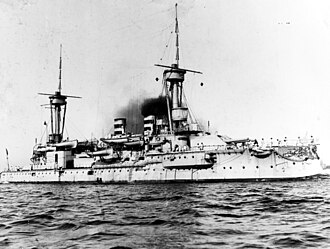
SMS Wörth: The Brandenburg-Class Battleship That Bridged Two Naval Eras
SMS Wörth was one of the earliest modern battleships of the Imperial German Navy and a particularly revealing example of how rapidly naval technology evolved during the final years of the nineteenth century. The last of the four Brandenburg-class battleships to be launched, Wörth was nevertheless the first member of her class to enter active service. Built by Germaniawerft at Kiel, she was laid down in March 1890, launched on 6 August 1892, and commissioned on 31 October 1893. At the time of her completion, she represented a major change in German naval policy: instead of concentrating primarily on coastal-defense vessels, Germany was beginning to construct large, ocean-going battleships capable of operating as part of a battle fleet.
The ship was an unusual and ambitious design. Her most striking characteristic was her main battery of six 28 cm guns arranged in three twin turrets. Most contemporary battleships carried four heavy guns, normally grouped into two twin turrets, so the Brandenburg class possessed an unusually powerful broadside. Wörth was also protected by a substantial armored belt, barbettes, turrets, and conning tower, while her two triple-expansion engines gave her a maximum speed of roughly 16.5 knots. These characteristics made her a formidable warship when she entered service, although the very speed of battleship development meant that her technological advantage would last only a relatively short time.
Her career was largely peaceful, but it included an important overseas deployment during the Boxer Uprising in China in 1900–1901. Later, after modernization and the arrival of newer German battleships, Wörth was relegated to secondary duties. She survived into the First World War but by then was obsolete as a frontline battleship. Her eventual conversion to an accommodation ship and scrapping after the war marked the end of a career that had begun during the formative period of Germany’s modern naval expansion.
The Birth of the Brandenburg Class
Germany’s First Modern Ocean-Going Battleships
The origins of Wörth lie in a major change in German naval thinking during the late 1880s. Before Kaiser Wilhelm II came to the throne, the German Navy had invested heavily in coastal-defense ships, reflecting the belief that the fleet’s principal mission was to protect Germany’s coastline and maritime approaches. The new imperial leadership increasingly favored a fleet containing large battleships capable of operating on the open sea. In 1888, Admiral Alexander von Monts replaced Leo von Caprivi as head of the German Naval Office and advocated a program that included four large battleships. Those ships became the Brandenburg class.
The four vessels were Brandenburg, Kurfürst Friedrich Wilhelm, Weissenburg, and Wörth. They were ordered as roughly 10,000-ton ships, a substantial increase over many of the coastal-defense vessels that had preceded them. Their construction was part of Germany’s gradual transition toward a battle fleet and, in retrospect, represented an early foundation for the much larger naval program that would later be associated with Admiral Alfred von Tirpitz.
The choice of names also reflected Germany’s military traditions. Wörth commemorated the Battle of Wörth, fought during the Franco-Prussian War on 6 August 1870. The ship was therefore named after a German victory from the recent national conflict that had helped establish the German Empire.
Construction of Wörth proceeded more slowly than that of her three sisters. Her keel was laid at Germaniawerft in Kiel on 3 March 1890, but the hull was not launched until 6 August 1892, several months after the other Brandenburg-class ships. Once launched, however, fitting-out proceeded rapidly. She was commissioned on 31 October 1893, making her the first Brandenburg-class ship to enter active service despite being the last to leave the building ways.
A Radical Main Battery
The most remarkable feature of Wörth was her armament. Six 28 cm guns were mounted in three twin turrets, with one turret forward, one aft, and another positioned amidships. Four of the guns were 28 cm L/40 weapons, while the central turret carried two shorter L/35 guns. The arrangement was unconventional, but it gave the Brandenburg class a six-gun broadside at a time when four heavy guns were more typical of contemporary battleships.
The central turret was the most controversial part of the design. Its guns were shorter and had somewhat less favorable firing characteristics than those in the forward and rear turrets. Nevertheless, the arrangement reflected the designers’ determination to maximize heavy-gun firepower within a relatively compact displacement. Battleship design was still highly experimental in the early 1890s, and naval architects had not yet settled on the basic configuration that would eventually lead to the all-big-gun dreadnought.
The secondary armament consisted of eight 10.5 cm quick-firing guns and eight 8.8 cm quick-firing guns, supplemented by smaller weapons and six 45 cm torpedo tubes. This combination was intended to defend the battleship against torpedo boats while giving her additional offensive capability at shorter ranges.
The ship’s armor was equally significant. Wörth possessed a main belt reaching approximately 400 mm in its thickest section, with substantial protection around the ammunition spaces and machinery. Her barbettes were protected by approximately 300 mm of armor, while the armored deck was about 60 mm thick. The conning tower also received extremely heavy protection.
In combination, this armor and firepower made Wörth a formidable capital ship for the early 1890s. She was not especially fast by later standards, but battleship tactics at the time emphasized armored battle lines in which the ability to absorb and return heavy gunfire was considered more important than the high speeds that later became characteristic of dreadnought fleets.
Entering German Fleet Service
The First Years of Wörth
After commissioning, Wörth underwent sea trials and joined the active German battle fleet. Her early career centered on exercises and maneuvers, activities that were extremely important to a navy still developing its experience with large formations of modern battleships. The ship’s early assignment was particularly significant because the Brandenburg class was intended to form the nucleus of a more capable German battle fleet.
In August 1894, Wörth became the flagship for the annual autumn fleet exercises under Admiral Max von der Goltz. Kaiser Wilhelm II visited the ship, and the vessel took part in a fleet parade in September. Her association with senior naval commanders and members of the imperial family reflected the political importance attached to these new battleships.
The ship also had connections with officers who would later become prominent figures in German naval history. Prince Heinrich of Prussia, the younger brother of Kaiser Wilhelm II, commanded Wörth for a period, while Franz von Hipper served aboard her as a senior watch officer. Hipper would eventually command the German battlecruiser forces during the First World War.
These details illustrate an important aspect of Wörth‘s historical significance. She was not merely a warship but part of the institutional development of the Imperial German Navy. Officers trained aboard ships such as Wörth would later occupy senior positions in a fleet that became one of the most powerful naval forces in Europe.
A Ship Built for Exercises Rather Than Battle
Despite her impressive appearance and heavy armament, Wörth never fought a major naval battle while serving under the German flag. Much of her operational life consisted of exercises, maneuvers, training cruises, and ceremonial duties. This was not unusual for German battleships before the First World War. The Imperial Navy was created during a period of intense naval competition, but Germany’s most important battleships spent much of their peacetime careers preparing for a war that had not yet arrived.
The exercises were nevertheless essential. Large warships had to practice maneuvering in formation, communicating through flags and signals, coordinating gunfire, managing their engines, and maintaining readiness. These skills would become increasingly sophisticated as German naval doctrine developed.
The Boxer Uprising and the Voyage to China
Germany’s Overseas Expedition
The most dramatic deployment of Wörth‘s German career came in 1900, when the four Brandenburg-class battleships were sent to China during the Boxer Uprising. Germany joined the international intervention intended to protect foreign interests and relieve the besieged international legations in Beijing. The dispatch of four major battleships demonstrated that Germany could deploy a substantial force of capital ships far beyond European waters.
The voyage itself was a major logistical undertaking. Wörth and her sisters passed through the Indian Ocean and reached Colombo in August 1900 before continuing through the Strait of Malacca to Singapore. From there they sailed to Hong Kong and subsequently reached the waters off Shanghai.
When the German force arrived, however, the international expedition had already relieved Beijing. As a result, Wörth did not experience the major combat for which her guns had been designed. Instead, she was used to support German operations and protect the movement of expeditionary forces.
Operations Around the Yangtze
One of Wörth‘s principal duties was connected with the German expeditionary corps. She helped cover the disembarkation of German troops in the vicinity of the Taku Forts, while later operations included participation in the blockade of the Yangtze River.
These duties were less glamorous than a fleet battle, but they demonstrated the versatility of a battleship. A ship of Wörth‘s size could act as a floating base, protect troop movements, deter hostile forces, and provide heavy artillery if required. Her deployment also gave German crews valuable experience in maintaining a large battleship far from home.
The expedition exposed the enormous logistical demands of global naval operations. Coal had to be secured, machinery maintained, ammunition supplied, and crews rested. The German Navy’s ability to keep four large battleships operating in East Asian waters was an important demonstration of its growing international reach.
By late 1900 and early 1901, the situation in China had calmed sufficiently for the battleships to undergo maintenance and overhaul. Wörth went to Nagasaki, where she remained from the end of November until late December 1900.
The Decline of a Once-Modern Battleship
The Speed of Naval Technological Change
When Wörth entered service in 1893, she was one of the most powerful battleships in the German fleet. By the early twentieth century, however, the standards had changed dramatically. Newer battleships were larger, faster, better protected, and equipped with more effective secondary batteries and improved fire-control systems.
This rapid technological change was one of the defining characteristics of the pre-dreadnought period. Naval architecture was evolving so quickly that a ship could be considered cutting-edge at launch and substantially outdated within fifteen years. The Brandenburg class was particularly vulnerable because its unusual three-turret arrangement represented a transitional design philosophy rather than the standardized layout that eventually emerged.
The modernization of older battleships could improve their usefulness, but it could not completely transform their basic hulls. A ship designed around 1890 remained constrained by its original dimensions, machinery, armor distribution, and internal arrangements.
The arrival of HMS Dreadnought in 1906 made the difference even more obvious. The revolutionary British battleship combined ten heavy guns with turbine propulsion and a speed comparable to or better than many existing battleships. Although Wörth was already aging before Dreadnought entered service, the new generation made the older pre-dreadnoughts appear even more obsolete.
Service During the First World War
From Battleship to Coastal Defense
Despite her age, Wörth was still retained when the First World War began in 1914. Germany had insufficient reason to discard every older battleship immediately, and ships like Wörth could still perform useful secondary functions. Her heavy armor and guns remained potentially valuable for coastal defense even though she was no longer suitable for a confrontation with modern dreadnoughts.
During the war, Wörth and her sister Brandenburg were increasingly relegated to defensive and support roles. In 1915 they were reduced to coastal-defense ships, reflecting their declining value as mobile fleet units. By 1916, Wörth had been converted into an accommodation ship.
This was a remarkable transformation. The same vessel that had once served as a fleet flagship was now primarily a floating barracks. Yet this was a practical use for a large, relatively stable hull with extensive internal spaces. It allowed the German Navy to preserve useful infrastructure without committing the ship to dangerous frontline operations.
The End of the Ship
Wörth survived the First World War. Unlike the Brandenburg-class ships sold to the Ottoman Empire, she did not experience another national identity or a second combat career. After the war, the former battleship was eventually sold for scrap and dismantled in 1919.
Her disposal brought an end to a career that had lasted more than a quarter of a century. During those years she had gone from one of Germany’s newest and most prestigious capital ships to an obsolete accommodation vessel.
The Historical Importance of SMS Wörth
A Milestone in German Naval Development
The importance of Wörth lies less in battles won or enemies sunk than in what she represented. She belonged to the first generation of German battleships specifically intended for sustained fleet operations at sea. The Brandenburg class therefore marked an important step toward the powerful High Seas Fleet that Germany would possess two decades later.
The ship’s unusual design also provides a snapshot of naval thinking before the dreadnought revolution. Her six heavy guns represented an attempt to maximize broadside firepower, while her thick armor reflected the prevailing belief that battleships should survive punishment in a close-range gun battle. The design was powerful but transitional, occupying the space between the heavily armored ships of the 1880s and the standardized all-big-gun battleships of the twentieth century.
A Witness to the Transformation of Naval Warfare
Wörth‘s career also demonstrates the extraordinary pace of technological change. She was laid down when armored ships still carried a mixture of heavy and medium artillery and when naval engineers were experimenting with turret arrangements. By the time she was scrapped, battleships had become vastly larger, turbine-powered, and increasingly dependent on sophisticated fire-control systems.
Her experience in China additionally illustrates the globalization of naval power. A German battleship could travel from the North Sea to East Asia, operate alongside an international expedition, and return home. Such deployments would have been extraordinary for earlier generations of German warships, but they were becoming increasingly normal as Germany developed its overseas naval ambitions.
Technical Specifications of SMS Wörth
The exact figures vary somewhat among historical references because specifications could be reported at different load conditions and because the ship’s armament and equipment changed during her career. The figures below represent the ship primarily in her original German configuration. Sources give a normal displacement of about 10,501 tonnes and a full-load displacement of approximately 10,670 tonnes, with a length of 115.7 meters, beam of 19.5 meters, and a designed maximum speed of approximately 16.5 knots.
| Specification | SMS Wörth |
|---|---|
| Class | Brandenburg class |
| Type | Pre-dreadnought battleship |
| Builder | Germaniawerft, Kiel |
| Laid down | 3 March 1890 |
| Launched | 6 August 1892 |
| Commissioned | 31 October 1893 |
| Length overall | 115.7 m |
| Beam | 19.5 m |
| Draft | Approximately 7.9 m |
| Normal displacement | Approximately 10,501 tonnes |
| Full-load displacement | Approximately 10,670 tonnes |
| Propulsion | 2 vertical triple-expansion steam engines |
| Boilers | 12 cylindrical Scotch marine boilers |
| Shafts | 2 |
| Power | Approximately 10,000–10,228 PS |
| Maximum speed | Approximately 16.5 knots |
| Range | Approximately 4,300 nautical miles at 10 knots |
| Fuel | Coal, approximately 1,050 tonnes |
| Main armament | 6 × 28 cm guns |
| Main-gun arrangement | 3 × twin turrets |
| Main guns | 4 × 28 cm L/40 and 2 × 28 cm L/35 |
| Secondary armament | 8 × 10.5 cm quick-firing guns |
| Additional armament | 8 × 8.8 cm quick-firing guns and 12 × 3.7 cm revolver cannon |
| Torpedo armament | 6 × 45 cm torpedo tubes |
| Main belt armor | Approximately 305–406 mm |
| Armored deck | Approximately 60 mm |
| Barbette armor | Approximately 300 mm |
| Turret armor | Approximately 120–127 mm |
| Conning tower armor | Up to approximately 300 mm |
| Crew | Approximately 568 personnel |
| World War I role | Coastal-defense ship and later accommodation ship |
| Final fate | Scrapped after the First World War, 1919 |
Conclusion
SMS Wörth was a warship born at a pivotal moment in German and European naval history. When she was conceived, Germany was only beginning to move toward a modern ocean-going battle fleet. When she entered service in 1893, her six 28 cm guns and exceptionally heavy armor made her an impressive capital ship. She belonged to a new generation of German battleships that demonstrated that the Imperial Navy intended to become more than a force designed simply to defend the coastline.
Her operational career was quieter than her appearance might suggest. She never fought the great battleship engagements for which she had been designed, but her peacetime fleet service helped train officers and crews who would later form part of Germany’s increasingly sophisticated naval establishment. Her deployment to China during the Boxer Uprising further demonstrated the growing ability of the German Navy to project military power far from Europe.
Yet perhaps the most revealing part of Wörth‘s history is the speed with which she became obsolete. The battleship that had represented modern naval power in the 1890s was already a secondary asset by the time the First World War began. The arrival of dreadnoughts, improved machinery, increasingly sophisticated artillery, and new methods of naval warfare had changed the meaning of battleship power.
Even so, Wörth remained useful. She served as a coastal-defense vessel and ultimately as an accommodation ship, proving that an obsolete warship could still contribute to a navy long after her frontline career had ended. Her scrapping in 1919 closed the chapter on one of the Imperial German Navy’s pioneering capital ships.
Today, Wörth is best remembered not as a famous combatant but as a representative of naval transition. Her unusual three-turret battery, massive armor, overseas deployment, and long service life encapsulate the extraordinary evolution of battleship design between the Franco-Prussian War and the First World War. In that sense, SMS Wörth was more than one ship among four Brandenburg-class sisters: she was a tangible link between the experimental armored fleets of the nineteenth century and the industrial battleship warfare that would dominate the twentieth.
