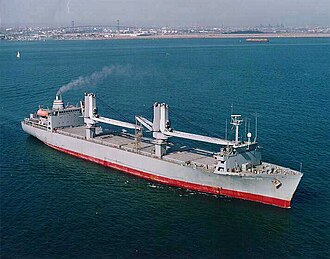
A Floating Heavy-Lift Platform Built for Strategic Logistics
When people think about military sealift, their minds often turn to enormous roll-on/roll-off cargo ships transporting tanks or fast sealift vessels racing across oceans with armored vehicles aboard. Yet another category of support ship has quietly played an equally important role in ensuring that military cargo reaches the battlefield: the crane ship. Among the most capable examples of this specialized type is SS Cornhusker State (T-ACS-6), a vessel whose mission is not merely transporting cargo but enabling it to be unloaded when ports lack adequate infrastructure. In many military operations, particularly those involving undeveloped coastlines or damaged harbor facilities, the ability to transfer containers, vehicles, and heavy equipment without relying on shore-based cranes can determine how quickly a force becomes operational. Cornhusker State was created specifically to solve that problem.
Unlike conventional cargo ships, Cornhusker State is equipped with powerful heavy-lift cranes capable of moving hundreds of tons of cargo each hour. This unique capability allows the ship to serve as a floating cargo terminal, transferring containers, vehicles, engineering equipment, and military supplies between vessels, barges, and temporary logistics platforms. Such flexibility makes her an indispensable component of the United States’ strategic sealift capability, especially during expeditionary operations where permanent port facilities may be unavailable or severely damaged.
Although she now serves as part of the Ready Reserve Force (RRF) under the U.S. Maritime Administration (MARAD), Cornhusker State did not begin her career as a military vessel. Like many ships that later entered government service, she was originally constructed for commercial trade during the rapid expansion of international container shipping in the late twentieth century. Her transformation from merchant ship to crane ship illustrates how civilian maritime technology can be adapted to satisfy specialized military requirements without the need to design entirely new vessels from scratch.
Throughout her decades of service, Cornhusker State has participated in military readiness exercises, supported strategic logistics planning, and stood ready for activation whenever the United States required additional sealift capability. Although she has rarely appeared in headlines, ships like Cornhusker State represent the invisible infrastructure behind global military operations. They ensure that cargo continues moving even when conventional ports cannot support the enormous logistical demands of modern warfare.
The Evolution of Container Shipping
A Revolution in Maritime Transportation
The origins of Cornhusker State are closely connected to one of the most significant changes in maritime commerce: the widespread adoption of containerization. Before standardized containers became common, cargo was loaded piece by piece into a ship’s holds, a labor-intensive process requiring days of work and thousands of individual handling operations. Every crate, pallet, barrel, or machine had to be lifted separately, increasing loading times, labor costs, and the likelihood of cargo damage.
The introduction of standardized steel containers fundamentally changed this process. Containers could be transferred seamlessly between trucks, trains, and ships, reducing loading times from days to hours while dramatically improving efficiency. Shipping companies responded by commissioning increasingly specialized container vessels capable of carrying hundreds and eventually thousands of containers across international trade routes.
During the 1970s, commercial shipbuilders focused on creating larger, stronger, and more efficient container ships that could support the rapidly growing volume of global trade. Among these new vessels was SS C.V. Stag Hound, the ship that would eventually become SS Cornhusker State.
Constructed by Sun Shipbuilding & Dry Dock Company in Chester, Pennsylvania, C.V. Stag Hound entered service as a modern container ship designed to transport standardized cargo efficiently between major ports. At the time of her completion, few could have predicted that her commercial career would eventually lead to an entirely different role supporting military logistics.
SS C.V. Stag Hound
Built for Commercial Service
Originally delivered in the early 1980s, C.V. Stag Hound represented the advanced commercial shipbuilding practices of her era. She was designed as a cellular container ship, meaning that her cargo holds incorporated fixed vertical guide structures allowing containers to be stacked securely and efficiently within the hull. This design minimized cargo movement during heavy weather while maximizing carrying capacity.
Like many commercial vessels of the period, the ship emphasized operational efficiency rather than speed alone. Reliable diesel propulsion, large cargo capacity, and economical fuel consumption made her well suited for international liner service. The vessel spent her early career transporting containerized cargo between ports in North America and overseas destinations, participating in the rapidly expanding global shipping industry.
Commercial operators valued ships such as C.V. Stag Hound because they offered predictable schedules and efficient cargo handling in well-developed ports equipped with large container cranes. However, military planners viewed these vessels from a different perspective. While commercial shipping relied upon sophisticated terminal infrastructure, military operations often occurred in locations where such facilities either did not exist or had been damaged by conflict.
This difference would eventually inspire the ship’s remarkable transformation.
Strategic Lessons from Military Logistics
The Challenge of Limited Port Infrastructure
Throughout the twentieth century, military planners repeatedly encountered the same logistical problem during overseas operations: cargo ships could reach a destination, but unloading them proved far more difficult. Modern military deployments require enormous quantities of vehicles, engineering equipment, ammunition, construction materials, fuel systems, medical supplies, and containerized cargo. In developed commercial ports, shore-based cranes can unload this cargo rapidly. In undeveloped regions—or after natural disasters or wartime destruction—those cranes may be unavailable.
The United States carefully studied these logistical challenges following conflicts such as Vietnam and during Cold War planning for large-scale overseas deployments. Analysts concluded that future operations required ships capable of functioning independently of existing port infrastructure.
One solution involved developing floating heavy-lift capability through specialized crane ships. Rather than depending on docks equipped with cargo cranes, these vessels would carry their own lifting equipment powerful enough to unload cargo directly onto barges, lighterage systems, or temporary logistics facilities.
This concept dramatically increased operational flexibility and reduced dependence upon fixed infrastructure that might not be available during military emergencies.
Acquisition by the U.S. Government
A New Mission Begins
Recognizing the potential value of existing commercial container ships, the U.S. Maritime Administration began acquiring suitable vessels for conversion into crane ships during the 1980s. C.V. Stag Hound proved to be an excellent candidate because of her robust construction, large cargo spaces, and adaptable design.
The vessel was purchased by the U.S. government and entered an extensive conversion program that fundamentally changed her purpose. Rather than carrying containers in commercial service, she would become a floating heavy-lift platform capable of supporting expeditionary logistics operations worldwide.
Following conversion, the ship received the new name SS Cornhusker State (T-ACS-6). The name honors the state of Nebraska, widely known by its nickname “The Cornhusker State.” This naming convention reflects the tradition of assigning state-related names to many Ready Reserve Force crane ships.
The vessel was designated T-ACS, indicating Auxiliary Crane Ship, distinguishing her from other categories of Military Sealift Command and Ready Reserve Force vessels.
Conversion into a Crane Ship
One of the Most Extensive Maritime Conversions Ever Undertaken
Transforming a commercial container ship into a crane ship required far more than simply installing lifting equipment. Engineers essentially rebuilt large portions of the vessel while preserving its strong hull and reliable propulsion machinery.
The most visible change involved installing two enormous pedestal-mounted revolving cranes. Each crane possesses heavy-lift capability sufficient to move large military cargoes weighing dozens of tons. Working together, these cranes can rapidly transfer containers, construction equipment, armored vehicles, generators, and oversized military supplies between ships and barges.
Supporting these cranes required extensive structural reinforcement throughout the hull. Heavy lifting generates tremendous forces that must be distributed safely through the ship’s structure. Engineers strengthened deck plating, internal frames, longitudinal girders, and supporting bulkheads to withstand repeated lifting operations under varying sea conditions.
Cargo handling systems were also redesigned to improve efficiency. Dedicated work areas, equipment storage spaces, maintenance facilities, and power distribution systems were integrated into the ship’s layout. Together, these modifications transformed an ordinary merchant vessel into a specialized logistics platform unlike almost any other ship in the reserve fleet.
Engineering and Heavy-Lift Capability
Floating Port Operations
The defining characteristic of Cornhusker State is her ability to function as a floating cargo terminal. Instead of requiring expensive port infrastructure, the ship effectively brings much of that capability with her.
Each heavy-lift crane can rotate through a wide operating arc, allowing cargo to be transferred between multiple vessels positioned alongside. This flexibility is especially valuable during Joint Logistics Over-the-Shore (JLOTS) operations, where military cargo is unloaded offshore and transferred to barges or amphibious craft for movement to beaches lacking developed ports.
During such operations, Cornhusker State may work continuously for extended periods, lifting container after container while maintaining precise control despite wind, waves, and changing vessel positions. Highly trained crane operators coordinate every movement to maximize efficiency while ensuring safety for personnel working throughout the cargo transfer area.
Unlike traditional cargo ships whose unloading speed depends largely upon shore facilities, Cornhusker State carries much of her own cargo-handling capability. This independence significantly expands the range of locations where military logistics operations can be conducted.
Role Within the Ready Reserve Force
Readiness Rather Than Continuous Deployment
Unlike active naval auxiliaries that spend much of the year underway, Cornhusker State serves primarily within the Ready Reserve Force, a fleet maintained by the Maritime Administration to provide surge sealift capability during national emergencies. Ships assigned to the Ready Reserve Force remain in reduced operating status while undergoing continuous maintenance and periodic readiness inspections.
The philosophy behind the Ready Reserve Force recognizes that strategic sealift capacity cannot be created after a crisis begins. Specialized ships require years to design and construct, making advance preparation essential. By preserving vessels like Cornhusker State in a high state of readiness, the United States ensures that heavy-lift capability can be activated rapidly whenever military operations require it.
Activation exercises regularly test the ship’s machinery, crane systems, navigation equipment, communications, and engineering plant. Civilian mariners assigned during activation periods train alongside military transportation specialists to verify that the vessel can return to operational service within established readiness timelines.
This readiness mission may appear less dramatic than continuous deployments, but it represents one of the most important elements of national logistics planning. A crane ship that is available immediately during an emergency can significantly accelerate the establishment of overseas supply operations.
Operational History: A Specialized Ship for Uncertain Environments
Supporting Military Logistics Beyond Traditional Ports
The true value of SS Cornhusker State (T-ACS-6) lies not in the number of miles she sails or the number of containers she carries, but in her ability to solve one of the most difficult problems in military logistics: unloading cargo when normal port facilities are unavailable. In a conventional commercial shipping environment, cargo movement depends heavily on sophisticated terminals equipped with enormous shore-based cranes, extensive storage yards, and transportation networks. Military operations, however, frequently occur in locations where these advantages cannot be guaranteed.
Ports may be damaged by war, overwhelmed by large-scale deployments, or simply nonexistent in remote regions. During such circumstances, ships like Cornhusker State provide a critical bridge between ocean transportation and land-based operations. Her cranes allow her to transfer cargo directly to barges, landing craft, and other support vessels, enabling military forces to receive equipment even without a fully functioning harbor.
This capability makes Cornhusker State particularly valuable for expeditionary warfare. Modern military forces often operate far from established bases, and their success depends on the ability to create temporary logistics networks quickly. The ship’s heavy-lift cranes, large cargo capacity, and independent operational capability allow commanders greater flexibility when planning deployments.
Although she does not operate as a combatant vessel, Cornhusker State contributes directly to military effectiveness by ensuring that equipment reaches the places where it is needed. Her mission represents the principle that logistics is a decisive element of national power.
Joint Logistics Over-the-Shore Operations
The Importance of JLOTS Capability
One of the most important missions associated with crane ships like Cornhusker State is Joint Logistics Over-the-Shore (JLOTS). This operational concept allows military forces to move cargo from ships anchored offshore to shore areas without relying on traditional port facilities.
JLOTS operations are particularly useful during amphibious operations, humanitarian assistance missions, and situations where ports have been destroyed or are incapable of handling large numbers of military vessels. Instead of requiring a modern harbor, the military establishes a temporary offshore logistics system involving ships, barges, causeways, and landing craft.
Cornhusker State serves as a major component of this system. Positioned offshore, she can use her cranes to unload containers and heavy equipment onto smaller vessels capable of moving cargo to shore. This method allows military planners to establish a supply chain rapidly in locations that otherwise could not support large-scale operations.
The value of this capability became increasingly clear after several conflicts and humanitarian emergencies where damaged infrastructure slowed relief efforts. A military force may be able to reach a crisis area quickly, but without equipment and supplies, its effectiveness remains limited. Crane ships help overcome this challenge by bringing port-like capabilities directly to the operational environment.
Training and Readiness Exercises
Maintaining a Rare but Essential Capability
Because crane ships are specialized assets, regular training is essential. Operating heavy-lift cranes at sea requires coordination between ship crews, cargo specialists, naval planners, and supporting vessels. Even minor mistakes during cargo transfer operations can result in delays, equipment damage, or safety hazards.
Cornhusker State has participated in numerous readiness exercises designed to maintain the Navy’s ability to conduct large-scale logistics operations. These exercises often involve multiple branches of the U.S. military, civilian maritime organizations, and allied forces.
During training events, crews practice:
- Offshore cargo transfer operations.
- Container handling procedures.
- Heavy equipment movement.
- Coordination with barges and landing craft.
- Emergency response procedures.
- Rapid activation requirements.
Such exercises ensure that the ship can transition from reserve status to operational service when required. They also allow planners to identify challenges before an actual crisis occurs.
The importance of these exercises extends beyond the ship itself. JLOTS capability depends on an entire network of supporting assets, including transportation units, engineering organizations, port specialists, and naval forces. Cornhusker State is one part of a larger system designed to maintain America’s ability to move military forces worldwide.
Supporting Operations in the Post-Cold War Era
Adapting to New Military Requirements
The end of the Cold War changed the strategic environment, but it did not eliminate the need for specialized sealift. Instead, the United States found itself involved in a wider variety of missions, including regional conflicts, peacekeeping operations, disaster relief efforts, and coalition deployments.
These operations often occurred in areas with limited infrastructure. Unlike the Cold War scenario of preparing for a major conflict in Europe, many post-Cold War missions required forces to deploy quickly to unpredictable locations.
Cornhusker State’s capabilities became especially relevant in this environment. A damaged port, isolated coastline, or underdeveloped harbor no longer represented an insurmountable obstacle because crane ships could provide essential cargo-handling capability.
The vessel’s role reflected a broader change in military thinking. Flexibility became increasingly important. Rather than preparing for only one type of conflict, the U.S. military sought assets capable of supporting a wide range of missions. Auxiliary crane ships fit this requirement by providing adaptable logistics support.
Supporting Operations After September 11
The Global War on Terror and Logistics Challenges
The terrorist attacks of September 11, 2001, led to extended American military operations requiring sustained logistical support across multiple regions. Operations in Afghanistan and Iraq demonstrated once again that military success depended on reliable transportation networks.
Although much of the public focus centered on combat aircraft, ground forces, and special operations units, behind every deployment was an enormous logistical effort. Vehicles, construction equipment, communications systems, spare parts, and supplies had to be transported thousands of miles.
Crane ships such as Cornhusker State contributed to the broader strategic sealift system by maintaining the ability to move and transfer cargo in difficult environments. While not every operation required her direct participation, the existence of such vessels provided military planners with additional options when developing deployment strategies.
The conflicts of the early twenty-first century also reinforced the importance of infrastructure independence. Military forces increasingly operated in regions where traditional port facilities could not always be relied upon. Ships capable of creating temporary logistics hubs became valuable tools in maintaining operational flexibility.
Humanitarian Assistance and Disaster Response
A Dual-Purpose Strategic Asset
Although Cornhusker State was developed primarily for military requirements, her capabilities also support humanitarian missions. Natural disasters frequently destroy or overwhelm transportation infrastructure, leaving affected communities dependent on outside assistance.
After major earthquakes, hurricanes, tsunamis, or other disasters, relief organizations often require heavy equipment such as bulldozers, generators, water purification systems, medical facilities, and construction machinery. Delivering these items can be challenging when roads, airports, and ports are damaged.
A crane ship provides a practical solution by bringing its own unloading capability. Instead of waiting for damaged port facilities to be repaired, cargo can be transferred using the ship’s onboard cranes and supporting vessels.
This dual-use capability reflects one of the greatest strengths of strategic sealift assets. The same technologies developed for military logistics can support humanitarian objectives, disaster recovery, and international assistance efforts.
The Importance of the Ready Reserve Force
Preserving America’s Maritime Surge Capability
Cornhusker State’s service in the Ready Reserve Force highlights a fundamental principle of national security planning: some capabilities must exist before they are needed.
A crisis may develop quickly, but specialized ships cannot be constructed overnight. Heavy-lift vessels, trained crews, maintenance systems, and operational procedures require years of investment. The Ready Reserve Force ensures that these resources remain available during emergencies.
Ships assigned to this fleet are maintained carefully even when inactive. Their machinery is inspected, their systems are preserved, and their crews remain available for activation. This approach allows the United States to maintain significant sealift capacity without the cost of operating every vessel continuously.
For Cornhusker State, reserve status does not mean inactivity. Instead, it represents preparedness. Her mission is to remain ready so that she can respond when national requirements demand additional logistics capability.
Design Legacy and Historical Importance
A Unique Class of Military Support Ships
Cornhusker State belongs to a relatively small group of auxiliary crane ships that perform a specialized but essential function. Unlike aircraft carriers, submarines, or destroyers, these vessels rarely receive public attention. However, their importance becomes clear when examining the practical requirements of overseas operations.
A military force cannot deploy successfully without transportation infrastructure. Ships carrying combat equipment must eventually unload that equipment. When ports are unavailable, crane ships provide the missing link between maritime transportation and land operations.
The conversion of commercial vessels into military support ships also demonstrates the adaptability of American maritime strategy. Rather than relying exclusively on purpose-built military vessels, the government successfully transformed existing commercial technology into specialized defense assets.
Cornhusker State represents this philosophy perfectly. She began as a container ship designed for international trade and became a strategic military logistics platform capable of supporting global operations.
The Future of Crane Ship Capability
Continuing Relevance in Modern Warfare
The nature of warfare continues to change, but logistics remains a constant requirement. Emerging technologies such as autonomous vehicles, advanced aircraft, and precision weapons may transform combat operations, yet armies still require fuel, equipment, spare parts, and infrastructure.
Future conflicts may occur in contested environments where traditional ports are vulnerable to attack. Climate-related disasters may also increase the demand for rapid humanitarian logistics. In both scenarios, flexible maritime support platforms will remain valuable.
While newer ships and technologies may eventually replace older vessels, the operational lessons learned from Cornhusker State will continue influencing future sealift planning. The importance of independent cargo-handling capability, rapid deployment, and adaptable logistics will remain central to military transportation strategy.
Technical Specifications of SS Cornhusker State (T-ACS-6)
| Specification | Details |
|---|---|
| Ship Name | SS Cornhusker State |
| Hull Number | T-ACS-6 |
| Type | Auxiliary Crane Ship |
| Class | Keystone State-class Crane Ship |
| Original Name | SS C.V. Stag Hound |
| Original Type | Commercial container ship |
| Operator | U.S. Maritime Administration / Ready Reserve Force |
| Military Support Organization | Military Sealift Command (MSC) |
| Builder | Sun Shipbuilding & Dry Dock Company, Chester, Pennsylvania |
| Launched | Early 1980s |
| Acquired by U.S. Government | 1980s |
| Converted to Crane Ship | 1980s |
| Primary Mission | Heavy-lift cargo transfer and strategic sealift support |
| Length Overall | Approximately 685 feet (209 meters) |
| Beam | Approximately 106 feet (32 meters) |
| Draft | Approximately 35 feet (10.7 meters) |
| Displacement | Approximately 35,000–40,000 tons (varies by configuration) |
| Propulsion | Diesel propulsion system |
| Propulsion Type | Single-screw merchant ship arrangement |
| Speed | Approximately 18–20 knots |
| Cargo Type | Containers, vehicles, military equipment, heavy cargo |
| Crane Type | Two large revolving pedestal cranes |
| Crane Capacity | Approximately 50 tons each (class dependent) |
| Cargo Handling Role | Floating cargo terminal and offshore transfer platform |
| Special Capability | Joint Logistics Over-the-Shore (JLOTS) operations |
| Crew | Civilian merchant mariners when activated |
| Readiness Status | Ready Reserve Force |
| Primary Users | U.S. military transportation organizations |
| Major Roles | Expeditionary logistics, port-independent cargo handling, humanitarian support |
Conclusion: The Unsung Importance of SS Cornhusker State
SS Cornhusker State (T-ACS-6) represents a different kind of military power. She does not carry missiles, aircraft, or weapons systems, yet her contribution to national security is undeniable. Her mission is to solve one of the most difficult problems in military operations: moving critical equipment from ships to shore when normal infrastructure cannot be trusted.
From her beginnings as the commercial container ship C.V. Stag Hound to her transformation into a specialized auxiliary crane ship, Cornhusker State demonstrates the flexibility and ingenuity of maritime logistics planning. Her powerful cranes, independent cargo-handling capability, and readiness role provide the United States with an essential strategic option during military crises and humanitarian emergencies.
The history of modern warfare repeatedly shows that logistics determines success. Forces cannot fight effectively without equipment, and equipment cannot reach the battlefield without ships capable of transporting and unloading it. Cornhusker State embodies this reality.
Though she operates far from the spotlight, her mission remains vital: keeping the supply chain open, strengthening America’s ability to respond globally, and ensuring that when a crisis occurs, the tools needed for action are already available.
