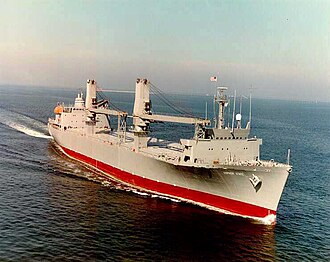
The Story of SS Gopher State (T-ACS-4)
When people think about naval power, their attention usually goes to aircraft carriers launching fighter jets, destroyers defending battle groups, or submarines operating beneath the oceans. However, behind every successful naval operation exists an enormous logistical system designed to move equipment, maintain supplies, and ensure that military forces can continue operating far from their home bases. One of the vessels that represented this essential but often overlooked capability was SS Gopher State (T-ACS-4), a specialized Auxiliary Crane Ship operated by the United States Navy’s Military Sealift Command.
Unlike traditional warships, SS Gopher State was not created to engage enemy forces directly. Instead, its mission was centered around mobility, cargo handling, and maritime logistics. The vessel provided the ability to transport and handle heavy equipment, vehicles, containers, and other military cargo in locations where normal port facilities might not be available. Through its powerful crane systems and large cargo capacity, the ship served as a floating logistics platform capable of supporting a wide range of military requirements.
The designation T-ACS-4 placed Gopher State within a specialized group of Military Sealift Command auxiliary vessels. These ships were designed to bridge the gap between ordinary commercial cargo ships and military support requirements. They combined the endurance and capacity of merchant vessels with specialized equipment that allowed them to support expeditionary operations around the world.
The history of SS Gopher State demonstrates an important lesson in modern military strategy: logistical capability is just as important as combat capability. A navy can possess the most advanced weapons systems in the world, but without reliable transportation, cargo handling, repair support, and supply networks, those forces cannot remain effective. Auxiliary ships such as Gopher State provided the infrastructure necessary to sustain American maritime operations.
Origins and Development of SS Gopher State
From Commercial Cargo Ship to Naval Auxiliary
SS Gopher State began its existence as a commercial cargo vessel before being transformed into a military logistics ship. The United States has long relied on civilian maritime technology and merchant shipping expertise to expand its strategic sealift capabilities. Instead of designing every support vessel from the ground up as a military ship, the Navy has frequently converted existing commercial ships into specialized auxiliary platforms.
This approach provided several advantages. Commercial cargo vessels were already designed for long-distance ocean transportation, efficient fuel use, and large cargo capacity. By modifying these ships with military-specific equipment, the Navy could quickly develop additional logistics capabilities without the cost and time required to construct entirely new vessels.
The conversion of Gopher State involved significant modifications. The ship received specialized cargo-handling systems, including heavy-duty cranes, allowing it to independently load and unload large military equipment. These changes transformed the vessel from a conventional cargo carrier into an Auxiliary Crane Ship capable of supporting military operations.
The result was a ship that retained the endurance and efficiency of a merchant vessel while gaining capabilities that were highly valuable in military environments.
The Meaning Behind the T-ACS Designation
The classification T-ACS refers to Auxiliary Crane Ship vessels operated under the Military Sealift Command. The “T” prefix identifies the ship as a non-commissioned naval auxiliary operated primarily by civilian mariners rather than active-duty Navy crews. The “ACS” designation identifies the ship’s specialized crane and cargo-handling mission.
These vessels were created because modern military operations require more than transportation alone. Delivering cargo to a destination is only part of the challenge. Once equipment arrives, it must be removed from the ship and transferred to the forces that need it.
Many ports around the world lack the heavy cranes required to unload oversized military cargo. Some ports may become unavailable due to conflict, disasters, or infrastructure limitations. Auxiliary Crane Ships solve this problem by carrying their own lifting equipment, allowing them to operate with greater independence.
SS Gopher State was therefore not simply a cargo ship. It was a mobile logistics facility capable of extending American operational reach.
The Role of Military Sealift Command
Supporting the U.S. Navy Beyond the Battlefield
Military Sealift Command plays a crucial role in maintaining American maritime readiness. While Navy combat ships focus on missions involving defense, deterrence, and warfare, MSC vessels provide the transportation and support services required to keep those forces operating.
SS Gopher State belonged to this important support network. Its responsibilities were centered on logistics rather than combat. The ship helped move critical materials and equipment, ensuring that military forces could deploy and operate effectively across the globe.
The importance of such vessels becomes clear when considering the scale of modern military operations. A deployed force may require thousands of vehicles, replacement parts, engineering equipment, and other supplies. Moving these resources across oceans requires specialized ships capable of transporting and handling enormous amounts of cargo.
Auxiliary Crane Ships provided an additional layer of flexibility because they could perform cargo operations without depending entirely on existing port facilities.
Civilian Mariners Operating a Military Asset
One of the unique characteristics of SS Gopher State was its crew structure. Unlike Navy warships operated by military sailors, the ship was operated by civilian merchant mariners working under Military Sealift Command.
These professional mariners brought extensive experience in ocean transportation, engineering, navigation, and cargo operations. Their expertise allowed the ship to function efficiently while maintaining the operational standards required by the Department of Defense.
Operating a large auxiliary ship requires specialized skills. Crew members were responsible for maintaining propulsion systems, navigation equipment, cargo-handling machinery, and safety systems. Crane operations required careful coordination because military equipment often involves extremely heavy and valuable cargo.
The civilian crew model allowed the Navy to maintain important logistical capabilities while using experienced maritime professionals.
Design and Engineering Features of SS Gopher State
A Vessel Built for Heavy Cargo Operations
The defining characteristic of SS Gopher State was its crane capability. The ship’s onboard cranes allowed it to perform heavy-lift operations that ordinary cargo ships could not accomplish independently.
These cranes were designed to move large and heavy loads, including military vehicles, containers, machinery, and oversized equipment. This capability was particularly valuable during expeditionary operations where military forces needed to establish or expand logistics facilities in remote areas.
The ship’s cargo spaces were designed to maximize transportation capacity while supporting military requirements. The combination of cargo volume and lifting capability made Gopher State a flexible asset within the sealift fleet.
Unlike a standard commercial cargo ship that might arrive at a port and wait for shore-based equipment, Gopher State could actively participate in the unloading process.
Adaptability in Military Operations
A major advantage of Auxiliary Crane Ships was adaptability. Military requirements change depending on global conditions, and support vessels must be capable of performing different missions.
SS Gopher State could support:
- overseas military deployments
- large-scale exercises
- humanitarian assistance operations
- emergency logistics missions
- transportation of heavy equipment
- port support activities
The ship’s ability to operate independently increased the flexibility of American forces. In areas where infrastructure was limited, damaged, or unavailable, an Auxiliary Crane Ship could provide valuable cargo-handling capability.
Operational Importance of SS Gopher State
Supporting Expeditionary Military Forces
The United States has historically maintained the ability to deploy forces far from its territory. This capability depends heavily on maritime transportation because large quantities of equipment cannot easily be moved by air.
Ships like SS Gopher State provided the ability to transport large amounts of material efficiently across oceans. Tanks, vehicles, construction equipment, communications systems, and other heavy items require maritime transportation due to their size and weight.
Once transported, these items must be unloaded and distributed. This is where the crane ship concept became especially valuable.
The ship’s cranes allowed it to serve as an important link between ocean transportation and land-based military operations.
The Importance of Logistics During Military Campaigns
Military history has repeatedly shown that logistics can determine success or failure. Even the most advanced military force requires reliable supply chains.
A force without equipment cannot fight effectively. A base without supplies cannot operate. A deployed unit without replacement parts cannot maintain its vehicles and systems.
SS Gopher State represented the logistical side of military power. Its contribution was measured not by weapons carried but by the ability to enable other military capabilities.
The vessel demonstrated that support ships are an essential component of national defense strategy.
Life and Operations Aboard SS Gopher State
Daily Operations of an Auxiliary Crane Ship
Life aboard SS Gopher State involved a combination of traditional merchant ship operations and specialized military support duties. The crew worked continuously to maintain the ship’s machinery, navigation systems, and cargo equipment.
Operating a large ship requires constant attention. Engineers maintained propulsion and electrical systems, deck crews managed cargo operations, and officers coordinated navigation and safety procedures.
When conducting crane operations, teamwork was essential. Heavy cargo movements require precise planning because even small errors can create significant risks.
Maintaining Readiness for Strategic Missions
Although SS Gopher State was not a combat vessel, readiness remained a priority. The ship needed to be available when required, meaning its equipment had to remain operational and its crew had to maintain professional standards.
Maintenance activities included:
- inspection and repair of crane systems
- propulsion system maintenance
- navigation equipment checks
- cargo equipment servicing
- safety training
- operational preparation
A logistics ship’s value depends on reliability. When military operations require additional support, the ship must be capable of responding quickly.
The Strategic Value of Auxiliary Crane Ships
Extending American Maritime Reach
One of the greatest advantages provided by vessels like SS Gopher State was increased operational flexibility. Military forces often operate in regions where infrastructure is limited, and specialized support ships help overcome these challenges.
By carrying its own cargo-handling equipment, the ship reduced dependence on foreign ports and local resources. This capability provided commanders with additional options when planning deployments.
In strategic terms, Auxiliary Crane Ships helped transform transportation into operational capability.
A Partnership Between Commercial Shipping and Defense
The existence of SS Gopher State also reflected the close relationship between commercial maritime expertise and national defense.
Merchant ships and civilian mariners have historically played an important role in American military logistics. The use of converted commercial vessels allowed the Navy to maintain specialized capabilities while benefiting from established maritime technologies.
This approach demonstrated how civilian and military resources can work together to support national objectives.
Legacy of SS Gopher State (T-ACS-4)
An Overlooked but Essential Naval Asset
SS Gopher State was not a ship designed for headlines. It did not participate in naval battles or carry advanced weapons systems. Instead, its contribution came through dependable logistical support.
The ship represented the countless support assets that make military operations possible. Without transportation and cargo-handling capability, combat forces cannot sustain themselves.
Auxiliary Crane Ships may not receive the same recognition as warships, but their strategic value is undeniable.
The Continuing Need for Maritime Logistics
Even as military technology continues to evolve, logistics remains a fundamental requirement. Modern forces still require transportation, equipment movement, and infrastructure support.
The lessons demonstrated by SS Gopher State remain relevant today. Global military operations require more than advanced weapons; they require the ability to move and sustain those weapons wherever they are needed.
The vessel’s legacy is therefore connected to a larger principle: maritime power depends not only on ships that fight, but also on ships that support.
Technical Specifications of SS Gopher State (T-ACS-4)
| Specification | Details |
|---|---|
| Ship Name | SS Gopher State |
| Naval Designation | T-ACS-4 |
| Vessel Type | Auxiliary Crane Ship |
| Operator | United States Navy Military Sealift Command |
| Primary Mission | Heavy cargo handling and maritime logistics support |
| Ship Category | Naval auxiliary support vessel |
| Original Type | Commercial cargo vessel converted for military service |
| Crew | Civilian merchant mariners under MSC management |
| Main Capability | Independent heavy-lift cargo operations |
| Cargo Role | Transportation and handling of military equipment, vehicles, and containers |
| Specialized Equipment | Heavy-duty onboard cargo cranes |
| Propulsion | Conventional marine propulsion system |
| Propulsion Type | Diesel-powered commercial vessel machinery |
| Operational Purpose | Supporting overseas deployments and expeditionary logistics |
| Deployment Areas | Global maritime operations and military exercises |
| Key Advantage | Ability to unload cargo without relying completely on shore-based cranes |
| Command Structure | Military Sealift Command / U.S. Department of Defense |
| Strategic Function | Enhancing global sealift capacity and logistical flexibility |
Conclusion: The Enduring Importance of SS Gopher State
The story of SS Gopher State (T-ACS-4) illustrates the importance of the ships that operate behind the scenes of military power. While aircraft carriers, submarines, and combat vessels often represent the public image of naval strength, support ships provide the foundation that allows those forces to operate effectively.
As an Auxiliary Crane Ship, Gopher State combined transportation capacity with specialized cargo-handling capability. It provided the ability to move heavy equipment, support overseas operations, and overcome logistical challenges in locations where traditional infrastructure might not be available.
The ship’s history highlights a fundamental reality of maritime strategy: victory depends not only on combat power but also on the ability to sustain that power. SS Gopher State served as a reminder that logistics is a critical element of national defense, and ships like it remain essential components of any global maritime force.
