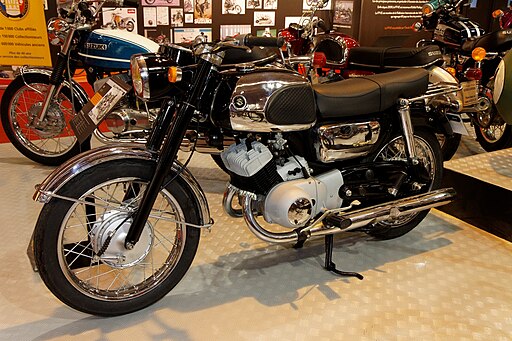
Suzuki T10
Suzuki T10: A Forgotten Pioneer in Two-Stroke Innovation
The Suzuki T10, introduced in the early 1960s, marked an important milestone in the evolution of Suzuki’s motorcycle engineering. While it never achieved the celebrity status of some of its successors like the GT or RG series, the T10 was instrumental in shaping Suzuki’s identity as a manufacturer of advanced two-stroke motorcycles. It was one of the company’s earliest multi-cylinder street bikes and showcased a number of technical innovations that were considered forward-thinking for its time.
This article provides a comprehensive and original deep dive into the Suzuki T10, examining its history, design philosophy, mechanical layout, and its legacy in the motorcycling world. We’ll explore how the T10 fit into the broader picture of 1960s motorcycling, along with the technical specifications that defined this lightweight twin-cylinder machine.
Historical Context: The Early Days of Suzuki’s Road Machines
In the post-World War II era, Japanese motorcycle manufacturers were beginning to gain global recognition. Honda, Yamaha, Kawasaki, and Suzuki were all refining their approaches, with Suzuki initially focusing on two-stroke engines. Prior to the T10, Suzuki had already released a number of successful small-capacity motorcycles and mopeds, but the company needed a machine that could compete in the growing mid-size market, particularly in export regions such as Europe and North America.
The T10 debuted in 1962 and was aimed at riders who wanted a practical, reliable, and affordable commuter motorcycle with a touch of refinement and modernity. It was the successor to the Suzuki Colleda TT and represented a clear step forward in performance and engineering.
Engine and Transmission
- Type: Air-cooled, two-stroke, parallel twin
- Displacement: 246 cc
- Bore x Stroke: 52 mm x 58 mm
- Compression Ratio: 7.2:1
- Carburetors: Twin Mikuni carburetors
- Ignition: Coil ignition system (battery and coil type)
- Lubrication: Premix (manual mixing of oil and fuel)
- Power Output: Approximately 20 hp at 7,500 rpm
- Torque: Around 22 Nm (16.2 lb-ft) at 6,000 rpm
- Transmission: 4-speed constant mesh gearbox
- Clutch: Wet multi-plate
- Final Drive: Chain
The heart of the Suzuki T10 was its 246cc air-cooled two-stroke engine. Featuring a parallel twin-cylinder layout, the T10 was one of the earliest Japanese bikes to use a twin-cylinder two-stroke configuration in a roadgoing format. This gave it smoother performance and more torque than the single-cylinder bikes of the era, as well as a distinctive exhaust note.
Its bore and stroke dimensions of 52 mm by 58 mm gave it a slightly undersquare engine character, promoting low-to-midrange torque, ideal for urban commuting. The engine’s power delivery was typical of early two-strokes—abundant at the top end but requiring skillful gear shifting to stay in the power band. With around 20 horsepower on tap, the T10 could reach a top speed of approximately 130 km/h (81 mph), which was quite respectable for its class and era.
Suzuki equipped the T10 with a 4-speed constant mesh gearbox. The shifting was done via a heel-and-toe lever—common on Japanese motorcycles of the time. The clutch was a wet multi-plate unit that provided smooth engagement and durability. The T10 used a traditional chain final drive setup.
Chassis and Suspension
- Frame Type: Steel tubular cradle frame
- Front Suspension: Telescopic forks
- Rear Suspension: Swingarm with twin shock absorbers
- Front Brake: 180 mm drum brake
- Rear Brake: 160 mm drum brake
- Front Tire: 3.00 x 17
- Rear Tire: 3.25 x 17
- Wheelbase: 1,340 mm (52.8 inches)
- Dry Weight: Approximately 140 kg (309 lbs)
The Suzuki T10’s chassis was based on a strong and relatively simple steel tubular cradle frame. Designed for both comfort and robustness, the frame helped absorb vibrations from the engine while supporting the motorcycle’s weight and providing a planted feel at speed.
Suspension duties were handled by conventional telescopic forks up front and a dual-shock swingarm at the rear. While basic by modern standards, this setup offered sufficient compliance for city and rural roads of the 1960s. The T10 delivered a soft and composed ride that prioritized rider comfort over aggressive handling.
Braking was managed by drum brakes both front and rear. The front featured a relatively large 180 mm drum, which gave it decent stopping power for the time. The rear drum was slightly smaller at 160 mm. Although these brakes lacked the bite and fade resistance of modern disc systems, they were well-suited to the bike’s performance envelope.
The bike rode on 17-inch wire-spoke wheels fitted with narrow profile tires, offering a blend of agility and comfort. Despite its modest dimensions, the T10 felt stable at cruising speeds, making it ideal for new riders or those seeking a relaxed ride.
Styling and Features
The Suzuki T10 was ahead of its time in styling. Unlike some of its contemporaries that retained a more utilitarian look, the T10 had modern lines, a clean fuel tank design, and distinctive twin exhausts that exited on either side of the rear wheel.
It also featured a full rear fender, chrome accents, and a large, comfortable dual seat that made it a viable option for two-up riding. The handlebars were slightly raised, giving a relaxed and upright riding posture.
Instrumentation was simple but effective, consisting of a speedometer with an odometer and a few basic indicator lights. The headlamp was a round sealed beam unit with a chrome bezel, while the rear tail light assembly had a classic teardrop shape.
Performance and Ride Experience
While not a race bike by any means, the Suzuki T10 had a lively personality, thanks in part to its lightweight and peppy two-stroke engine. Acceleration was brisk in the low gears, and the engine came alive once it crossed the 5,000 rpm mark. The sound and smell of the twin-stroke engine added to the visceral experience.
Its compact dimensions and light steering made the T10 easy to maneuver through traffic, and its relatively soft suspension made it forgiving on less-than-perfect roads. The wide seat and upright riding position meant that longer rides weren’t out of the question, even though it lacked wind protection.
Fuel economy was fairly good, with average consumption figures around 30-35 km/l (70-82 mpg), depending on riding style. However, due to the premix system, riders had to manually add oil to the fuel, a practice that required attention to ensure engine longevity.
Legacy and Collectibility
The Suzuki T10 may not be as well-remembered as some of Suzuki’s racing-inspired later models, but it represents a key turning point in the company’s development. It was one of Suzuki’s first mass-produced twin-cylinder motorcycles and laid the groundwork for the more sophisticated T20 and GT250 models that followed.
Today, the T10 is a rare find, especially in complete and original condition. Collectors who come across one in good shape recognize it as an important piece of Suzuki history. While it may not have the performance of a modern motorcycle, its vintage charm, simplicity, and historical relevance make it a treasured classic for two-stroke enthusiasts.
Conclusion
The Suzuki T10 was a quietly revolutionary motorcycle that helped usher in an era of two-stroke performance and reliability from Japan. With its twin-cylinder engine, attractive styling, and practical usability, it struck a chord with everyday riders during the 1960s and played an important role in establishing Suzuki as a global motorcycle manufacturer.
Though it has long since been overshadowed by its faster and more famous descendants, the T10 deserves recognition for the role it played in shaping the two-stroke legacy of the Suzuki brand. It remains a charming and technically interesting motorcycle that embodies the spirit of a transformative era in motorcycling history.
