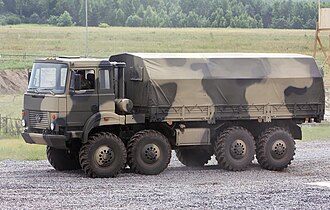
Ural-5323: The Heavy-Duty 8×8 Truck Built for Extreme Terrain
The Ural-5323 is one of the most distinctive heavy off-road trucks to emerge from the Soviet and Russian automotive industry. Developed by the Ural Automotive Plant in Miass, the four-axle machine was created for situations in which ordinary trucks simply could not provide enough traction, payload capacity, or mechanical durability. With its 8×8 drivetrain, substantial ground clearance, heavy-duty chassis, centralized tire-pressure control and powerful diesel engines, the Ural-5323 became a versatile platform for military logistics, engineering equipment, special-purpose bodies and other demanding applications. Its imposing dimensions and utilitarian appearance are not merely stylistic features: almost every aspect of the vehicle reflects the philosophy of building a truck capable of continuing to work when roads disappear and the terrain becomes difficult.
The model belongs to the same broad tradition of rugged Ural trucks that emphasizes simplicity, mechanical strength and cross-country mobility over comfort or economy. The Ural-5323 was produced in several configurations, and specifications therefore differ depending on the particular version and period of manufacture. Published references describe payloads around 10–12 tonnes for important variants, maximum speeds in the region of 80–85 km/h, and a gross vehicle weight exceeding 20 tonnes. One commonly cited Ural-5323-20 configuration is rated to carry up to 10 tonnes and tow a trailer with a total weight of up to 16 tonnes.
Development and Purpose of the Ural-5323
From Soviet Off-Road Thinking to a Heavy 8×8 Platform
The concept behind the Ural-5323 was rooted in the Soviet requirement for trucks that could operate far beyond established road networks. A military transport vehicle might have to move ammunition, fuel, personnel, engineering equipment or specialist systems across mud, snow, sand and rough forest tracks. In such circumstances, payload capacity alone is not enough. The vehicle must also distribute its weight effectively, maintain traction when individual wheels lose grip and survive the repeated stresses generated by uneven terrain.
The resulting Ural-5323 adopted an 8×8 configuration, giving all four axles driven wheels. This arrangement provides a considerable advantage over conventional two- or three-axle trucks when the surface becomes soft or broken. Instead of relying on only a small number of driven wheels, the truck can use its entire wheel arrangement to generate traction. Its chassis was consequently designed not simply as a road-going cargo carrier but as a mobile platform capable of supporting specialized equipment while retaining significant off-road capability.
The model entered serial production around the beginning of the 1990s, although sources differ on the exact production chronology and describe the family as originating in the late Soviet period. Early examples used cab arrangements associated with KamAZ, while later vehicles received different cab solutions. This evolution illustrates one of the recurring characteristics of the Ural-5323 family: the basic chassis concept remained useful even as individual components and configurations changed.
A Truck Designed as a Platform
One of the most important characteristics of the Ural-5323 is that it should not be viewed simply as a conventional cargo truck. Its chassis can serve as the foundation for a variety of specialist bodies and systems. This makes the vehicle particularly valuable where a customer needs a heavy-duty carrier rather than a truck with a single fixed purpose.
The platform has been associated with military logistics and specialist applications, including air-defense equipment. The Ural-5323 has notably been used as a carrier platform for the Pantsir-S1 air-defense system, demonstrating how the chassis could accommodate substantial mission equipment while retaining the mobility expected from an all-terrain vehicle.
This modular philosophy also explains why photographs of Ural-5323 vehicles can look surprisingly different from one another. One example may have a conventional cargo body, another may carry engineering equipment, while another may be configured as a specialist military vehicle. Beneath these different bodies, however, the fundamental qualities of the heavy 8×8 chassis remain the same.
Engineering and Off-Road Capability
The 8×8 Drivetrain
The defining feature of the Ural-5323 is its eight-wheel-drive layout. Four axles and eight driven wheels give the truck the traction needed to negotiate terrain where a conventional truck would quickly become immobilized. The drivetrain is combined with a transfer system designed to provide appropriate gearing for difficult conditions, including low-range operation for demanding off-road work. Published descriptions of the vehicle also mention locking differentials and a two-range transfer arrangement, emphasizing that the drivetrain was designed around mobility rather than merely highway performance.
This approach is particularly effective when the surface beneath the truck changes constantly. On firm ground, the vehicle can make relatively efficient progress, while in mud, loose soil or snow the low gearing and multiple driven axles allow the engine’s torque to be translated into forward movement. The system is mechanical and substantial, reflecting an era when durability and field serviceability were considered essential characteristics of military vehicles.
Suspension, Ground Clearance and Tires
The Ural-5323’s suspension is another major contributor to its off-road performance. The truck uses heavy-duty solid axles and leaf-spring-based suspension arrangements, with the rear axle groups supported through a balancing system. Such a design sacrifices the sophistication and road comfort of modern independent suspension, but it offers strength and durability under heavy loads.
Ground clearance is approximately 400 millimetres in commonly cited specifications, giving the vehicle considerable space beneath the chassis when crossing rocks, ruts and uneven terrain. Published data also place its fording capability at roughly 1.2 metres, while its ability to negotiate trenches and steep grades further demonstrates the emphasis placed on cross-country operation.
Large 14.00-20 tires are commonly associated with the vehicle, and centralized tire-pressure regulation is one of its particularly useful features. Instead of requiring the driver to manually adjust individual tires when conditions change, the system allows tire pressure to be controlled from the vehicle. Lower pressure can improve flotation and traction on soft surfaces, while higher pressure is appropriate for firmer terrain and road travel. For a truck intended to move between highways and undeveloped terrain, this capability can make a substantial difference.
Engine and Performance
Large-Displacement V8 Diesel Power
Different Ural-5323 variants have been equipped with different engines, which is one reason specifications found in reference material do not always agree. One widely cited configuration uses the YaMZ-238B V8 turbo-diesel, with a displacement of approximately 14.9 litres and an output of about 300 horsepower. Other early or alternative configurations are associated with KamAZ powerplants.
The important characteristic is not simply the horsepower figure but the engine’s ability to produce substantial torque at relatively low engine speeds. Heavy off-road trucks need torque when climbing, pulling through soft ground or moving with a substantial load. A large-displacement diesel is well suited to this role because it can deliver strong pulling power without requiring extremely high engine speeds.
In road conditions, commonly cited figures put the top speed of representative versions at approximately 80–85 km/h. That may seem modest compared with modern highway trucks, but outright speed was never the primary objective. The Ural-5323 was engineered around a different priority: carrying heavy loads through difficult environments and returning under its own power.
Transmission and Low-Speed Control
The transmission is another part of this philosophy. An eight-speed manual gearbox is cited for the model, combined with a transfer case offering different ranges for road and off-road operation. The lower gearing allows the engine to operate effectively when the truck is moving slowly but encountering very high resistance.
This is particularly important on steep slopes. A truck carrying several tonnes of cargo cannot simply rely on momentum when climbing a muddy incline. It needs controlled torque at the wheels, predictable gearing and sufficient traction. The Ural-5323’s drivetrain was therefore designed to give the driver the ability to keep the vehicle moving at low speeds without placing excessive demands on the clutch or engine.
Payload, Towing and Practical Utility
Heavy Loads Without Giving Up Mobility
A representative Ural-5323-20 is commonly described as having a payload capacity of around 10 tonnes, while some published specifications for the wider family give higher payload figures depending on the version. Towing capability is likewise substantial, with figures of up to approximately 16 tonnes cited for certain configurations.
These numbers help explain why the vehicle has been useful as a platform for specialist equipment. A chassis intended only for light cargo would have limited value once a large technical installation, crane or other heavy body was added. The Ural-5323, by contrast, was designed with sufficient structural capacity to support substantial equipment while retaining its all-terrain characteristics.
The cargo area also reflects its military heritage. Depending on the configuration, the vehicle can transport equipment and personnel, while its chassis can be adapted for bodies tailored to particular logistical or engineering tasks. This adaptability is arguably as important as its raw payload rating.
Design Philosophy and Legacy
Why the Ural-5323 Still Attracts Attention
The Ural-5323 is interesting because it represents a very specific approach to truck design. Modern heavy vehicles increasingly emphasize electronics, automated transmissions, sophisticated suspension systems, driver comfort and emissions control. The Ural-5323 comes from a different engineering philosophy. Its priorities are mechanical robustness, high ground clearance, simple serviceability and the ability to keep moving under difficult conditions.
That does not make it a universally superior truck. A modern commercial vehicle will generally be more comfortable, economical and technologically advanced. The Ural-5323’s strengths become apparent instead when the definition of “good truck” changes from fuel-efficient highway transportation to reliable movement across terrain where there may be no road at all.
Its continued presence in military and specialist contexts is a testament to the usefulness of that design philosophy. The basic 8×8 layout provides a strong foundation, while the chassis can accept different bodies and equipment. It is a machine designed to be useful first and elegant second.
A Distinctive Chapter in Heavy Truck History
The Ural-5323 occupies an important place in the history of Soviet and Russian heavy off-road vehicles. It expanded the capabilities of the Ural truck family into a much heavier four-axle class while retaining the fundamental emphasis on cross-country mobility. Its large diesel engine, eight-wheel drive, substantial ground clearance, centralized tire-pressure system and heavy-duty suspension combine to create a vehicle that is unusually well suited to extreme terrain.
Perhaps the most interesting aspect of the Ural-5323 is the balance between specialization and adaptability. It was created with military requirements in mind, yet its fundamental engineering qualities are not limited to one type of mission. A powerful chassis with eight driven wheels and substantial payload capacity can become a cargo carrier, engineering vehicle, equipment transporter or platform for complex specialist systems. That versatility is what has allowed the Ural-5323 name to remain recognizable long after the earliest versions appeared.
For enthusiasts of heavy trucks, the vehicle is also a reminder that off-road capability involves much more than simply adding four-wheel drive. Effective mobility comes from the interaction of drivetrain, gearing, suspension, tire technology, weight distribution, ground clearance and engine torque. The Ural-5323 brings all of those elements together in a distinctly rugged package.
Ural-5323 Technical Specifications
The following table summarizes representative specifications reported for the Ural-5323 family. Because the model was produced in multiple configurations and received different engines and equipment over its production history, individual vehicles can differ from these figures.
| Specification | Representative figure |
|---|---|
| Manufacturer | Ural Automotive Plant (UralAZ), Miass |
| Vehicle type | Heavy-duty off-road truck |
| Wheel arrangement | 8×8 |
| Engine | YaMZ-238B V8 turbo-diesel on a commonly cited configuration |
| Engine displacement | Approximately 14.86 litres |
| Engine output | Approximately 300 hp (220 kW) |
| Maximum torque | Approximately 1,200 N·m |
| Transmission | 8-speed manual with transfer case |
| Payload | Approximately 10,000–12,000 kg, depending on variant |
| Gross vehicle weight | Approximately 21,900 kg for a commonly cited configuration |
| Maximum speed | Approximately 80–85 km/h |
| Ground clearance | Approximately 400 mm |
| Fording depth | Approximately 1.2 m |
| Tire size | Commonly 14.00-20 |
| Tire-pressure system | Centralized/regulated tire-pressure control |
| Maximum gradient | Approximately 31° in commonly cited specifications |
| Typical towing capacity | Up to approximately 16,000 kg on certain variants |
| Production | Serial production began around the early 1990s; model family developed through later variants |
Conclusion
The Ural-5323 is best understood not as a conventional truck that happens to have four axles, but as a purpose-built mobility platform. Its 8×8 drivetrain, heavy-duty suspension, large-displacement diesel power, substantial ground clearance and centralized tire-pressure system were all chosen to solve the same problem: how to move people, cargo and specialized equipment through terrain that ordinary trucks would struggle to cross. Its specifications varied across different versions, but the central idea remained remarkably consistent.
Decades after its introduction, the Ural-5323 remains memorable because its engineering priorities are so clearly visible. It is large, mechanically substantial and unapologetically designed for difficult work. Whether considered as a military logistics vehicle, a specialist equipment carrier or simply an example of extreme off-road truck engineering, the Ural-5323 demonstrates the enduring appeal of a machine built around one straightforward principle: when the road ends, the truck should keep going.
