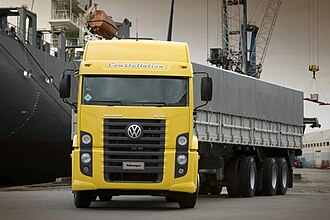
Volkswagen Constellation: The Brazilian Heavy Truck Built for Every Kind of Road
The Volkswagen Constellation is one of the most important heavy-truck families produced by Volkswagen Caminhões e Ônibus, combining the practicality of a work-focused commercial vehicle with the versatility required by modern freight, construction and agricultural operations. Developed primarily with the needs of the Latin American market in mind, the Constellation has evolved into a broad family covering multiple weight classes, axle configurations and applications. From relatively light 4×2 distribution trucks to powerful 6×4 and 8×4 workhorses, the range is designed around a straightforward principle: give operators a truck that can be configured for the job rather than forcing every customer into the same specification. The result is a family that has become particularly recognizable on Brazilian roads, where long-distance freight, construction, agriculture and specialized transport can demand very different characteristics from the same basic category of vehicle.
What makes the Constellation particularly interesting is the way Volkswagen has continued expanding and modernizing the family without abandoning its reputation for robustness. Current versions include engines from MAN and Cummins, manual and automated transmissions, and configurations ranging from 4×2 through 8×4. At the upper end, models such as the Constellation 33.480 combine a 475-hp MAN D26 engine with 2,400 Nm of torque and a 74-tonne gross combination weight rating in the Brazilian market. At the other end of the family, models such as the 14.210 use a 205-hp MAN diesel and target applications where maneuverability, operating cost and useful payload are more important than extreme power.
The Origins and Evolution of the Constellation
A Truck Family Designed for the Brazilian Market
The Constellation name emerged as Volkswagen Caminhões e Ônibus sought to strengthen its position in the medium- and heavy-duty truck market with a modern family capable of serving a wide range of commercial applications. Rather than being a single truck model, Constellation became a platform around which numerous configurations could be developed. This distinction is important because it explains why two trucks carrying the Constellation badge can have dramatically different dimensions, engines, transmissions and intended uses.
The philosophy behind the family is particularly suited to Brazil. Freight operators may need a vehicle for urban distribution one day and a long-haul tractor or rigid truck the next, while construction companies need something capable of coping with unpaved sites, heavy loads and demanding working cycles. Agricultural operators similarly require vehicles that can travel on highways but also reach farms, warehouses and fields where road conditions may be considerably worse. By offering different wheel arrangements and power levels, Volkswagen can adapt the same general family identity to these very different environments.
The Constellation has therefore developed a reputation for versatility rather than being associated with one narrowly defined role. Its variants can be found in distribution, regional freight, long-distance transport, construction, mining-related operations and other specialist applications. This broad positioning has been one of the most important factors in the longevity of the name.
Expansion Into Heavier Categories
The evolution of the Constellation has also followed the increasing demands of the freight industry. As operators have sought greater payloads, improved fuel efficiency and more capable drivetrains, Volkswagen expanded the family into increasingly heavy categories. The company eventually introduced the Constellation 33.460 6×4 as part of its move into the extra-heavy segment, with a 13-liter engine and 460 horsepower. Volkswagen described the introduction as a major expansion of its heavy-truck portfolio and emphasized that the new vehicles were developed to serve the demands of modern, increasingly connected freight operations.
More recent versions have pushed performance even further. The current 33.480, for example, uses the MAN D2676LFAG engine, producing 475 horsepower and 2,400 Nm of torque. Its homologated gross combination weight reaches 74 tonnes in the Brazilian specification, placing it firmly in the heavy-duty long-haul category.
Design and Engineering of the Volkswagen Constellation
A Modular Approach to Truck Construction
One of the greatest strengths of the Constellation is its modular character. Truck buyers rarely want exactly the same vehicle, because the body, trailer, cargo, road conditions and operating cycle all influence the ideal specification. Volkswagen consequently offers the family in several axle configurations, including 4×2, 6×2, 6×4 and 8×2 or 8×4 arrangements depending on the model and application.
The choice of axle configuration can have a major effect on how a truck behaves. A 4×2 is relatively simple and efficient for road transport, while a 6×2 can increase carrying capacity without requiring all axles to be driven. A 6×4, by contrast, is particularly useful when traction is important, making it suitable for construction, difficult terrain and heavy-duty applications. The 8×4 configuration goes another step further, providing a substantial chassis and high axle capacity for demanding work.
This variety allows the Constellation name to cover a remarkable range of jobs. A 14.210 can function as a medium-duty workhorse for distribution, while a 27.320 6×4 or 33.480 6×4 can be specified for much heavier operations. Volkswagen’s current official range includes numerous such configurations, demonstrating that Constellation is fundamentally a family rather than a single fixed vehicle.
Engines Focused on Torque and Durability
Engine choice varies significantly across the Constellation range. Smaller models such as the 14.210, 17.210 and 18.210 use the MAN D0834LF08, producing 205 horsepower and 750 Nm of torque. Moving upward, the 18.260 and related variants use MAN’s D0836 family with approximately 260 horsepower and 950 Nm. More powerful 18.320 and 26.320 models increase output to 315 horsepower and 1,200 Nm.
The larger trucks introduce substantially more power. The 32.380 and 19.380 use a Cummins ISL producing 375 horsepower and 1,700 Nm, while the 33.480 and 20.480 move to the MAN D26 with 475 horsepower and 2,400 Nm. The difference is not simply a matter of higher top speed. For a heavy truck, torque is crucial because it determines how effectively the vehicle can accelerate under load, climb grades and maintain momentum without excessive shifting.
This is why the Constellation’s most powerful versions are particularly well suited to heavy freight. When combined with a suitable transmission and axle ratio, a large torque reserve allows the truck to handle substantial combination weights while keeping engine speeds within an efficient operating range.
Transmission and Driving Characteristics
Manual Gearboxes for Direct Driver Control
The Constellation family has historically offered manual transmissions across numerous configurations, and the current range continues to include them. Depending on the model, gearboxes include Eaton and ZF units with different numbers of ratios. The 26.280, for example, uses a ZF 16-speed manual transmission in one of its configurations, while other Constellation models employ nine- or 12-speed ZF gearboxes.
A manual transmission remains valuable in applications where drivers need precise control over vehicle behavior. Construction trucks, agricultural vehicles and heavily loaded rigid trucks may encounter conditions where selecting the correct gear manually provides an advantage. The mechanical simplicity of a manual gearbox can also be attractive to operators who prioritize straightforward maintenance and predictable operation.
Automated Transmission for Long-Distance Work
At the heavier end of the family, automated transmissions are also available. The current Constellation range includes ZF automated gearboxes on models such as the 31.320, 33.480 and 20.480. Automated shifting can reduce driver workload, particularly during long highway journeys, while allowing the transmission to select ratios according to vehicle load and road conditions.
This reflects the changing expectations of the commercial trucking industry. A modern truck is expected not only to carry heavy loads but also to reduce fatigue, improve consistency and make efficient use of the engine. Automated transmissions are therefore an important part of the Constellation’s evolution from a traditional work truck into a more technologically advanced commercial vehicle.
Constellation in Construction and Off-Road Applications
The 26.280 as a Construction Specialist
Not every Constellation is intended for highway freight. Volkswagen has developed dedicated versions for construction and off-road work, with the 26.280 being a particularly notable example. The manufacturer describes it as suited to construction operations while emphasizing robustness, technology, driver comfort and productivity. It is available in 6×4 and 8×4 forms and can be equipped with either a 16-speed ZF manual transmission or a six-speed Allison automatic in certain applications.
The 26.280 illustrates how the Constellation platform can be adapted to a completely different operating environment. A construction truck may spend much of its working day moving slowly, starting and stopping frequently, carrying heavy equipment or concrete, and traveling over rough surfaces. The requirements are therefore very different from those of a highway tractor traveling hundreds of kilometers at a time.
Volkswagen’s own description identifies the 26.280 as a leading vehicle in the mixer-truck segment, showing how specialized the Constellation range can become. Its 6×4 and 8×4 layouts provide the traction and axle capacity required by demanding vocational work, while the engine’s 280-class power output provides a balance between capability and operating cost.
Long-Distance Freight and the Heavy Constellation
The 25.480 and 33.480
At the other end of the spectrum are Constellation models designed for serious road freight. The 25.480HD 6×2 uses the 13-liter MAN D26 engine, producing 475 horsepower and 2,400 Nm. Volkswagen lists a homologated gross combination weight of 58.5 tonnes for this version and describes it as intended for medium- and long-distance operations.
The 33.480 6×4 moves into an even heavier category. Its combination of a 475-hp engine, 2,400 Nm of torque and 74-tonne homologated gross combination weight makes it one of the most powerful members of the current Constellation family. Such a specification is aimed at operators who need substantial pulling capacity and a drivetrain capable of handling heavy combinations over long distances.
These trucks also demonstrate how much the Constellation concept has evolved. What began as a broad family of medium- and heavy-duty trucks has grown to include vehicles capable of competing in demanding extra-heavy applications. Yet the name continues to be associated with practicality and configurability rather than focusing solely on headline horsepower.
Driver Comfort and Modern Truck Technology
More Than Just a Work Machine
Although durability remains central to the Constellation concept, modern commercial trucks also have to consider the driver. A truck can spend thousands of hours on the road each year, so seating, steering, visibility, controls and general cab ergonomics directly affect productivity. Volkswagen has progressively incorporated comfort and technology improvements into newer versions, particularly in its heavier models.
The latest 25.480HD, for example, is marketed with a Prime package that includes a multifunction steering wheel and premium driver’s seat with multiple adjustments. Volkswagen also describes the model as more efficient, economical, connected and equipped with active safety technology as standard.
These developments are important because the modern truck market is no longer defined exclusively by engine output and payload. Fleet operators increasingly consider fuel consumption, uptime, driver retention, safety, connectivity and total operating cost when selecting equipment. The Constellation’s continued development reflects that broader change.
Why the Volkswagen Constellation Remains Important
The appeal of the Volkswagen Constellation lies in its breadth. Few truck families can be discussed meaningfully in the same article while covering a 205-hp distribution truck, a 260-hp construction vehicle, a 315-hp regional freight model and a 475-hp heavy-duty road tractor. Yet that is precisely what makes the Constellation distinctive.
Its success also comes from understanding the realities of the markets in which it operates. Brazil and other Latin American countries place unusual demands on commercial vehicles because freight routes can combine excellent highways with rough secondary roads, while agriculture, construction and industrial operations often require trucks to leave paved surfaces entirely. A truck that is too specialized may be excellent in one environment but inefficient in another. The Constellation addresses this problem through a broad range of configurations.
The family also demonstrates the importance of gradual technological development. Instead of replacing the entire concept every few years, Volkswagen has continued refining engines, transmissions, safety systems, driver environments and chassis configurations. This allows the Constellation name to remain familiar to operators while the underlying vehicles become increasingly capable.
Technical Specifications of the Volkswagen Constellation
Because “Constellation” refers to an entire truck family rather than one specific model, there is no single technical specification sheet for every Constellation. The table below summarizes representative current models and shows how widely the family varies. Figures are based on Volkswagen Caminhões e Ônibus specifications for the Brazilian market and can differ according to configuration, equipment and application.
| Model | Axle configuration | Engine | Power | Torque | Transmission | Homologated weight* |
|---|---|---|---|---|---|---|
| Constellation 14.210 | 4×2 | MAN D0834LF08 | 205 hp | 750 Nm | Eaton FS 5406-A manual | 14,500 kg PBT |
| Constellation 18.260 | 4×2 | MAN D0836LF18 | 260 hp | 950 Nm | Eaton FSO 6406 A | 16,000 kg PBT |
| Constellation 18.320 | 4×2 | MAN D0836LF17 | 315 hp | 1,200 Nm | ZF 9S / 12TX | 16,000 kg PBT |
| Constellation 26.280 | 6×4 / 8×4 | MAN D0836 280 | 277 hp | 1,050 Nm | ZF 16-speed manual / Allison automatic on certain versions | 23,000 kg PBT |
| Constellation 26.320 | 6×2 | MAN D0836LF17 | 315 hp | 1,200 Nm | ZF 9S / 12TX | 23,000 kg PBT |
| Constellation 31.320 | 6×4 | MAN D0836LF17 | 315 hp | 1,200 Nm | ZF 12TX 2424 TD automated | 23,000 kg PBT |
| Constellation 32.380 | 6×4 | Cummins ISL | 375 hp | 1,700 Nm | ZF 12TX 2624 TD | 23,000 kg PBT |
| Constellation 25.480HD | 6×2 | MAN D2676LFAG | 475 hp | 2,400 Nm | ZF 12TX 2624 TD | 58,500 kg PBTC |
| Constellation 33.480 | 6×4 | MAN D2676LFAG | 475 hp | 2,400 Nm | ZF 12TX 2824 TO | 74,000 kg PBTC |
*PBT = Gross Vehicle Weight; PBTC = Gross Combination Weight, according to Brazilian homologation. Specifications vary by version and market.
Conclusion
The Volkswagen Constellation is much more than a single heavy truck model. It is a complete family built around the idea that commercial operators need different solutions for different jobs. Its range stretches from compact 4×2 trucks producing just over 200 horsepower to 6×4 heavy-duty machines with 475 horsepower and 2,400 Nm of torque. Along the way, the family includes vehicles optimized for regional freight, long-distance transportation, construction, agriculture and specialized applications.
Its strongest quality is therefore versatility. The Constellation can be configured to prioritize maneuverability, payload, traction, long-distance performance or vocational durability, depending on the selected model. Modern versions add automated transmissions, more sophisticated engines, improved driver environments and active safety technology while retaining the ruggedness expected of a commercial truck.
For anyone interested in Brazilian trucking, the Volkswagen Constellation is an especially important vehicle to understand. It reflects the development of a truck industry that has had to balance demanding roads, heavy freight, diverse applications and increasingly sophisticated technology. From the 14.210 to the powerful 33.480, the Constellation family demonstrates how one truck platform can evolve into an extensive range of specialized machines while maintaining a consistent identity: practical, adaptable and built to work.
