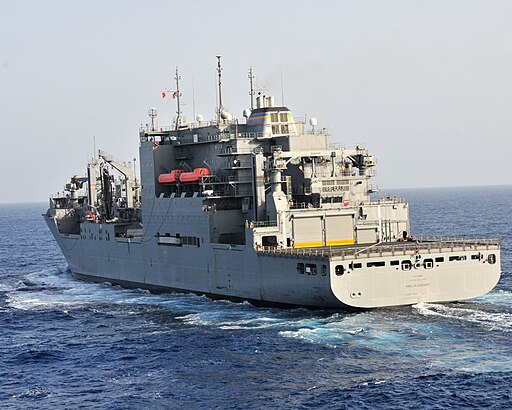
USNS Amelia Earhart (T-AKE-6): Technical Overview and Operational Significance
The USNS Amelia Earhart (T-AKE-6) is a Lewis and Clark-class dry cargo and ammunition ship operated by the United States Navy’s Military Sealift Command (MSC). As the sixth vessel in the class, Amelia Earhart serves as a key logistical asset designed to deliver ammunition, provisions, spare parts, and other critical materials to U.S. Navy and allied vessels at sea. Her name honors Amelia Mary Earhart, the pioneering American aviator known for her record-setting flights and enduring legacy in aviation history. Like her namesake, the ship represents courage, endurance, and technological innovation in the service of exploration and mission success.
Background and Development
The Lewis and Clark-class (T-AKE) ships were developed as part of the Navy’s Combat Logistics Force modernization program, aimed at replacing the older Kilauea-class (AE) ammunition ships, Mars-class (AFS) combat stores ships, and Sacramento-class (AOE) fast combat support ships. The program emphasized efficiency, reduced crew requirements, and the integration of modern automation systems for cargo handling and propulsion.
The construction of USNS Amelia Earhart was undertaken by General Dynamics NASSCO (National Steel and Shipbuilding Company) in San Diego, California, under a contract awarded by the U.S. Navy. The ship was laid down on April 17, 2007, launched on April 6, 2008, and delivered to the Military Sealift Command on October 30, 2008. Following her delivery, the vessel joined the Naval Fleet Auxiliary Force, operated by civilian mariners under the command and logistical direction of MSC.
General Characteristics
-
Class and Type: Lewis and Clark-class dry cargo/ammunition ship
-
Hull Number: T-AKE-6
-
Builder: General Dynamics NASSCO, San Diego, California
-
Operator: Military Sealift Command (MSC)
-
Displacement: Approximately 41,000 tons (full load)
-
Length: 689 feet (210 meters)
-
Beam: 106 feet (32 meters)
-
Draft: 30 feet (9.1 meters)
-
Propulsion Type: Integrated diesel-electric drive
-
Main Engines: Four MAN B&W 9L32/40 diesel generators
-
Propulsion Motors: Two Alstom electric motors, driving twin controllable-pitch propellers
-
Power Output: 24,000 shaft horsepower (combined)
-
Speed: 20 knots (maximum)
-
Range: 14,000 nautical miles at 20 knots
-
Endurance: 45–60 days without port replenishment
-
Crew: Approximately 124 (civilian mariners and military detachment combined)
Propulsion and Engineering
The diesel-electric propulsion system installed aboard Amelia Earhart represents a major step forward in efficiency and reliability. Four diesel generators produce electrical power for both propulsion and shipboard systems, feeding two main electric propulsion motors. This arrangement provides greater flexibility, fuel efficiency, and reduced maintenance compared to older mechanical drive systems.
The electric propulsion motors allow for precise control, reduced vibration, and lower acoustic signatures, an important feature during replenishment operations where ship stability and quiet operations are critical. The propulsion system is also optimized for energy conservation, allowing sustained operations at sea with minimal refueling requirements.
Cargo Handling and Replenishment Systems
As a dry cargo and ammunition ship, USNS Amelia Earhart is specifically designed to perform underway replenishment (UNREP) missions, supplying fleet units without requiring them to return to port. The ship can simultaneously transfer ammunition, dry goods, refrigerated stores, and limited quantities of fuel.
Key cargo and replenishment features include:
-
Cargo Capacity: 10,800 tons of dry and refrigerated cargo
-
Refrigerated Storage: Over 480 cubic meters for perishable provisions
-
Cargo Holds: Multiple deck levels, climate-controlled, with automated handling systems
-
Replenishment Stations:
-
Four STREAM (Standard Tensioned Replenishment Alongside Method) stations for transferring pallets and containers to other ships
-
Dual conveyor systems for simultaneous multi-ship support
-
Helicopter vertical replenishment (VERTREP) capability from the aft flight deck
-
Cargo operations are managed using advanced material handling systems, including electric-powered cranes, forklifts, and automated conveyors that allow high-volume movement with minimal manpower. The ship’s design also incorporates heavy-lift cranes rated up to 52 tons, enabling the transfer of large ammunition containers or mechanical assemblies.
Aviation Facilities
Amelia Earhart is fitted with a helicopter flight deck capable of supporting two MH-60S Seahawk helicopters for vertical replenishment operations. While the ship does not include a permanent hangar, its flight deck is equipped with aviation fueling systems, maintenance stations, and day/night operation capability. The aviation facilities are essential for delivering supplies to vessels that cannot safely approach for side-by-side transfer due to size, sea conditions, or tactical posture.
Navigation and Control Systems
The ship’s navigation suite integrates advanced automation and redundancy for safe global operations. Systems include ECDIS (Electronic Chart Display and Information System), GPS, ARPA radar, gyrocompass, and dynamic positioning controls for precision maneuvering during replenishment. The bridge layout emphasizes ergonomic control and visibility, with multiple redundant systems ensuring continuous operation even in the event of equipment failure.
The vessel also features Integrated Platform Management Systems (IPMS) that allow centralized monitoring of propulsion, electrical distribution, and auxiliary systems from a single control station.
Crew Accommodations and Living Facilities
USNS Amelia Earhart’s design emphasizes comfort and efficiency for extended deployments. The ship’s interior spaces provide modern accommodations, including private and semi-private berthing, a fitness center, galley, mess facilities, medical area, and recreation lounges. The automation of cargo handling and engineering systems allows for a smaller crew complement compared to earlier generations of supply ships, reducing operational costs and improving quality of life onboard.
Communications and Defensive Systems
Although Amelia Earhart is not a combatant ship, it is equipped with robust communication and basic defensive systems to ensure survivability and mission continuity.
-
Communication Systems:
-
Satellite communication (SATCOM) for long-range voice and data transmission
-
HF, VHF, and UHF transceivers for fleet coordination
-
Encrypted digital data links with Naval command and control networks
-
-
Defensive Equipment:
-
Crew-served 0.50 caliber machine guns and small arms for close-in protection
-
Electronic surveillance and countermeasures for situational awareness
-
Mission Profile and Operational Role
The primary mission of the USNS Amelia Earhart is to sustain fleet combat operations by delivering vital logistics support at sea. She provides ammunition, food, repair parts, and other materials to aircraft carriers, destroyers, amphibious assault ships, and submarines. This logistical capability enables U.S. naval forces to maintain persistent forward presence across the globe, reducing dependence on shore-based facilities.
Amelia Earhart also plays a supporting role in humanitarian assistance and disaster relief (HADR) missions. Her extensive cargo capacity and ability to operate independently make her ideal for delivering relief supplies, water, and medical aid to affected regions during crises.
Environmental and Efficiency Features
The Lewis and Clark-class ships, including Amelia Earhart, were built with environmental stewardship in mind. The vessel’s systems include:
-
Ballast water treatment to prevent cross-ocean biological contamination
-
Waste heat recovery systems to reduce fuel consumption
-
Low-emission diesel engines that comply with international MARPOL emission standards
-
Advanced waste management systems to handle sewage and solid waste in compliance with international environmental regulations
These measures make the Amelia Earhart one of the most environmentally responsible ships in the U.S. Navy’s logistics fleet.
Operational Service
Since entering service in 2008, USNS Amelia Earhart has operated extensively throughout the Pacific, Indian, and Arabian seas, supporting carrier strike groups and amphibious readiness groups. She has participated in RIMPAC (Rim of the Pacific) exercises, routine deployments, and multinational maritime operations. Her flexibility has made her an integral component of the Navy’s ability to project power and maintain sustained presence in areas of strategic importance.
Summary
The USNS Amelia Earhart (T-AKE-6) embodies the next generation of naval logistics—efficient, versatile, and resilient. Her advanced diesel-electric propulsion, automated cargo systems, and long-range endurance make her an indispensable enabler of global naval operations. Beyond her technical sophistication, she carries forward the legacy of her namesake by embodying exploration, innovation, and service to a greater cause. As part of the Military Sealift Command’s logistics force, Amelia Earhart ensures that the U.S. Navy remains operationally ready, globally mobile, and strategically sustained in an increasingly complex maritime environment.
