USNS Apalachicola (T-EPF-13): Technical Specifications and Operational Capabilities
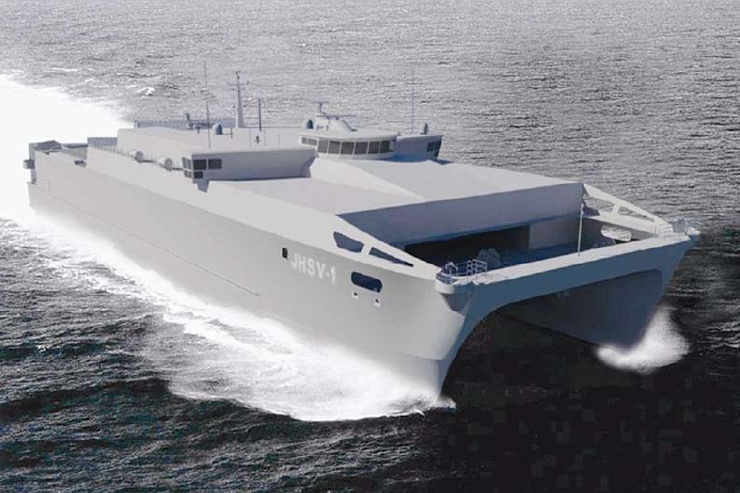
The USNS Apalachicola (T-EPF-13) is a Spearhead-class Expeditionary Fast Transport (EPF) vessel operated by the United States Navy’s Military Sealift Command (MSC). Built by Austal USA in Mobile, Alabama, Apalachicola represents a significant evolution in the EPF program, incorporating new technologies that make her the first ship in her class designed for autonomous operations. As a high-speed, shallow-draft aluminum catamaran, she provides rapid intra-theater transport of troops, vehicles, and equipment, capable of operating in austere ports and coastal environments where larger vessels cannot.
Named after the city of Apalachicola, Florida, this ship honors the community’s maritime heritage and the Navy’s enduring connection to coastal America. USNS Apalachicola serves as a testbed for cutting-edge automation and unmanned control systems that will shape the future of naval logistics and sea lift operations.
Development and Construction
The Expeditionary Fast Transport (EPF) program was initiated to replace older intra-theater lift vessels with fast, flexible platforms capable of supporting diverse missions ranging from combat logistics to humanitarian relief. The ships are built by Austal USA using a commercial catamaran hull design adapted from high-speed ferry technology, optimized for rapid deployment and shallow-water operations.
USNS Apalachicola is the 13th ship of the Spearhead class and the first to feature autonomous navigation systems, enabling her to operate with minimal crew or even in fully unmanned mode under specific conditions. Construction began with the keel laying on January 27, 2020, the ship was launched in November 2021, and delivered to the Navy on February 16, 2023.
Her design incorporates upgrades to navigation, control, and power systems to support extended autonomous testing. These advancements were developed in collaboration with the Office of Naval Research (ONR) and the Program Executive Office Ships (PEO Ships) as part of the Navy’s push toward unmanned surface vessel (USV) integration.
General Characteristics
-
Class and Type: Spearhead-class Expeditionary Fast Transport (EPF)
-
Hull Number: T-EPF-13
-
Builder: Austal USA, Mobile, Alabama
-
Operator: Military Sealift Command (MSC)
-
Displacement: Approximately 2,400 tons (light) / 3,200 tons (full load)
-
Length: 338 feet (103 meters)
-
Beam: 93.5 feet (28.5 meters)
-
Draft: 13 feet (4 meters)
-
Hull Type: Aluminum catamaran, wave-piercing design
-
Propulsion: Four MTU 20V 8000 M71L diesel engines driving four Wärtsilä waterjets via reduction gearboxes
-
Power Output: 36,000 total brake horsepower
-
Speed: 35–45 knots (depending on load and sea state)
-
Range: 1,200 nautical miles at 35 knots; 4,700 nautical miles at economical speeds
-
Crew: 26 civilian mariners (MSC); capable of reduced or autonomous operations
-
Payload Capacity: 600 short tons
-
Flight Deck: Capable of supporting one MH-60S Seahawk helicopter
-
Vehicle Deck: 20,000 square feet of mission bay space
Propulsion and Performance
USNS Apalachicola’s quad waterjet propulsion system gives her exceptional maneuverability, shallow-draft capability, and high transit speed. Waterjets allow rapid acceleration, tight turning radii, and access to ports with limited depth. The MTU 20V 8000 M71L diesels provide both high power and efficiency, allowing long-range operations with minimal refueling.
The hull design is a wave-piercing aluminum catamaran, which minimizes drag and improves stability in rough seas. This configuration ensures smoother rides at high speed and reduces slamming compared to traditional monohull vessels.
Apalachicola’s propulsion plant is integrated into an automated control system that can be remotely managed. This system plays a critical role in her autonomous capability, coordinating propulsion, steering, and navigation without continuous human input.
Cargo and Transport Capabilities
The ship is designed for rapid intra-theater transport, enabling movement of military forces, vehicles, and supplies between intermediate staging bases and forward-deployed units. Her mission deck is a large, open space adaptable for multiple cargo types.
Key transport specifications include:
-
Cargo Deck Area: 20,000 square feet (1,858 square meters)
-
Cargo Payload: 600 short tons of vehicles, containers, or equipment
-
Ramp Capacity: Vehicle ramp rated for 100 metric tons, suitable for heavy armor, trucks, and construction vehicles
-
Vehicle Access: Stern and side ramps compatible with roll-on/roll-off (Ro-Ro) operations in austere ports
-
Aviation Facilities: Flight deck supports MH-60S Seahawk or similar rotary-wing aircraft for vertical replenishment and transport missions
The open deck design and adjustable cargo configurations make Apalachicola suitable for a variety of roles including troop movement, medical evacuation, humanitarian aid delivery, and disaster response.
Navigation, Autonomy, and Control Systems
USNS Apalachicola represents a milestone in U.S. Navy ship automation. The ship is equipped with a fully integrated autonomous navigation suite, enabling her to operate with minimal crew oversight during transit or station-keeping missions.
Key autonomous technologies include:
-
Autonomous Navigation Software: Developed through ONR collaboration, capable of route planning, collision avoidance, and traffic rule compliance under international maritime regulations
-
Advanced Sensor Suite: Includes radar, LIDAR, electro-optical cameras, and infrared systems for situational awareness
-
Dynamic Positioning System: Allows precision station-keeping and close maneuvering operations
-
Redundant Control Architecture: Dual redundant control processors ensure fail-safe operation during unmanned modes
-
Remote Command and Control Interface: Allows offboard monitoring from a shore-based or ship-based control center
These systems allow Apalachicola to conduct extended autonomous transits of several hundred nautical miles under supervision from remote operators. She serves as the Navy’s first large-scale autonomous ship test platform, advancing the service’s future unmanned surface operations doctrine.
Mission Flexibility
The ship’s modular configuration and adaptable mission bay enable a wide range of naval and joint missions:
-
Intra-theater lift: Rapid transport of personnel, vehicles, and cargo between ports and forward bases
-
Humanitarian and disaster response: Delivery of emergency relief supplies and evacuation of civilians from coastal areas
-
Special operations support: Deployment of small craft, unmanned vehicles, and special forces units
-
Medical evacuation platform: Configurable with mobile hospital modules or field medical facilities
-
Autonomous experimentation: Serving as a prototype and operational test platform for Navy unmanned systems integration
Command, Communications, and Electronics
Apalachicola features a state-of-the-art command and communication suite capable of maintaining secure connectivity with naval and joint networks.
-
Communications Systems: SATCOM, UHF/VHF radios, and encrypted digital networks for fleet coordination
-
Data Systems: Integrated mission management and logistics tracking for real-time cargo monitoring
-
Navigation Equipment: Multi-sensor GPS, radar, ECDIS, and inertial navigation systems integrated with autonomous control software
Crew and Habitability
While designed for minimal crew, Apalachicola includes accommodations for up to 104 personnel for mission-specific deployments. Crew quarters are equipped with modern living amenities, including galley, mess facilities, medical space, and fitness areas. Automation and digital control reduce manual workloads, enabling smaller crews and more efficient operations.
Environmental Systems and Sustainability
The ship employs environmentally friendly design principles consistent with Navy sustainability goals:
-
Low-emission diesel engines compliant with MARPOL Tier II standards
-
Waste management systems for solid and liquid waste treatment
-
Energy-efficient lighting and power distribution for reduced fuel consumption
-
Hull coatings designed to minimize marine growth and improve hydrodynamic efficiency
Operational Role and Service
Since her delivery in 2023, USNS Apalachicola has served both as an operational transport and as a test platform for unmanned surface vessel technologies. She has participated in extensive trials demonstrating autonomous transit, navigation, and system redundancy in both coastal and open-ocean environments. These tests mark an essential step toward integrating unmanned ships into the Navy’s logistical and support structure.
Apalachicola is currently based under MSC Atlantic operations, providing flexible transport capability while supporting the Navy’s Unmanned Campaign Framework, which aims to deploy autonomous systems alongside manned fleets to increase reach and efficiency.
Summary
The USNS Apalachicola (T-EPF-13) stands at the forefront of a new generation of naval auxiliary vessels—fast, efficient, and capable of operating autonomously. Combining high-speed transport with experimental unmanned capabilities, she bridges the gap between traditional logistics platforms and the Navy’s emerging autonomous surface fleet. Her construction, systems integration, and mission flexibility exemplify the evolution of naval sea lift technology and operational innovation.
