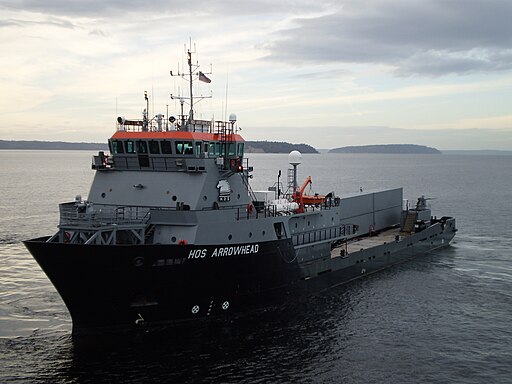
USNS Arrowhead (T-AGSE-4): Technical Profile and Operational Role
USNS Arrowhead (T-AGSE-4) is a submarine and special warfare support vessel under the U.S. Navy’s Military Sealift Command (MSC). She is one of a small class of ships acquired to provide auxiliary support capabilities—especially for submarine operations and special warfare missions—by leveraging civilian-style offshore support ship designs adapted to naval requirements. Her configuration emphasizes flexibility, endurance, and utility in undersea and littoral environments.
Origins, Acquisition, and Class Affiliation
Arrowhead began life in the commercial offshore support sector. She was built in 2009 by Leevac (Leevec) Industries in Jennings, Louisiana, originally for Hornbeck Offshore Services as an offshore support vessel (OSV). In 2015, the Navy acquired her and redesignated her T-AGSE-4, assigning her to submarine and special warfare support duties. She is part of what is informally referred to as the Black Powder–class support vessels, a small group of former Hornbeck Offshore ships purchased by the Navy and reclassified to the “AGSE” (Auxiliary General Submarine & Special Warfare Support) designation. The class includes several sister ships (e.g. Black Powder, Westwind, Eagleview) adapted to this support role.
Under MSC, Arrowhead is crewed by civilian mariners with a small naval detachment for operations and mission coordination.
General Characteristics
Below is a summary of known technical parameters and design features of USNS Arrowhead:
| Parameter | Value / Description |
|---|---|
| Type / Role | Submarine & Special Warfare Support Vessel |
| Hull Number | T-AGSE-4 |
| Builder | Leevac Industries, Jennings, Louisiana |
| Year Built / Delivered | 2009 (delivered to Hornbeck), purchased by Navy 2015 |
| Displacement / Tonnage | ~2,428 gross tons (as per offshore registry) |
| Length (overall) | 250 feet (~76 meters) |
| Beam | 54 feet (~16 meters) |
| Draft | ~14 to 15 feet (~4.3 to 4.6 meters) |
| Propulsion System | Hybrid diesel + diesel-electric arrangement: two Caterpillar 3516 main diesels plus three Caterpillar C18 diesel-electric engines |
| Propellers | Dual fixed props (two shafts) |
| Power Output (Propulsive) | ~3,000 shp combined for the propulsion system |
| Speed (Service / Max) | Approx. 14 knots maximum |
| Complement / Crew | Not publicly confirmed; likely a civilian mariner crew plus mission detachment |
| Armament / Self-Defense | None standard; vessel serves in support, not combat role |
| IMO Number | 9472373 |
| MMSI and Call Sign | MMSI 368926300 , Callsign “NARR” |
Propulsion, Power, and Systems Layout
Arrowhead’s propulsion configuration is suited for both reliability and adaptability. The combination of main diesels and diesel-electric units allows her to modulate power delivery: the main diesels handle primary thrust and transit operations, while the diesel-electric generators can manage lower-load demands such as hotel services, mission systems, and auxiliary loads. This dual-mode system gives operational flexibility, economy at low speed, and redundancy in case of component failure.
Her twin propeller arrangement provides straightforward, robust propulsion. Vibration and noise are considerations in submarine support operations, so engineering design likely incorporates measures—such as isolation mounts, dampeners, and careful mechanical layout—to reduce acoustic signature, though detailed Navy-level specifications are not publicly disclosed.
Electrical and auxiliary systems are integrated to support mission equipment, communications, deck machinery, lifting systems, and sensors.
Mission Role, Capabilities, and Adaptations
As a support vessel in the submarine and special warfare domain, Arrowhead’s mission set includes:
-
Logistics and resupply support: transporting gear, munitions, specialized tools, spares, and consumables to forward-deployed submarines, underwater vehicles, and special warfare teams.
-
Platform for mission systems: provisioned to carry and host specialized equipment such as diver deployment systems, small unmanned underwater vehicles (UUVs), remotely operated vehicles (ROVs), and submarine interface gear.
-
Deployment of support personnel: carrying specialized technicians, divers, or support detachments to conduct maintenance, repair, or mission-specific tasks in remote maritime areas.
-
Flexible operations in constrained waters: with modest draft and a support-ship profile, Arrowhead can operate in littoral zones and port facilities where larger auxiliaries may not reach.
-
Command, communications, and control node: facilitating coordination with submarines, surface ships, shore bases, and mission control centers to support special operations and undersea warfare missions.
Because she is not heavily armed, Arrowhead relies on operating in cooperative or low-threat environments, often under escort or within secure task group formation.
Structural & Deck Arrangements
Though detailed deck plans are not publicly published, one can infer certain design features:
-
Open deck spaces and mission deck: likely configurable areas for modular mission payloads, containers, and over-the-side handling of gear.
-
Cargo and handling equipment: deck cranes, winches, and handling stanchions to load/unload heavy gear or vehicles, especially for submarine interface or special warfare support.
-
Accommodations and support spaces: living quarters, workshops, storage, communications and command spaces to support both crew and specialist mission detachments.
-
Mission interfaces: possible fittings for diver lockout systems, moonpools, or side launch/recovery zones for submersible systems or swimmer operations, although the extent of such installations depends on missionfit modifications.
-
Stability & seakeeping: inherent to support operations, the vessel must maintain stable deck conditions in moderate seas; hull form and ballasting schemes would be optimized for this role.
Operational History & Status
Since acquisition by the Navy in 2015, Arrowhead has operated under MSC in support of submarine force and special operations forces missions. She is listed in MSC’s submarine and special warfare support inventory. Her commercial origin means she was upfitted and modified to integrate Navy communications, interfaces, mission support systems, and logistic capability.
She remains active as of the latest MSC ship inventory listings. Her commercial registry continues to report vessel particulars such as length, beam, draft, and operational status via AIS and maritime databases.
Strengths, Limitations, and Strategic Value
Strengths
-
Flexibility & Modularity: Her commercial support-ship roots allow for rapid reconfiguration for diverse missions.
-
Access to constrained environments: Smaller size and draft make her useful in ports or littorals inaccessible to larger auxiliaries.
-
Cost-efficiency: Operating under MSC with civilian crew yields lower operating cost compared to commissioned warships.
-
Support niche mission sets: Her role bridges the gap between fleet logistics vessels and specialized submarine/special warfare support craft.
Limitations
-
Speed: With a top speed of roughly 14 knots, Arrowhead cannot keep pace with fast fleets or high-speed task groups.
-
Limited defensive capability: Being unarmed or lightly armed, she is vulnerable in hostile environments unless escorted.
-
Size constraints: Her smaller payload compared to large auxiliaries limits the volume and mass of supplies or gear she can handle.
-
Adaptation trade-offs: Because she was designed originally for commercial operations, some naval mission requirements must be accommodated through retrofit rather than inherent design.
Strategic Value
In the context of distributed undersea and special warfare operations, Arrowhead contributes a low-cost, responsive support node. She enhances operational reach by delivering specialized support deep in forward areas, enabling sustained undersea presence or special operations without overtaxing high-end logistics vessels. Her existence reflects a broader Navy trend toward leveraging commercially derived hulls to fulfill niche but vital mission roles.
Summary
USNS Arrowhead (T-AGSE-4) is a repurposed offshore support ship adapted to support undersea and special operations missions for the U.S. Navy. With a 250 ft length, 54 ft beam, ~14–15 ft draft, and propulsion centered on diesel and diesel-electric systems, she offers moderate speed and operational flexibility. Though lacking heavy armament, her value lies in her logistical support, modular payload capacity, and ability to operate in environments inaccessible to larger auxiliaries. As part of the Black Powder–class support fleet, she plays a specialized but important role in sustaining submarine, diver, and underwater systems forces across the globe.
.jpg)