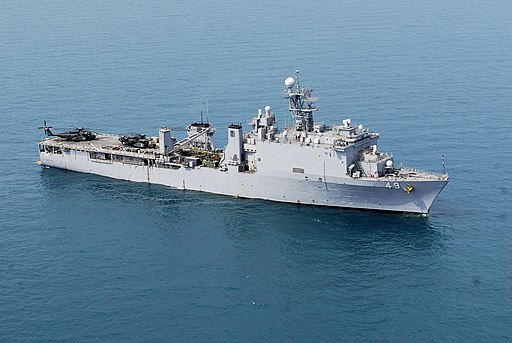
USS Harpers Ferry (LSD-49)
The USS Harpers Ferry (LSD-49) is a modern amphibious transport dock of the United States Navy and a vital asset within the Whidbey Island-class. Designed to support a wide range of amphibious operations, this ship provides a flexible platform for launching landing craft, amphibious vehicles, and helicopters. Its innovative design and robust construction ensure that it can perform diverse missions—from humanitarian assistance and disaster relief to full-scale combat operations. In this article, we delve into the history, design, operational capabilities, and technical specifications of the USS Harpers Ferry (LSD-49).
Overview and Mission
Role in Amphibious Warfare
The USS Harpers Ferry is engineered to serve as a forward-deployed element in amphibious ready groups. It plays a crucial role in transporting Marines, vehicles, and equipment from ship to shore during amphibious assaults. With a well-deck capable of launching and recovering various landing craft, the ship provides the Navy with the agility to project power ashore in diverse operational scenarios.
Strategic Importance
In modern military operations, the ability to rapidly deploy forces across challenging terrains is essential. The USS Harpers Ferry exemplifies this by combining logistic support, command and control, and combat readiness. Its versatility allows it to support multinational exercises, humanitarian missions, and crisis response operations worldwide.
Design and Capabilities
Architectural Concept
The design of the USS Harpers Ferry reflects decades of evolution in amphibious warfare. Emphasizing both durability and flexibility, the ship incorporates a robust hull, advanced shock-absorbing systems, and modern command facilities. The integration of state-of-the-art technology ensures that it can maintain communications and situational awareness even in complex operational environments.
Multi-Mission Platform
The USS Harpers Ferry is not solely a transport vessel; it is a multi-mission platform that can serve as:
- A floating base: For command and control operations during amphibious assaults.
- A logistics hub: Capable of storing and distributing supplies and munitions.
- A support vessel: For the repair and maintenance of smaller craft deployed from its well deck.
Technical Specifications
Dimensions and Displacement
Length, Beam, and Draft
- Overall Length: Approximately 644 feet (196 meters)
- Beam (Width): About 105 feet (32 meters)
- Draft: Roughly 14–15 feet (4.3–4.6 meters)
These dimensions allow the USS Harpers Ferry to navigate a wide range of maritime environments, from deep blue oceans to shallow coastal waters.
Displacement
- Full Load Displacement: Approximately 16,900 long tons
- Light Displacement: Significantly lower, optimized for fuel efficiency and operational flexibility
The displacement figures reflect the vessel’s capability to carry heavy equipment, troops, and additional stores while maintaining stability and speed.
Propulsion and Performance
Engine and Powerplant
The USS Harpers Ferry is powered by a combination of diesel engines that provide a balanced mix of power and fuel efficiency. Its propulsion system is designed for long-range operations and high-speed maneuvers.
Speed, Range, and Endurance
- Maximum Speed: Approximately 20+ knots
- Operational Range: Capable of transoceanic voyages without the need for refueling
- Endurance: Engineered for extended deployments, supporting missions that can last several weeks at sea
These performance characteristics ensure that the vessel can rapidly respond to emerging threats or humanitarian needs while maintaining a global presence.
Crew and Capacity
Complement and Personnel
- Crew Size: Typically around 450 personnel, including officers, enlisted sailors, and technical staff
- Additional Embarkment: Designed to accommodate embarked Marines and their equipment, often numbering several hundred more
The flexible accommodation arrangements enable the USS Harpers Ferry to function as both a transport and a temporary base of operations.
Living and Working Conditions
- Accommodations: Modern living quarters designed for extended deployments, featuring recreational and medical facilities
- Command and Control Centers: Advanced communication suites and operations centers that facilitate real-time decision-making
Well Deck and Aircraft Capabilities
Landing Craft and Vehicle Support
One of the defining features of the USS Harpers Ferry is its well deck, which allows for the launch and recovery of various amphibious craft:
- Landing Craft Utility (LCU): For transporting heavy vehicles and equipment directly to shore
- Landing Craft Air Cushion (LCAC): High-speed craft capable of rapid deployment over soft or unimproved beaches
The well deck’s design ensures that the ship can support a variety of amphibious assault vehicles and improve operational flexibility.
Helicopter Operations
- Flight Deck: The vessel is equipped with a full-length flight deck that supports rotary-wing operations
- Helicopter Hangar: Designed to store and maintain multiple helicopters, enhancing the ship’s vertical lift capabilities
- Integration with Airborne Assets: Provides seamless coordination between sea-based and air-based operations, ensuring timely insertion and extraction of forces
The ability to launch and recover helicopters is critical for reconnaissance, search and rescue, and close air support during amphibious missions.
Operational History and Modern Deployments
Key Missions and Exercises
Since its commissioning, the USS Harpers Ferry has participated in numerous joint exercises and real-world operations. Its versatility and robust design have enabled it to play a vital role in:
- Amphibious Training Exercises: Demonstrating rapid force projection and coordinated landings
- Humanitarian Assistance Missions: Providing disaster relief and support during crises
- International Naval Operations: Strengthening alliances through multinational drills and port visits
Technological Upgrades
Over the years, the USS Harpers Ferry has received several upgrades to maintain its technological edge. Enhancements in communication systems, sensor arrays, and combat support modules have kept the vessel relevant in the rapidly evolving landscape of modern warfare.
Conclusion
The USS Harpers Ferry (LSD-49) stands as a testament to the evolution of amphibious warfare and the United States Navy’s commitment to operational flexibility and technological innovation. With its advanced design, robust technical specifications, and multi-mission capabilities, the ship serves as a critical component in power projection and maritime security. Whether tasked with amphibious assaults, humanitarian missions, or joint multinational exercises, the USS Harpers Ferry continues to exemplify excellence in naval engineering and operational readiness.
