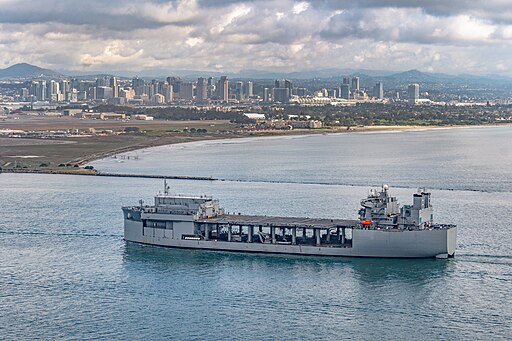
USS John L. Canley (ESB-6)
USS John L. Canley (ESB-6): A Modern Expeditionary Sea Base
The USS John L. Canley (ESB-6) is a newly commissioned expeditionary sea base (ESB) of the United States Navy, representing a strategic asset within the U.S. Navy’s Military Sealift Command (MSC) and the broader expeditionary warfare capabilities. Named after Sergeant Major John L. Canley, a Medal of Honor recipient for his heroic actions during the Vietnam War, ESB-6 continues a proud tradition of service while embracing a modular, adaptive design suited for modern threats.
Commissioned into naval service in 2023, the ship serves as a forward-deployed base for a wide range of military operations, from special operations and mine countermeasures (MCM) to humanitarian missions and maritime security efforts. With its massive deck space, aviation facilities, and mission flexibility, the USS John L. Canley is a vital node in extending U.S. naval power across contested maritime domains.
Design and Construction
The USS John L. Canley belongs to the Montford Point-class expeditionary mobile base ships, originally classified as Mobile Landing Platforms (MLPs) before transitioning to the ESB designation to better reflect their expanded capabilities. The ship was built by General Dynamics NASSCO at its shipyard in San Diego, California.
Key Design Features:
- Hull Type: Commercial tanker-based hull (based on the Alaska-class crude oil tanker)
- Length: 784 feet (239 meters)
- Beam: 164 feet (50 meters)
- Displacement: Approximately 90,000 tons (full load)
- Draft: 27 feet (8.2 meters)
- Speed: 15 knots (maximum), 12 knots (sustained cruising speed)
- Range: 9,500 nautical miles at 15 knots
The ESB design focuses on flexibility, enabling the ship to support a wide array of missions across maritime regions. Its large flight deck and hangar space make it capable of supporting helicopter and tiltrotor operations, and its reconfigurable interior allows for mission-specific equipment installations.
Aviation Capabilities
The flight deck is one of the hallmark features of the USS John L. Canley. It can simultaneously support:
- Four landing spots for rotary-wing aircraft such as the MH-53E Sea Dragon, CH-53E Super Stallion, and MH-60 Seahawk.
- V-22 Osprey tiltrotor operations, enabling rapid personnel and equipment movement over extended ranges.
- Unmanned Aerial Vehicles (UAVs) for surveillance and reconnaissance.
The aviation hangar provides covered maintenance and storage space for multiple helicopters and UAVs, enabling extended operations in remote areas.
Mission Capabilities
The ESB class is built to be modular and mission-agnostic, with onboard systems and spaces configured to support various U.S. Navy, Marine Corps, and joint force missions.
Key Operational Roles:
- Special Operations Support: ESBs provide a base for staging, mission planning, and launching special operations forces (SOF) using helicopters, boats, and unmanned platforms.
- Mine Countermeasures (MCM): The ship supports MCM helicopters and remotely operated vehicles (ROVs), enhancing naval freedom of movement in contested waters.
- Logistical Support: With ample storage space for fuel, equipment, and supplies, the ESB can serve as a mobile logistics hub.
- Humanitarian Assistance / Disaster Relief (HA/DR): The ship can host medical teams, carry emergency supplies, and serve as a command-and-control center during crises.
- Command and Control: Equipped with secure communications and operational planning spaces, the USS John L. Canley functions as a floating headquarters for joint and coalition task forces.
Accommodations and Crew
The USS John L. Canley operates under a hybrid crewing model:
- Civilian Mariners (CIVMARs): Around 40-50 personnel operate and maintain the ship under Military Sealift Command authority.
- Military Detachments: 100–150 military personnel rotate based on mission needs (e.g., SOF teams, aviation detachments, C2 units).
Crew accommodations are designed for extended deployments, offering berthing, dining, and recreation facilities suitable for diverse military units.
Propulsion and Power Systems
The ESB class is powered by a diesel-electric propulsion system, offering both range and fuel efficiency.
Propulsion Details:
- Engines: Four MAN/B&W 9L48/60B diesel engines
- Generators: Provide power to electric propulsion motors
- Propulsion: Twin fixed-pitch propellers and bow thrusters for precision maneuvering
- Electrical Power: 12.47 kV system to support aviation, radar, and life support systems
This propulsion architecture allows for reduced acoustic signature, important for stealthier operations in contested waters.
Self-Defense and Survivability
While not a frontline combatant, the USS John L. Canley incorporates basic defensive systems to ensure survivability:
- Crew-Served Weapons: Multiple .50 caliber M2 Browning machine guns
- CIWS (Close-In Weapon System): Phalanx CIWS for last-ditch missile defense
- Decoy Launching Systems: MK-36 SRBOC for anti-missile chaff and flares
- Ballistic Protection: Armored areas around mission-critical spaces
- Damage Control Systems: Advanced fire suppression, redundant power and communications systems
Strategic Importance
The USS John L. Canley (ESB-6) plays a critical role in the Distributed Maritime Operations (DMO) doctrine. As great-power competition intensifies in the Indo-Pacific and elsewhere, the ability to deploy scalable, mobile sea bases like ESB-6 ensures the U.S. Navy can maintain forward presence, enable contested logistics, and support distributed forces.
Its ability to operate in low-threat environments while freeing up high-end warships for more demanding missions represents a strategic advantage. ESBs bridge the gap between conventional naval bases and agile, forward-deployed force packages.
Legacy of Sgt. Maj. John L. Canley
The ship’s namesake, Sgt. Maj. John L. Canley, exemplifies valor and selfless service. His actions during the Battle of Huế in 1968, where he repeatedly risked his life to rescue wounded Marines under fire, earned him the Medal of Honor in 2018. Naming ESB-6 after him pays tribute to the enduring spirit of the Marine Corps and the legacy of service that guides the ship’s mission.
Conclusion
The USS John L. Canley (ESB-6) is not merely a support vessel—it is a floating forward base that represents a new way of thinking about naval warfare and logistics. In a world where agility, endurance, and modularity are essential to maintaining maritime dominance, the ESB-6 stands out as a force multiplier.
As global threats evolve and the maritime domain becomes increasingly contested, ships like the USS John L. Canley will be at the forefront of projecting American power, humanitarian assistance, and ensuring maritime freedom.
_enters_San_Diego_Harbor,_California_(USA),_9_February_2024_(240209-N-NT811-1008).jpg)