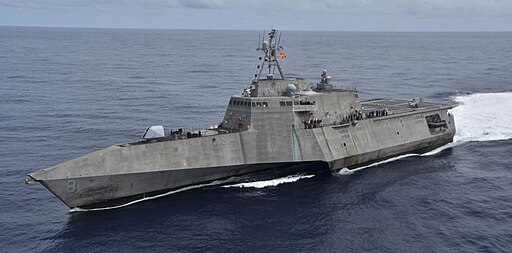
USS Montgomery (LCS-8): A Modern Littoral Combat Ship in Detail
Commissioned in September 2016, USS Montgomery (LCS-8) represents the United States Navy’s push toward agile, multi-mission warships optimized for coastal (littoral) operations. As the fourth Independence-class trimaran hull built by Austal USA, Montgomery combines high speed, shallow-water capability, modular mission payloads, and advanced sensor suites. This article examines her design heritage, construction history, and in-depth technical specifications, illustrating why LCS-8 embodies 21st-century naval innovation.
Class and Design
The Independence class is one of two competing littoral combat ship designs, distinguished by its trimaran hull form. This three-hulled configuration provides:
- Exceptional Stability: A wide beam (over 31 meters) and central hull flanked by two slender side hulls yields a stable weapons and sensor platform in rough near-shore seas.
- Shallow Draft: At under 5 meters of draft, Independence-class ships can operate closer to shore than traditional monohull vessels.
- Reduced Signatures: Composite aluminum construction and a fine forward hull section minimize radar and acoustic detectability.
Montgomery incorporates dozens of enhancements over early LCS-2 variants: reinforced composite structures, improved corrosion protection, upgraded aviation facilities, and standardized rigid-hulled inflatable boat (RHIB) mounts.
Construction and Commissioning
- Contract Awarded: December 2010, U.S. Navy selects Austal USA in Mobile, Alabama, for additional Independence-class ships.
- Keel Laid: 25 June 2013, marking the start of hull assembly in Austal’s modular building system.
- Launch and Christening: 6 August 2014 launched; christened 8 November by sponsor Mary Blackshear Sessions.
- Commissioned: 10 September 2016, home-ported at Naval Base San Diego.
- Operational Milestones: Participated in Pacific littoral exercises, conducted counter-mine and anti-submarine trials, and integrated unmanned surface and aerial vehicles.
Technical Specifications
Dimensions and Displacement
- Length Overall: 127.4 meters (418 ft)
- Beam: 31.6 meters (104 ft)
- Draft: 4.27 meters (14 ft)
- Light Displacement: ≈2,307 metric tons
- Full-Load Displacement: ≈3,104 metric tons
- Deadweight: ≈797 metric tons
Wide beam and sizable flight deck maximize stability and aviation operations, while the lightweight aluminum-composite structure keeps overall displacement below 3,200 tons.
Propulsion and Performance
- Main Engines:
- 2× General Electric LM2500 gas turbines (each 35 MW)
- 2× MTU 20V 8000 diesel engines (each 9.1 MW)
- Electrical Generation: 4× Wärtsilä diesel generators feeding integrated power system
- Propulsion Trains:
- 4× Rolls-Royce/Kongsberg Spey-Mark 4 waterjets
- 1× Retractable bow thruster for low-speed maneuvering
- Maximum Speed: 40+ knots
- Cruising Speed: 15–20 knots (optimal for transits)
- Range: ≈4,300 nautical miles at 20 knots
Combined diesel-gas (CODAG) arrangement allows sprinting at high speed while diesel-only mode extends range during low-threat transits.
Weapons and Combat Systems
- Primary Gun: BAE Mk 110 57 mm naval gun, dual-purpose for surface and air targets
- Point-Defense:
- Evolved SeaRAM (11-cell RAM Block 1B) missile launcher
- 4× .50 caliber machine guns (2 forward, 2 aft)
- 2× Mk 46 Mod 2 30 mm remotely-operated cannons
- Mission-Module Support: Reconfigurable bay supports anti-mine, anti-submarine, or surface warfare packages, including launch and recovery systems for unmanned vehicles.
Sensors and Electronic Warfare
- Radar Suite:
- Sea Giraffe 1X 3D surveillance radar for air and surface targets
- Bridgemaster-E navigational radar
- Electro-Optical/Infrared: AN/UYQ-70 workstation with FLIR targeting pod and day/night cameras
- Electronic Warfare:
- EDO ES-3601 electronic support measures (ESM)
- 4× SRBOC decoy launchers for chaff/flare countermeasures
- Combat Management: Integrated mission system linking sensors, weapons, and unmanned assets into a unified tactical display.
Aviation and Mission Bay
- Flight Deck:
- Supports 2× MH-60R/S Seahawk helicopters or a mix of helicopters and vertical-takeoff unmanned aerial vehicles (VTUAVs)
- Aft hangar shelters maintenance and two small unmanned aerial or surface vehicles
- Mission Bay:
- 1,880 m² modular bay configurable for 4× RHIBs, unmanned surface vessels, mine-countermeasure modules, or additional containerized payloads
- Rapid-reconfiguration system allows swap-out of mission packages in under 48 hours ashore.
Crew and Accommodation
- Core Complement: 40 personnel (8 officers, 32 enlisted)
- Mission Crew: Up to 35 additional specialists for specific mission modules
- Total Capacity: ≈75 crew and mission personnel
- Habitability: Ergonomically designed berthing, recreation, and workspaces; advanced shipboard automation reduces watchstanding requirements.
Operational Role and Missions
LCS-8 operates as part of the Navy’s agile littoral force, undertaking:
- Maritime Security: Patrols and escorts in choke points and contested coastal waters
- Mine Countermeasures: Emplacing unmanned vehicles and sonar to detect and neutralize mines
- Anti-Submarine Warfare: Deploying towed arrays, helicopters, and unmanned vehicles
- Surface Warfare: Engaging fast small boats or asymmetric threats with rapid-fire gun and missile systems
Her trimaran design and modular bays enable swift adaptation to evolving mission demands, reinforcing U.S. naval presence in littoral zones.
Future Upgrades and Challenges
While Independence-class ships like Montgomery showcase cutting-edge concepts, they face:
- Maintenance of Aluminum Hull: Specialized corrosion control required in saltwater, addressed through improved coatings and cathodic protection.
- Mission Module Maturation: Continued development of unmanned systems and payload integration essential to fully leverage LCS potential.
- Frigate Conversion: Plans to up-arm and bulk up select LCS hulls into guided-missile frigates may extend service life and enhance lethality.
Ongoing modernization programs aim to enhance survivability, networked warfare capabilities, and crew conditioning.
Conclusion
USS Montgomery (LCS-8) exemplifies the U.S. Navy’s littoral combat vision: a high-speed, shallow-draft trimaran optimized for modular multi-mission packages. From her composite-aluminum hull to her SeaRAM point-defense and unmanned systems, Montgomery bridges near-shore agility with ocean-going flexibility. As operational experience accumulates and mission modules mature, LCS-8 will continue to evolve, safeguarding maritime interests from constrained waterways to blue-water contingencies.
_prepares_to_pull_alongside_USNS_Cesar_Chavez_(T-AKE_14)_during_a_replenishment-at-sea._(49912055123).jpg)